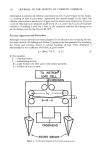
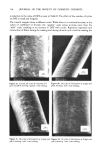
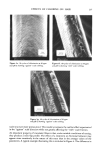
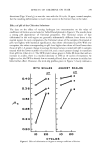
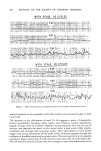
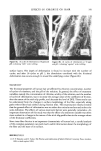
j. Soc. Cosmet. them., 33, 229-242 (August 1982) Effects of chlorine on friction and morphology of human hair NANCY FAIR and B. S. GUPTA, School of Textiles, North Carolina State University, Raleigh, NC 27650. Received January 8, 1982. Presented at the Society of Cosmetic Chemists' Annual Technical Meeting, December 1 O, 1981. Synopsis Chlorine-hair interaction was investigated through a study of hair surface properties. Treatment variables included chlorine concentration, number of chlorination cycles, and the pH level of the chlorine solution. Inter-hair friction was measured by the twist method, and scanning electron microscopy was used for studying the effects of treatments on surface morphology. In general, the effect of chlorination was to increase the value of the coefficient of friction and decrease the differential frictional effect. Greater change was observed in the nature of the tension profiles produced by the friction tests this reflected a change in surface morphology which was confirmed with SEM analysis. INTRODUCTION The adverse effects of exposure to swimming pool water on the appearance and tactile properties of human hair are well recognized. These effects are speculatively attributed to the sorption of chlorine from the pool water. While there is much technical literature on the reaction of wool with active chlorine, little has been published on the nature of the chlorine-hair interaction. An experimental investigation is reported in this paper which examines several aspects of this interaction. The main variables of the study were the chlorine concentration, the number of chlorination cycles, and the pH level of the chlorine solution. The effect of these variables was examined on inter-hair friction. Hair measurements were made under loads which were of the same order of magnitude as those imposed "in use," such as in combing. Also examined was the change in morphology resulting from the chlorina- tion treatment. Of particular interest was the nature of any change or damage resulting to the hair surface along the path where fibers had rubbed during frictional measurements. Examination of this damage provided useful information about the condition of the cuticle and the expected response of hair fibers to physical handling. INTER-HAIR FRICTION In classical physics, frictional force is independent of the area of contact between two surfaces and is proportional to the normal force, leading to the relationship: 229

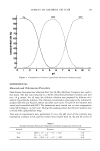
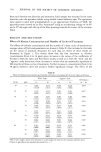
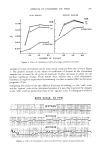
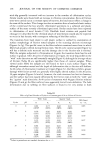
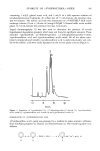
230 JOURNAL OF THE SOCIETY OF COSMETIC CHEMISTS F /x- N , (1) in which/a is the coefficient of friction, F the frictional force, and N the normal load. It has been shown by Bowden and Tabor (1) that Equation 1 applies only to materials which deform plastically, such as metals, plastics, etc. Materials deforming elastically or viscoelastically exhibit a departure from this behavior. Thus, in fibers, which are generally viscoelastic, the coefficient of friction is a function of factors such as fiber dimensions, physical properties, testing environment, and the testing conditions (2). It is for this reason that the results of fiber friction tests have generally shown a lack of reproducibility. In research requiring reproducible measurements, therefore, it is essential that tests be carried out under strictly controlled conditions, with as many variables as possible maintained constant. When force is applied to the sliding member, energy is stored in the elastic parts of the system. Sliding begins, and when this force exceeds the value necessary to maintain a constant speed the fiber accelerates, overshoots, then decelerates. This process keeps repeating, producing the stick-slip effect (3). Thus, one can obtain values of static (Fs) and kinetic (Fk) frictional forces from a frictional trace and from Equation 1, the corresponding values of the static (/as) and the kinetic (/Xk) coefficients of friction. The nature of the stick-slip also seems to depend upon the viscoelastic nature of the fiber and the method of testing. For a given speed of sliding, relatively soft surfaces tend to give a more pronounced stick-slip trace, hard surfaces a straighter trace. One of the unique features of hair and other animal fibers is that they possess a cuticular surface with scales. The consequence of this is that the fiber displays a directional character in frictional measurements. The value of the coefficient of friction of human hair obtained when rubbing against the scales (/xa) can be significantly higher than that obtained when rubbing with the scales (/Xw). The difference bewteen the two values "/xa -/Xw," is called the differential frictional effect, or DFE. The magnitude of DFE relates strongly to the tendency of the fibers to felt, or compact into a dense mass. Any treatment which tends to destroy and/or soften the scales lowers the value of DFE. Thus, the effect of a treatment on the fiber behavior can lead to insights on the changes in surface of the fibers. Since hair performance in such contexts as manageability, style holding, and ease of combing is more or less surface related, the changes in friction and surface character with a treatment could be expected to be informative as to such hair assembly behavior. NATURE OF CHLORINE IN AQUEOUS SOLUTIONS The composition of a chlorine solution in respect to the active oxidizing species present is determined by its hydrogen ion concentration. Depending on the pH, the chlorine is present either as C12, HOC1 and OCI-, or as mixtures of these (Figure 1). The oxidizing potential of a chlorine solution and, consequently, the nature and the magnitude of its effect on hair keratin, can be expected to depend greatly on its pH (Table I). It might be noted that the concentration of chlorine in solution can change due to reaction and to changes in solution pH. This warrants frequent checks and, if necessary, corrections in order to assure accuracy in experimental studies.
Purchased for the exclusive use of nofirst nolast (unknown)
From: SCC Media Library & Resource Center (library.scconline.org)