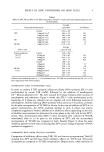
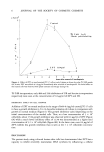
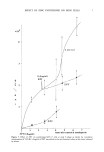
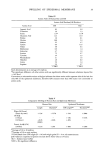
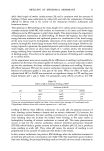
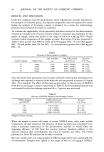
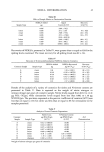
PATCH TEST SYTSEM 17 Table III Weight Changes (rag) and Standard Deviation (SD) of HTC Containing 0.3 ml of 0.3% Aqueous Sodium Lauryl Sulfate (SLS) or 0.3 ml of Aqueous Red Food Coloring After a 24-hour Application SLS Food Color Weight (rag) Weight (rag) Panelist No. Initial Final Change (rag) Initial Final Change (rag) 1 896 845 --51 893 868 --25 2 911 865 --46 897 831 --66 3 900 873 --27 898 813' --85 4 894 828 --66 922 866 --56 5 901 840 --61 921 822 --99 6 906 864 --42 912 877 --35 -- X 901 852 --49 907 846 -61 SD 6.3 17.4 14.0 12.8 27.3 28.4 showering showed an average weight loss of 85 mg for the ethanol solution and 30 mg for the aqueous solution as shown below in Table IV. Table IV Weight Changes (mg) and Standard Deviation (SD) of HTC Containing 0.3 ml of Alcoholic or Aqueous Red Food Coloring After a 48-Hour Application Alcoholic Solution Before Shower After Shower Panelist No. Initial Final Change Initial Final Change 1 866 769 --97 884 877 --7 2 883 720 --163 877 762 -- 115 3 869 789 --80 864 805 --59 4 872 742 --130 868 780 --88 5 868 766 --102 869 714 --155 -- X 872 757 --115 872 788 -85 SD 6.7 26.7 32.6 8.0 60.1 56.1 Aqueous Solution 1 902 846 --56 888 904 16 2 891 778 --113 895 896 1 3 896 862 --34 819 797 --22 4 892 828 --64 907 877 --30 5 869 723 --146 853 739 --114 -- X 890 807 83 872 843 --30 SD 12.5 56.8 45.7 36.0 71.8 50.5 In a comparison of the data from the 24-hour application with data from the 48-hour application, it was apparent that the additional 24-hour application time resulted in more weight loss. Since the red food coloring did not migrate outward, the loss is through dermal absorption of water and alcohol. No direct comparison between the HTC and other patch systems as to outward migration of red food color was considered necessary. Our experiences had amply demonstrated to us that migration would occur in any of the nonchamber systems and that migration is particularly noticeable with organic solvents.

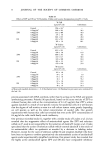
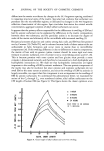
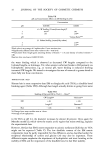
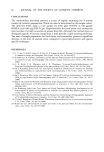
18 JOURNAL OF THE SOCIETY OF COSMETIC CHEMISTS EXPERIMENT IV--BASKETBALL This experiment was designed to evaluate the effects of perspiration on the HTC. Perspiration was elicited by practicing basketball for approximately three hours. The HTC was applied to the arms and backs of 20 membe•/s of a high school basketball team about two hours 'prior to a practice of about three hours' duration. The preweighed chambers were applied dry or moistened with 0.3 ml of aqueous red food coloring. All of the dry patches and half of the moistened patches were removed and weighed at the conclusion of practice. The other half were removed and weighed immediately after showering. The average sweat uptake by the dry chambers was 240 mg on the back and 185 mg on the arm. The wet chambers showed an average loss of 8 mg on the back and 31 mg on the arm prior to showering. After showering, the respective values showed an increase of 58 mg and 15 mg. These data are shown below in Table V. Table V Mean Weight Changes (mg) and Standard Deviation (SD) of HTC Unmoistened or Containing 0.3 ml of Aqueous Red Food Coloring After a Three Hour Basketball Practice (N = 20) Unmoistened Moistened (No Shower) Before Shower After Shower Back X 24O - 8 58 SD 91 47 36 Arm X 185 --31 15 SD 73 64 67 DISCUSSION The foregoing has demonstrated the occlusive value of the HTC. In addition to the prevention of water ingress or egress, this feature should prevent interaction between test materials and the tape. It should also permit precise determination of the quantity of test material absorbed by the skin over long periods, without loss of test material. The choice of adhesive tape is optional and is dependent in part on the purpose of the study. The chamber can be adapted to new types of adhesive tape as they become available. SUMMARY A new plastic chamber patch system has been evaluated experimentally for its occlusive properties. It has been demonstrated to minimize dilution of the test material by water during showering, swimming, or moderate exercise. No significant outward migration of the test material occurred during use as determined by a dye marker. For practical purposes this eliminates problems resulting from the interaction between samples and the adhesive tape. The occlusive properties are related to the chamber's design and the selection of the plastic from which the chamber is fabricated. The plastic is flexible, which enables it to follow the contours of the body, and is unaffected by most common solvents.
Purchased for the exclusive use of nofirst nolast (unknown)
From: SCC Media Library & Resource Center (library.scconline.org)