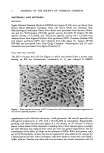
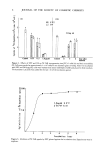
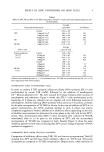
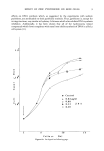
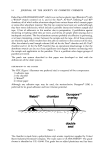
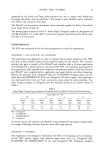
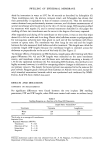
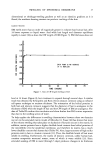
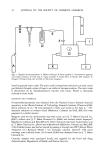
PATCH TEST SYTSEM 15 approved by the Food and Drug Administration for use in contact with foods and beverages (alcoholic and non-alcoholic). This grade is quite flexible, and it conforms very well to the contours of the skin. The Webril © is a non-woven, absorbent cotton material supplied by Kleen Test which has a long history of safe use. The release paper is made by the H. P. Smith Paper Company under the designation of 63//BL Polyslik L 275, Code 28385. It serves the purpose of protecting the system until the time it is to be used. EXPERIMENTAL The HTC was evaluated for its occlusive properties in a series of experiments. EXPERIMENT I--TAPE SELECTION AND SHOWERING This experiment was designed not only to evaluate the occlusive property of the HTC but also to find suitable semiocclusive adhesive tapes for the system. The criterion selected was gain in weight of the Webril © and chamber after a 24-hour application time followed by a shower prior to removal of the HTC. Ten panelists participated in this experiment. Each panelist wore duplicate unmoistened systems only the chamber and Webril © were weighed before application and again before and after showering. Half of the panelists used Ultrapore © (M) and SCANPOR © (S) paper tapes, and the other half used DERMILITE © II (L) and Durapore © (D) fabric tapes. The experiment was replicated three times on three consecutive days using the same panelists. The mean weight changes in milligrams and the standard deviation are shown below in Table I. Table I Mean Weight Changes (nag) and Standard Deviations of HTC and Webril © Before and After Showering Tape Type* (N = 30) M S L D Before After Before After Before After Before After (nag) (nag) (nag) (nag) (nag) (nag) (nag) (nag) X 9.7 186 13.2 70 7.9 28 9.0 3.0 SD 8.9 156 8.3 120 7.9 53 8.0 8.0 *M = Ultrapore © S = SCANPOR © L = DERMILITE II © D = Durapore © As shown above, the chamber and Webril © using Durapore © tape gained significantly less weight following a shower than the three other tape systems. EXPERIMENT II--SWIMMING This experiment was designed to determine the effect of swimming on the occlusivity of the HTC system. Again, four adhesive tapes were used, i.e., Ultrapore © (M), SCANPOR © (S), DERMALITE © II (L), and Durapore © (D). Duplicate weighed

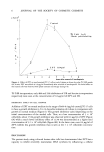
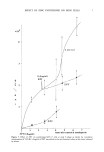
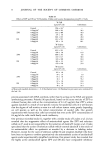
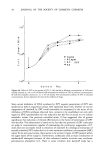
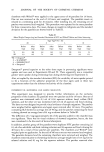
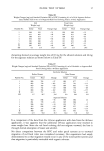
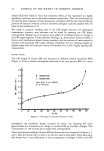
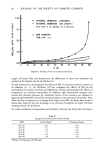
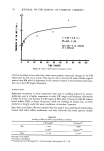
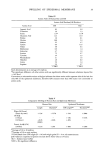
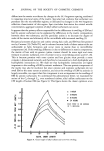
16 JOURNAL OF THE SOCIETY OF COSMETIC CHEMISTS chambers with Webril © were applied to the upper arms of 10 panelists for 24 hours. One set was removed at the end of 24 hours and weighed. The panelists swam or relaxed in a swimming pool for 20 minutes. After toweling dry, the remaining set of patches was removed and weighed. This procedure was repeated in the same panelists for three consecutive days. The mean changes in weight in milligrams and the standard deviation for the panelists are shown below in Table II. Table II Mean Weight Changes (mg) and Standard Deviations of HTC and Webril © Before and After Swimming Tape Type* (N = 30) M S L D Before After Before After Before After Before After (mg) (mg) (mg) (mg) (mg) (mg) (mg) (mg) X 8.6 288 9.8 140 8.9 178 12.9 54 SD 9.3 145 7.1 148 7.7 182 9.9 123 *M = Ultrapore © S = SCANPOR © L = DERMILITE II © D = Durapore © Durapore © proved superior to the other three tapes in preventing significant water uptake and was used in Experiments III and IV. There apparently was a somewhat greater water uptake during swimming than during showering (see Experiment I). Also, as implied by the standard deviations (SD), the variability of water uptake proved to be a function of the adhesive properties of the four tapes used in these two experiments rather than the inherent occlusivity of the chamber. EXPERIMENT III--SHOWERING AND SAMPLE MIGRATION This experiment was designed to provide further information on the occlusive properties of the chamber. Six panelists wore two patches each for 24 hours. One set of patches was moistened with 0.3 ml of 0.3% aqueous sodium lauryl sulfate (SLS) solution, and the other set was moistened with 0.3 ml of aqueous red food coloring. The latter set was designed to provide visual evidence of sample migration. The patches were weighed before application and again upon removal after 24 hours. The patches containing SLS showed an average loss of 49 mg, and the patches containing the food coloring showed an average loss of 61 mg as shown below in Table III. The difference of 12 mg (approximately 4% of the quantity added to the chamber) was not significant. There was no visual evidence of outward migrations hence, the loss was considered to be the result of dermal absorption. In addition, another group of five panelists wore duplicate HTC patches containing (a) 0.3 ml of an alcoholic red food coloring solution and (b) aqueous red food coloring for 48 hours for a total of four patches per panelists. The chambers and Webril © were weighed prior to application. At the end of 48 hours one set was removed and weighed. The panelists showered and the remaining chambers were removed and weighed. The chambers removed prior to showering showed an average weight loss of 115 mg for the ethanol solution and 83 mg for the aqueous solution. The patches removed after
Purchased for the exclusive use of nofirst nolast (unknown)
From: SCC Media Library & Resource Center (library.scconline.org)