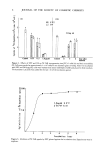
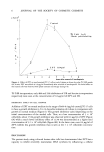
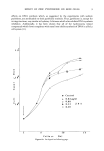
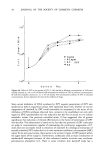
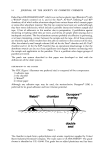
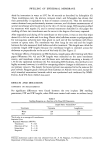
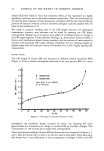
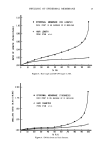
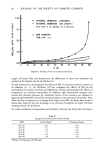
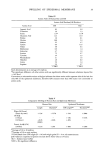
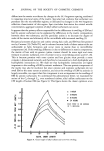
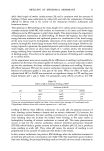
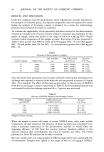
30 JOURNAL OF THE SOCIETY OF COSMETIC CHEMISTS diffuse into the matrix as evidence by changes in the 28.3 Angstrom spacing, attributed to repeating structural units of the matrix. Spei also had evidence that surfactant can penetrate into the microfibrillar regions, as indicated by changes in the 39.6 Angstrom reflection characteristic of this region. Spei concludes that above the critical micelie concentration, aggregate sorption of alkyl sulfate surfactants can occur. It appears that the primary effects responsible for the differences in swelling of EM and hair by anionic surfactant can be explained by differences in the matrix compositions between these two substrates, and the particular action is to decrease the degree of order of the matrix and ultimately of the microfibrils with increased swelling (2). Reciprocal amounts of glycine and cystine among hair, nails, and EM was first pointed out by Crounse (25) (Table IV), and is relevant because both of these amino acids are unfavorable to helix formation and occur more in matrix than in microfibrillar components (26). If this swelling difference is due to differences in matrix components, the matrix of hair with its greater cystine content should be more rigid and more resistant to anionic surfactant, even if cystine is not a cross-linking amino acid (27, 28). This is because proteins with more cystine and less glycine must provide a more complex 3-dimensional network, and therefore be less sensitive to both hydrophilic and hydrophobic interactions (2). We shall see that hydrophobic interactions are highly important to the swelling of EM by anionic surfactant. The non-protein component of the matrix may also be involved, but since cationic and nonionic surfactants do not swell EM to the same extent as anionics, and since the swelling of EM by anionics is largely reversible, we expect that this component is not as important to the swelling of EM by anionic surfactants. To understand this phenomenon better, we examined the action of the C8 through C•6, even numbered carbon, alkyl sulfate surfactants on the CW length of human EM (see Figure 9). This figure shows the classic optimum at an 1.4 0.4 0.2 zx I HOUR o :3 HOURS [] 6 HOURS ß 24 HOURS EACH POINT IS AN AVERAGE OF 5 REPLICAS I I I I I 8 I0 12 14 16 ALKYL CHAIN LENGTH Figure 9. Chain length of alkyl sulfates and cross-wise swelling.

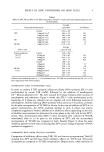
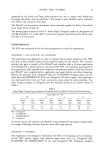
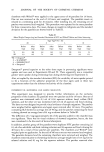
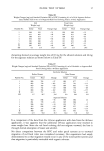
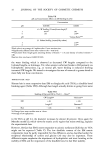
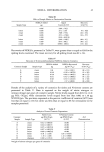
SWELLING OF EPIDERMAL MEMBRANE 31 alkyl chain length of twelve carbon atoms (29), and is consistent with the amount of binding of these same surfactants by callus (29), and with the explanation of binding offered by Breuer (30) in his review of the interaction between surfactants and keratinous tissues. This optimum in EM swelling at the chain length of 12 carbon atoms was produced at constant molarity (0.069 M), with sodium as counterion in all cases, and shows large differences in the EM response to alkyl chain length. This demonstrates the importance of hydrophobic interactions on EM swelling. As Breuer (30) explains, the total bond energy between surfactant and epidermal protein is a combination of the bond energy of the ionic bond and the hydrophobic attractions of the alkyl chain with epidermal protein hydrophobic bond energy increases with increasing chain length. However, the energy required to penetrate the epidermal protein matrix also increases with increasing chain length, and above an alkyl chain length of 12 carbon atoms, the penetration energy resulting from increased chain size becomes greater than the resultant increase in binding energy. Thus there is the optimum in the amount of binding and in swelling at 12 carbon atoms. As the experiments were run at neutral pH, the differences in swelling could possibly be explained on the basis of increased uptake of surfactant i.e., as more surfactant is taken up into the membrane, the latter exhibits increased hydration and swelling. However, pH effects between EM and the anionic surfactant interaction demonstrate that the amount of surfactant uptake is only part of the story. When the effect of water, pH adjusted with HCI or NaOH was examined, no significant change in CW swelling was found between pH 3 and 9. Table VI summarizes some effects of pH on the CW Table VI Effects of pH on Surfactant Swelling of EM* Surfactant (0.069 M) pH SLS LAS DTAB 3 3.09** 2.84** 2.77** 6 3.24 3.00** 2.70 9 3.27 2.95** 2.69 *Values are actual membrane lengths (cm.) after 1 hour reaction time (average of 5 membranes each) **Significantly different from other column responses at o• = 0.05 level. swelling of EM by three different surfactants. At acidic pH, the greatest amount of ionic bonding occurs between a keratin and an anionic surfactant (31) however, for both anionic surfactants, the least swelling is produced at acidic pH, indicating that ionic bonding does not increase the keratin water binding to the same extent as hydrophobic bonding of anionic surfactants at neutral pH. This same phenomenon occurs in hair for the cationic surfactant, dodecyl trimethyl ammonium bromide (DTAB), which binds in greater amount to keratin at alkaline pH (32), but it produces more swelling at acidic pH. Thus, when pH varies, the amount of swelling is not proportional to the amount of surfactant that binds to the keratin. In fact, anionic surfactants can produce EM shrinkage when the surfactant treatment is at both low pH and low concentration (see Table VII). This experiment gives evidence that ionic bonding, the principal bonding made at low pH, can even cause a decrease in
Purchased for the exclusive use of nofirst nolast (unknown)
From: SCC Media Library & Resource Center (library.scconline.org)