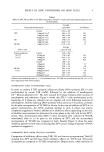
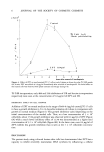
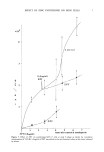
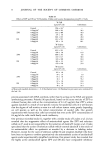
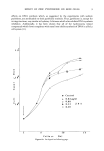
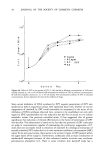
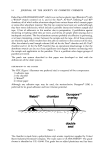
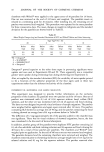
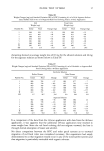
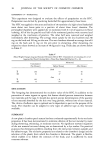
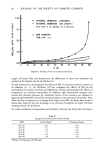
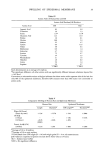
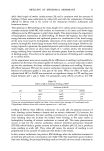
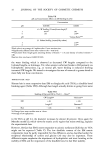
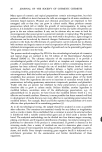
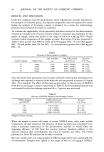
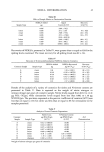
32 JOURNAL OF THE SOCIETY OF COSMETIC CHEMISTS Table VII pH and Concentration Effects on EM Swelling by LAS Concentration pH 0.0035M 0.069M A. C IV Swelling (Treated/water length) * 3 0.95** 1.03 6 1.03 1.10'* pH Volume Ratio*** B. Volume Swelling (treated/dry volume) 3 2.16'* 6 3.19'* *Each value is an average of 6 replicas after 1 hour reaction time. **Significantly different from other values at the = 0.05 level. ***Calculated from weight gains assuming density of keratin = 1.55, and density of sorbed solution 1.00. Reaction time one hour at 0.0035 M LAS. the water binding which is observed as decreased CW lengths compared to the hydrated lengths, or shrinkageJ Yet, when anionic surfactant bonds to EM primarily via hydrophobic interactions, e.g., at neutral pH, water binding is enhanced showing increased CW lengths. We intend to investigate this area of research in greater detail to more fully test these conclusions. THIOGLYCOLIC ACID Human hair is more responsive than EM to thioglycolic acid (TGA), a disulfide bond breaking agent (Table VIII). Although hair length actually shrinks in going from water Table VIII Swelling of Hair and EM by TGA (1 - Hour)* CW Length** Thickness** EM + 4% + 22% Length** Diameter** Hair -- 1.4% + 38% *% Change from water swollen state at 1-hour. **Average of 20 replications. to 6% TGA at pH 9.2, the diameter increases by almost 40 percent. Once again the Menefee model (1), which views the matrix as the region that resists swelling, explains the experimental data. However, the fact that EM is more responsive to anionic surfactant (SLS) than to TGA might not be expected (Table V). The low disulfide content of the EM matrix components must be partly responsible for this difference, and as described earlier the reciprocal relationship of cystine and glycine (25) may also be important. These differences again emphasize the importance of hydrophobic and ionic bonding to the stability of EM, and the importance of the disulfide bond to hair fiber stability.

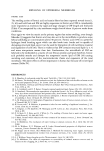
SWELLING OF EPIDERMAL MEMBRANE 33 FORMIC ACID The swelling action of formic acid on keratin fibers has been reported several times (1, 35, 36), and both hair and EM are highly responsive to formic acid. EM is considerably more responsive as evidenced by rapid and large changes in CW length and thickness (Table V) accompanied by a dry membrane weight loss of about 19 percent under these conditions. Once again we view the matrix as the primary region that resists swelling, even though Menefee (1) suggests that formic acid may also act in the microfibrils to produce some helical unfolding at concentrations above 90 percent. Formic acid (97%) is a powerful hydrogen bond breaking agent which can also break ionic bonds and is capable of disrupting structural lipid, since it can be used for disruption of cell membrane material and separation of cells (36). There is evidence that EM contains structural lipid (4, 5, 7) and more non-protein matter than hair. Furthermore, the micro fibrils of EM are believed to be embedded in a matrix of non-fibrous protein and lipid therefore, formic acid probably attacks and disrupts the nonprotein matrix lipid of EM (20) causing uncoiling and extension of the macromolecular chains and expansion of the total membrane. This latter effect is of less importance in human hair because of its low lipid content (Table IV). REFERENCES (1) E. Menefee, A mechanical model for wool, Textile Res. J. 38, 1149-1163 (1968). (2) M. Breuer, The binding of small molecules to hair: the hydration of hair and the effect of water on the mechanical properties of hair, J. $oc. Cosmet. Chem. 23,444-470 (1972). (3) C. R. Robbins, Chemical and Physical Behavior of Human Hair (Van Nostrand Reinhold Co., New York, 1979), p. 178. (4) L. A. Goldsmith and H. P. Baden, Uniquely oriented epidermal lipid, Nature 225, 1052, 1053 (1970). (5) G. Swanbeck, Macromolecular organization of epidermal keratin. An X-ray diffraction study of the horny layer from normal ichtlyatic and psoriatic skin, Acta Dermato- Venereol. 39, Suppl. 43 (1959). (6) R.J. Scheuplein, Mechanism of percutaneous adsorption. I. Routes of penetration and the influence of solubility,J. Invest. Dermatol. 45,334-346 (1965). (7) A.M. Kligman and E. Christophers, Preparation of isolated sheets of human stratum comeum, Arch. of Dermatol. 88, 70-73 (1963). (8) K. Femee and C. R. Robbins, A quantitative index for area swelling of epidermal membrane,J. Soc. Cosmet. Chem. 32, 53-54 (1981). (9) A. Kligman, in The Epidermis, W. Montagna and W. Lobitz, Jr., Eds. (Academic Press, New York, 19(4), p. 408. (10) P. B. Stam, R. F. Katy, and H.J. White, Jr., The swelling of human hair in water and water vapor, Textile ResearchJ. 22,448-465 (1952). (11) I. Blank, Factors which influence the water content of the stratum corneum, J. Invest. Dermatol. 18, 433-441 (1952). (12) J. D. Middleton, The mechanism of water binding in stratum corneum, Br.J. Derm. 80, 437-450 (1968). (13) M. A. Wolfram, N. F. Wolejsza, and K. Laden, Biomechanical properties of delipidized stratum corneum,J. Invest. Dermatol. 59, 421-426 (1973). (14) M. Rieger and D. Deem, Skin Moisturizers. I. Methods for measuring water regain, mechanical properties and transepidermal moisture loss of stratum corneum, J. Soc. Cosmet. Chem. 25, 239-252 (1974). (15) L.J. Wolfram, Some thoughts on skin 'Moisturization', Cutis 21,148 (1978). (16) J. D. Middleton, The effect of temperature on extensibility of isolated stratum corneum and its relation to skin chapping, Br.J. Derm. 81,717-721 (1969).
Purchased for the exclusive use of nofirst nolast (unknown)
From: SCC Media Library & Resource Center (library.scconline.org)