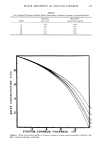
J. Soc. Cosmet. Chem., 34, 191-196 (July 1983) Water diffusivity and water concentration profile in human stratum corneum from transepidermal water loss measurements MAW-SHENG WU, Personal Care Division, The Gillette Company, Gillette Park, Boston, M/I 02106. Received October 21, 1982. Synopsis The diffusivity, D(C), of water in the stratum comeurn of human volar forearms was determined from passive water loss data obtained under various relative humidities by Goodman and Wolf and from the analytical method developed by Wu. The diffusivity is a function of the water concentration (C) in the stratum corneum it was found to be D(C) = 1.6 x 10 -•ø q- 5.1 x 10 -•ø C2'7o The water concentration profile within the stratum comeurn at various relative humidities was determined. It was found that except for the surface and first few cell layers near the surface, the water content in stratum corneum was essentially the same for all humidities. INTRODUCTION Measurement of transepidermal water loss (TEWL), the passive transpiration of water through stratum corneum, has been used as a method to determine the hydration state of the stratum corneum and to evaluate the occlusive effect of a skin moisturizer on the water content in the tissue (1). However, very few efforts have been devoted to a systematic analysis of the TEWL data to obtain quantitative information regarding the water concentration profile in stratum comeurn. Stockdale (2) has derived an equation for the water diffusivity in stratum comeurn as a function of water activity. The equation does not adequately represent the water diffusivity when the water concentra- tion in the tissue approaches saturation. The passive diffusion of water across stratum comeurn is governed by Fick's law. For transport (e.g., of water) in a single direction (e.g., across the thickness of stratum corneum), Fick's law has the form (3) dC F = --D d•' (1) where F is the flux of matter (e.g., the rate of transpiration of water across any place in the stratum comeurn), C is the concentration of the diffusion substance (e.g., water), x 191

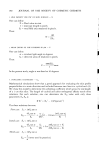
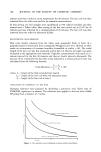
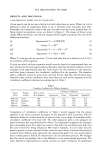
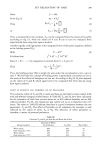
192 JOURNAL OF THE SOCIETY OF COSMETIC CHEMISTS is the position along the direction of diffusion (e.g., position along the thickness of the stratum corneum), and D is the diffusivity of water in the membrane. To understand TEWL, what we need is a picture (or graph) of the concentration, C, of water, across the stratum corneum, i.e., as a function of x. In principle, this can be obtained by integration of eq. 1. In practice, however, such integration is not straightforward because the diffusivity of water varies with the concentration of water, C, at different positions, x, in the tissue (4). This dependence of D on C is emphasized by writing D(C). Before we can integrate eq. 1, therefore, we must find an equation for D(C) in terms of C. Because water molecules bind to stratum corneum, the binding not only results in a concentration (water) dependent diffusivity, but also causes the swelling of the tissue. In a keratinous tissue, the increase in the tissue volume due to water uptake may not necessarily be equal to the volume of water absorbed, because the structure of water in the tissue is not the same as in bulk liquid (5). Therefore, to obtain an equation describing the diffusivity of water in the stratum corneum as a function of water concentration one needs methodology more complicated than that which suffices when the diffusivity is a constant. Recently, Wu (6) developed a permeation method to determine the penetrant diffusivity as a function of its concentration. The author was able to obtain an empirical equation describing the water diffusivity in fetal hog periderm. This report describes how this method of data analysis was used with TEWL data previously obtained by Goodman and Wolf (7) (from human volar forearm) to determine the diffusivity of water in human stratum corneum. With this equation, in conjunction with Fick's diffusion law, the water concentration profile in the stratum corneum under various relative humidities was determined. METHODS Assuming the stratum corneum at any position is uniform with respect to its water barrier properties, then at steady state, the rate of water transpiration (the flux, F) through the layers of tissue can be described by an integrated form of eq. 1 (3): F = • D(C)dC, (2) where H is the thickness of the stratum corneum, C h and Co are the water concentrations in the tissue at the surface and at the dermal side, respectively, D(C) is the water diffusivity (at each depth in the tissue) which can be a function of water concentration. __ __ The mean diffusivity D, at mean water concentration C, in the tissue can be defined as = Co [D(C)dC]/(Co - Ch). -- Substituting eq. 2 into eq. 3, D becomes: D = F H/(Co -- Ch). (3) (4)
Purchased for the exclusive use of nofirst nolast (unknown)
From: SCC Media Library & Resource Center (library.scconline.org)