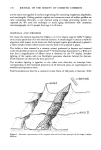
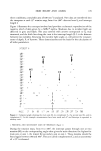
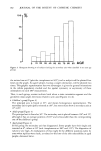
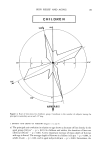
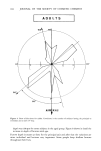
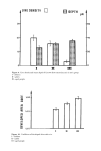
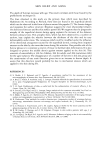
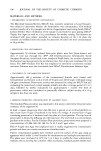
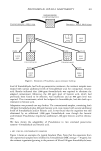
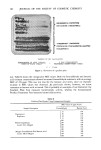
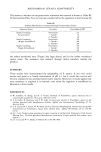
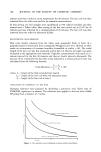
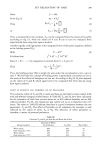
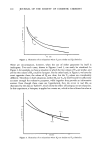
SKIN RELIEF AND AGING 179 these conditions, a total skin area of 100 mm 2 is analyzed. Two data are transferred into the computer at each 15 ø rotation step, from 0 to 36Oø: detected area Sd and intercept length I. Figure 1 illustrates the concepts involved and provides a schematic reproduction of the negative relief of skin given by a Silflo© replica. Shadows due to incident light are detected in grey and black. The area covered with arrows corresponds to Sd truly measured, and the thick line along the crest is the intercept length (I). L is the distance between two wrinkles. Knowing the incident light angle, o•, will permit the measure- ment of depth, P, of furrows. These determinations are the basis for the calculation of all other parameters. 228 M2 • C1 Figure 2. Computer graph showing the main axis M•, its complement C•, the second axis M2, and its complement C2. In this example, rneasurements have been made each 9 ø and Intercept is expressed in arbitrary units. 1. PRINCIPAL AND SECONDARY AXES OF WRINKLES (Figure 2) During the rotation steps, from 0 to 180 ø, the intercept passes through one or two maxima (M), so the corresponding angle value gives the main direction: the highest for main axis or axis 1, the lowest for secondary axis or axis 2. These maxima should be found again between 180 and 360 ø. They are called complements (C), and an asymmetry of + 15 ø •s tolerated.

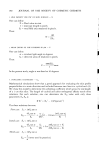
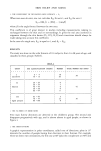
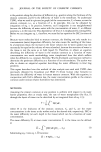
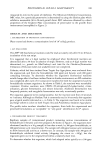
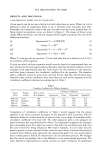
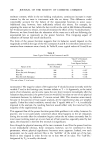
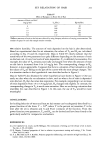
180 JOURNAL OF THE SOCIETY OF COSMETIC CHEMISTS 2. LINE DENSITY PER CM 2 OF SKIN SURFACE = N One can define: Z -- Pixel value in mm I = intercept length in pixels ST = total field area measured in pixels. Then: 10I N- ZST. 3. MEAN DEPTH OF ThE FURROWS IN •tM = P One Can define: c• = incident light angle in degrees S d = detected areas of shadows in pixels. Then: 1000ZS d P - -- tang. In the present study, angle ce was fixed at 26 degrees. 4. UNFOLDING COEFFICIENT = E M Mathematical simulations show that a good approach for evaluating the skin profile perpendicular to a main direction and included between two lines is a cycloid arch (4). We chose this model to determine the unfolding coefficient which gives the real length of a 1 cm skin slice. The length of cycloid arch after orthogonal affinity needs three solutions. For each solution, one can determine the EM value with only three parameters: ST, Sd, If K 2 = IST 2 -- 2(•rSatantx)2l The three solutions become: First case.' Sr 2 2•1'$ d tan c• Second case.' Third case.' 4Sdtanc• sT ( 2•rSdtanc•) E M -- ST -t- • •r -- 2A tan K S T 2•1'S d tan c• EM 4$ d tan oz S T 2•1'$ d tan c• 4- K -- ST -t- • + Ln 2•Sd tan c• -- K S T = 2•S d tan c• 4 EM = --(never used in practice).
Purchased for the exclusive use of nofirst nolast (unknown)
From: SCC Media Library & Resource Center (library.scconline.org)