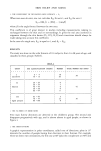
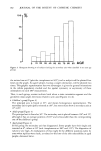
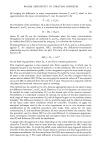
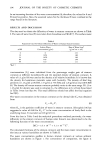
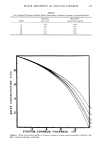
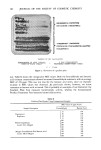
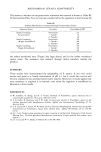
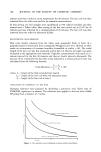
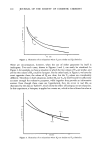
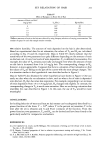
WATER DIFFUSIVITY IN STRATUM CORNEUM 195 Table II The Calculated Thickness and Mean Water Concentration of Stratum Corneum at Various Humidities % RH Thickness Mean Water (cm x 10 4) Concentration (g/ml) 0 8.6 0.50 29 11.0 0.52 54 12.1 0.53 80 12.3 0.55 88 13.9 0.58 .8 z Z.4 0 .2 .6 .8 STRATUM CORNEUM THICKNESS X/H Figure 1. Water concentration profiles in stratum corneum in various relative humidities (1:0% RH, 2:29% RH, 3:54% RH, 4:80% RH, 5:88% RH).

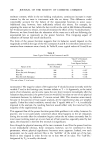
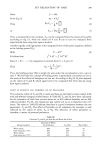
196 JOURNAL OF THE SOCIETY OF COSMETIC CHEMISTS presented in dimensionless coordinates. It can be seen that except at the surface and near the surface, the water concentrations in the tissue are essentially the same at all humidities. CONCLUSION The diffusivity equation, D(C) (see eq. 9), obtained here is not the final answer to the difficult problem of water diffusivity in human stratum corneum. The equation was derived from a concentration range narrower than that to which it must be applied. Since values of TEWL depend on the technique used to obtain them (12), parameters in eq. 9 may differ when alternate TEWL sources are employed. Nevertheless, eq. 9 still provides an analytical picture for the water diffusivity in stratum corneum. Therefore, the conclusions obtained in this report should be valid for qualitative comparisons. For example, when C = 0.83 g/ml, the water concentration of fully hydrated stratum corneum, the calculated diffusivity is 4.8 x 10 -•ø cm2/sec which is in good agreement with the experimental data (5 x 10 -•ø cm2/sec) (13). Also, the calculated thickness of stratum corneum (see Table II) compares favorably to the literature value (8 to 16/•) (14). ACKNOWLEDGEMENT The author thanks Dr. I. M. Klotz of Northwestern University for suggestions in the preparation of the manuscript. REFERENCES (1) R. L. Rietschel, Method to evaluate skin moisturizers in vivo, J. Invest. Dermatol., 70, 152 (1978). (2) M. Stockdale, Water diffusion coefficient versus water activity in stratum corneum: a correlation and its implication,J. Soc. Cosmet. Chem., 29, 625 (1978). (3) J. Crank, The Mathematics of Diffusion, 2nd. ed. (Oxford Press, 1975), p 191. (4) I. F. E1-Shimi and H. M. Princen, Diffusion characteristics of water vapor in some keratins, Polymer Sci., 256, 209 (1978). (5) R. L. D'Arcy and I. C. Watt, Analysis of sorption isotherms of non-homogeneous sorbents, Trans. Faracly Soc., 66, 1236 (1970). (6) M. Wu, Determination of concentration dependent water diffusivity in a keratinous membrane, J. Pharm. Sci., in press. (7) A. B. Goodman and A. V. Wolf, Insensible water loss from human skin as a function of ambient vapor concentration,J. AppL Physiology, 26, 203 (1%9). (8) I. F. EI-Shimi and H. M. Princen, Water vapor sorption and desorption behavior in some keratins, Polymer Sci, 256, 105 (1978). (9) D. A. Weigand, C. Haygood, andJ. R. Gaylor, Cell layer and density of Negro and Caucasian stratum corneum,J. Invest. DermatoL, 62, 563 (1974). (10) R.J. Scheuplein and L. Ross, Effect of surfactants and solvents on the permeability of epidermis,J. Soc. Cosmet. Chem., 21,346 (1970). (11) K. Diem and C. Lentner, Scientific Tab/e, 7th ed. (Ciba-Geigy Ltd., 1970), p 561. (12) B. Idson, In vivo measurement of transepidermal water loss,J. Soc. Cosmet. Chem., 29, 573 (1978). (13) R.J. Scheuplein and I. H. Blank, Permeability of the skin, Physiological Review, 51,702 (1971). (14) K. A. Holbrook and G. T. Odland, Regional differences in the thickness (cell layer) of human stratum corneum: an ultrastructure analysis,J. Invest. Dermatol., 62, 415 (1976).
Purchased for the exclusive use of nofirst nolast (unknown)
From: SCC Media Library & Resource Center (library.scconline.org)