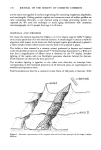
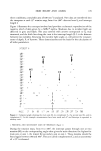
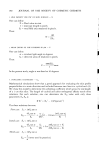
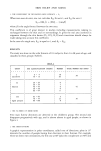
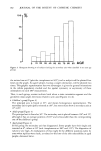
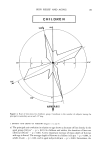
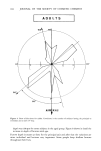
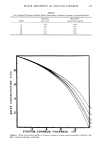
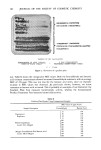
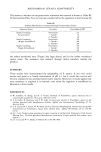
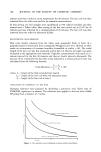
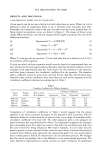
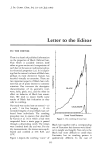
214 JOURNAL OF THE SOCIETY OF COSMETIC CHEMISTS straight, Caucasian hair, the engagement of the comb causes some parallelism of individual hair strands and results in a clear pathway ahead of the teeth of the comb. The comb moves through the hair mass with relatively little effort it is only at the tip end of the tress that the resis- tance of a multitude of individual hair cross-overs has to be overcome and the combing force sharply increases. Insertion of a comb into a tress of highly curled Black hair does not induce hair parallel- ism and thus creates no clear pathway. On the contrary, the engagement and motion of the comb lead to displacement and intensification of individual curl entangle- ments which are reflected in an immediate and progressive rise in the combing force. Some lesser contribution to the overall combing work of the Black hair may also come from the effort necessary to unbend those individual curls which are unable to twist their way through the teeth of the comb. The curly geometry of Black hair has an interesting consequence in the case of wet combing. Unlike Caucasian hair which is more difficult to comb wet than dry, the wet combing of Black hair is easier than its dry combing (Table I). Table I Dry and Wet Combing of Caucasian and Black Hair Work of Combing (g cm) Hair Type Dry Wet Caucasian 50 130 Black 575 225 Caucasian hair, fluffy while dry, acquires a stringy and compact form on wetting. Initially driven by the surface tension of water, the individual hairs adhere strongly to each other along much of their length, forming a cohesive and densely packed assembly. The disentanglement of this assembly by the moving comb is difficult because of reduced fiber stiffness, while the increased inter-fiber and fiber/comb friction further magnify the work of combing. Wetting of Black hair causes little change in the tress configuration as the curly geometry of individual hairs is able to resist fiber adhesion and clumping. There is slight relaxation of the curl which lessens somewhat the extent of individual entanglement. Both the torsion and bend- ing moduli decrease on wetting, which further aids in unbending of curls and in their "twist" passage between the teeth of the comb. Straightening of Black hair, whether by chemical (relaxers) or physical (hot comb- ing) means, results in hair whose assembly behavior in combing is indistinguishable from Caucasian hair. REFERENCES (1) j. Menkart, L.J. Wolfram, and I. Mao, Cauca- sian hair, Negro hair and wool: similarities and differences, j. Soc. Cosmet. Chem., 17, 769-787 (•966). (2) L.J. Wolfram, "The reactivity of human hair. A review" in Hair Research, ed. Orfanos, Montag- na, and Stuttgen (Springer Verlag, Berlin, 198•), pp 479-500. (3) M. L. Garcia and J. Diaz, Combability measure- ments on human hair,J. Soc. Cosmet. Chem., 27, 379-398 (1976). J. Epps L.j. Uolfram Clairol Inc. 2 Blachley Road Stamford, Conn. 06922
Purchased for the exclusive use of nofirst nolast (unknown)
From: SCC Media Library & Resource Center (library.scconline.org)