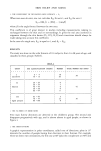
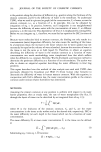
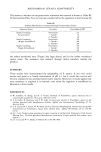
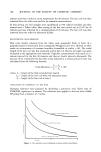
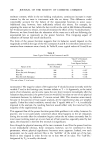
208 JOURNAL OF THE SOCIETY OF COSMETIC CHEMISTS moisture content, while in the set holding evaluations, continuous increase in water content by the set tress is concurrent with the set decay. This difference could conceivably account for the failure of the exponential function in some cases. Additional data, however, have sufficiently refuted this theory. For example, by exposing the water set hair (while the hair is still on the rod) at 90% Relative Humidity for 45 minutes prior to release, we should minimize the effect of this "humidity shock." However, we have found that the relaxation of the water set is still not following the exponential law as rigorously as the power function. This intriguing aspect of relaxation of human hair needs clarification. The form of the power function suggests that its behavior would depend on the magnitude as well as the sign of the two constants A and B. It is therefore instructive to examine these constants more closely. In Table II, some typical values of A and B are Table II Some Typical Values of the Constants A and B Values* of Constants Calculated from Least Square Analysis Humidity in Which Nature of Set Set is Relaxed A B Water Set 90% 15 --0.457 Water Set (with Hairspray) 90% 47 -0.139 Heat Set 65% 26 -0.349 Heat Set (with Hairspray) 90% 46 -0.144 *The unit of time, T, is in hours. summarized. The negative values of B require that Y should increase inversely with the variable T and in the limiting case, become infinite at T = 0. Apparently, at the initial point of set relaxation, and in some cases, the very short moment immediately after the relaxation has proceeded, the power function would fail to relate to one of our physical constraints because, by definition, Y cannot exceed 100%. This situation arises mainly because in the process of least square analysis, all the experimental data are weighed equally. Unless the initial condition, namely that Y equals 100% at T = 0, is artificially imposed in the analysis, the resulting function would reflect only the trend set by the majority of the experimental data. This apparent flaw of the power function poses little problem to its utility, however. In practice, one is not particularly concerned about what happens to the set relaxation during the seconds after the relaxation begins, unless the set relaxes extremely fast. In most cases involving water set or even heat set of hair swatches, especially aided by hair spray, the relaxation in the first few seconds is insignificant. Even though the physical meaning of the two constants A and B in the power function is not immediately obvious, these constants, however, can be combined to form parameters, whose physical significance becomes more apparent. Indeed, two such parameters can be easily derived. One is the "half-life" of the initial set of the hair, which is time elapsed in order for the set to lose 50% of its value. The "half-life," designated by T•0, is readily calculated:

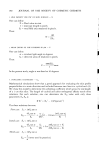
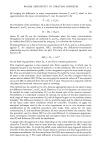
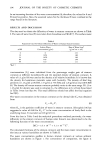
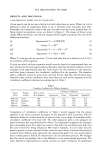
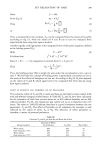
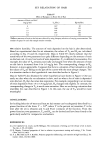
SET RELAXATION OF HAIR 209 Since Y = 50% From Eq. (2) 50 = AT,0 B (5) Then •n T,0 = • In (6) Thus, a characteristic time constant, T50, can be computed from the values of A and B, according to Eq. (7), while the values of A and B can in turn be evaluated from experimental data using least square analysis. Another equally useful parameter is the integrated form of the power equation, defined as the holding power (Hp). With Y = AT • (8) It follows that: f Y dT = f AT • dT Since 0 B -- 1, the integration is smooth from T = 0 up to T. Then Hp = (B-•) TB+I (9) Thus, the holding power (Hp) is simply the area under the set relaxation curve, up to a time T. We feel that this concept of holding power is particularly convenient to use in the study of the effects of hairsprays on hair set. According to Eq. (9), Hp also depends on the values of A and B, which again have to be computed first from data by using least square analysis. EFFECT OF HUMIDITY AND HAIRSPRAY ON SET RELAXATION The evaluative utility of T50 and Hp in water and heat set swatches has been tested, both with and without hairspray reinforcement. In Table III, T50 and Hp have been calculated for the relaxation of both heat set and water set, at 65% relative humidity and at 90% relative humidity. For Hp, the integration was carried out up to a relaxation time of 8 hours. The values in Table III indicate that there is a good correlation between the two parameters, T50 and Hp. The effect of humidity on set relaxation, for example, is well reflected by the values of either T50 or Hp. The selection of either parameter is, therefore, a matter of personal preference. Table III Calculated T50 and Hp for Heat Set and Water Set of Hair Humidity in Which Setting Condition Set is Relaxed T•0 (Hrs.) Hp (%/Hrs.) Water setting 90% 0.07 85 Heat setting (at 115øC) 90% 0.08 79 Water setting 65% 0.72 323 Heat setting (at 115øC) 65% 0.16 148
Purchased for the exclusive use of nofirst nolast (unknown)
From: SCC Media Library & Resource Center (library.scconline.org)