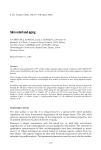
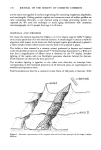
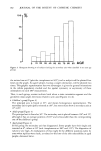
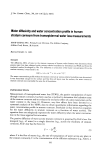
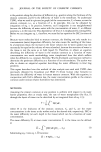
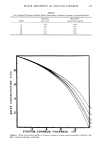
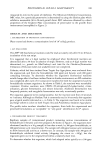
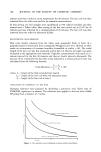
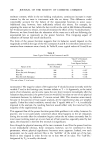
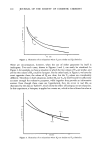
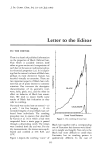
206 JOURNAL OF THE SOCIETY OF COSMETIC CHEMISTS minutes and then cooled at room temperature for 30 minutes. The hair curl was then removed from the roller and used for set retention measurements. In heat setting, the hair samples were equilibrated at 65% relative humidity and then wound onto a Teflon roller. Heat setting of the hair was carried out at 115øC for 20 minutes and was followed by a cooling period of 20 minutes. The hair curl was then removed from the roller for relaxation studies. SET-RETENTION MEASUREMENTS Hair curls, freshly removed from the roller, were suspended freely in front of a graduated panel (constructed from transparent Plexiglass) and were allowed to relax under an environment of constant humidity (controlled to within +_2%). The initial length of the hair curl was first measured, and as the curl relaxed, its length was again measured at the appropriate time intervals. Typically, measurements were made at a 5 minute interval for the first 30 minutes and then at hourly intervals afterwards. The amount of set retained by the hair after it has relaxed for a certain period of time was calculated from the following formula: L -- Lt % Set Retention - -- x 100 L -- L 0 where L = length of the fully extended hair swatch L0 = length of the hair curl when the relaxation starts Lt = length of the hair curl at time t. APPLICATION OF HAIRSPRAY TO THE HAIR Hairspray solutions were prepared by dissolving a polymeric resin (Ethyl ester of PVM/MA copolymer) in ethanol. The solutions were applied to the hair with a Mark II © pump from a distance of 7 inches. LATIVE HUMIDITY HEAT SET AT 90% RELATIVE HUMIDITY 0.5 1.0 TIME (HRS.) Figure 1. Set retention curves obtained at shown relative humidities.

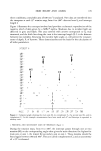
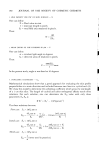
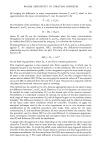
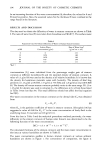
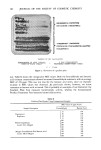
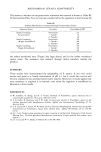
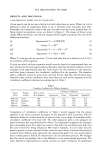
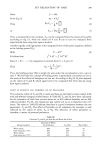
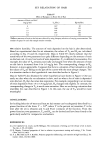
SET RELAXATION OF HAIR 207 RESULTS AND DISCUSSION A MATHEMATICAL MODEL FOR SET RELAXATION A hair swatch can be set into a helical coil with either heat or water. When the coil is allowed to relax by suspending freely in air, it becomes more extended with time. Generally, the relaxation is fast at the start, but then becomes more gradual later on. Some typical set-retention curves are shown in Figure 1. The slopes of these curves clearly reflect non-linear, time-related changes which might be portrayed by one of the following functions: (i) Exponential: Y = A EXP (BT) (1) (ii) Power: Y = AT B (2) (iii) Polynomial: Y = A + BT + CT 2 (3) (iv) Hyperbolic: Y = T/(A + BT) (4) Where Y is the percent set retention T is the time after the set is released and A, B, C are constants of the equation. To find out which of these equations would have the best fit to experimental data, we have resorted to the least square analysis. Basically, with this statistical method, one can calculate, from experimental data, the "best values" for the constants of the equation, and from these constants, the correlation coefficient for the equation. The equation with a coefficient closest to unity is the one that fits the data best. Set-retention data, obtained under various conditions, have been fitted to each of the equations and the correlation coefficients obtained are summarized in Table I: Table I Correlation Coefficients for Different Equations Correlation Coefficients Nature Product R.H. in which of Set on Hair Set is Released Exponential Power Polynomial Hyperbolic Water set None 90% 0.67 0.97 0.60 0.72 Water set Hairspray 90% 0.95 0.98 0.98 0.75 Heat set None 65% 0.87 0.95 0.70 0.80 Heat set Hairspray 90% 0.83 0.98 0.98 0.85 Comparison of correlation coefficients in Table I would suggest that the power equation is the most consistent descriptor of the relaxation data. It predicts well the relaxation behavior of either heat set or water set hair over a range of humidities with a correlation coefficient of at least 0.95. The other equations seem to be adequate for some situations, but unsatisfactory for others. The exponential equation, for example, has a reasonably good fit to data, but seems to fail when the set relaxes very fast, as is the case of water set being released at 90% relative humidity. It is not clear why the power equation is more universal. In fact, since the stress decay of keratin fibers held at constant strain follows quite rigorously the exponential path (5-6), one would expect that a similar pattern should be observed for the set relaxation process. We thought that the reason was perhaps due to the difference in the experimental procedure. The stress relaxation experiments are usually carried out under conditions of equilibrium
Purchased for the exclusive use of nofirst nolast (unknown)
From: SCC Media Library & Resource Center (library.scconline.org)