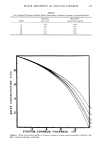
212 JOURNAL OF THE SOCIETY OF COSMETIC CHEMISTS (4) M. Feughelman, A. R. Haly, andJ. W. Snaith, Permanent set and keratin structure, Tex. Res. J, 32,913 (1962). (5) G. C. Wood, The relaxation of stretched animal fibers: the relaxation of human hair, J. Tex. Inst., 45, T462 (1954). (6) M. Feughelman and A. R. Haly, The physical properties of wool fibers at various regains: the mechanism of stress relaxation and length recovery, Tex. Res. J, 32, 227 (1962).

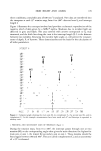
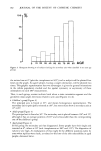
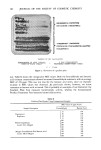
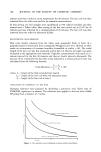
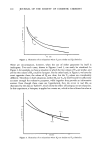
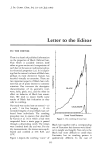
j. Soc. Cosmet. Chem., 34, 213-214 (July 1983) Letter to the Editor TO THE EDITOR: There is a dearth of published information on the properties of Black (African) hair. That which is available restricts itself either to gross amino-acid composition of such hair or focuses on rudimentary phys- ico-chemical properties (1,2). It is surpris- ing that the natural curliness of Black hair, perhaps its most distinctive feature, has received virtually no attention. There are two important aspects of Black hair curli- ness that are of prime interest to cosmetic scientists. One concerns the descriptive characterization of its geometry (coil, wave, helix, pitch, etc.), and the other its effect on behavior of Black hair assem- blies. We wish to report briefly some results of Black hair evaluation as they refer to combing. Our study was carried out on tresses (•-1.5 g each, 7 cm free hanging - 12 cm extended length) of intact Black hair col- lected from individuals. The combing procedure was in essence that described by Garcia et al. (3) in which a hair tress suspended from a strain gage is passed through a descending comb. The tresses were combed both dry and wet. For the dry measurements, the tresses were equili- brated and combed at 65% R.H. and 22øC. Figure 1 depicts the combing "curve" of BLACK CAUCASIAN Comb Travel Distance Figure 1. Dry combing of intact hair. Black hair together with a corresponding one of Caucasian hair (tresses were identi- cal in weight and length). Not only is the Black hair more difficult to comb than Caucasian, but its combing pattern is qualitatively different. In the case of 213
Purchased for the exclusive use of nofirst nolast (unknown)
From: SCC Media Library & Resource Center (library.scconline.org)