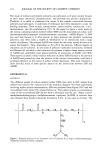
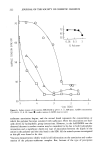
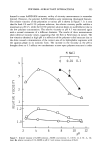
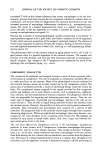
214 JOURNAL OF THE SOCIETY OF COSMETIC CHEMISTS The study of interactions between polymers and surfactants is of great interest because of their many industrial, pharmaceutical, and personal-care product applications. Therefore, it is useful to understand the nature of the complex interactions between polymers and surfactants. A multitude of techniques have been employed to study the binding isotherms. These include, among others, surface tension, conductivity, e.m.f. measurements, and dye solubilization (5,6). In this paper we report a study made on the system containing sodium dodecyl sulfate (SDS) and the macromolecule adipic acid/ dimethylaminohydroxypropyl diethylenetriamine copolymer, AADD (Figure 1). SDS was used here because it is often present in many personal care products containing polymers, and there exists a wealth of information on its interactions with a large variety of polymers. The polymer AADD was chosen for this study mainly because of its amino functionality. Thus, depending on the pH of the solution, different degrees of ionization can be achieved. In one study of polymer-surfactant interactions, Goddard and Hannan (8) included in their selection of polymers a higher charge density version of AADD and established some general patterns of interaction of AADD with SDS. They reported a drastic surface tension reduction in dilute SDS solutions in the presence of AADD and pointed out that the position of the cationic functionality could have a profound influence on the extent of surface tension depression. This work represents a more detailed study of some specific aspects on the interactions between SDS and AADD. EXPERIMENTAL MATERIALS Two different grades of sodium dodecyl sulfate (SDS) were used: A 98% sample from Aldrich was used for the construction of the solubility diagram. For those experiments involving surface tension measurements, SDS was purchased from Sigma (99%) and was recrystallized twice from 95% ethanol before use. The surface tension-vs-concentration curve of this recrystallized SDS did not show a minimum near the cmc. Adipic acid/di- methylaminohydroxypropyl diethylenetriamine copolymer (AADD) in solution form was obtained from Sandoz Chemicals (Cartaretin F-23). It was used as received. The õ ---C (CH2)4 C--N CH2•H2--N CH2•H2--N-- H I H CH• I CHõH I CH• I N HaC CHa Figure 1. Proposed structure of the monomeric unit of Cartaretin F-23, adipic acid/dimethylaminohy- droxypropyl diethylenetriamine copolymer.

POLYMER-SURFACTANT INTERACTIONS 215 amount of solid in the polymer solution was 23.7% and was taken as the weight of the polymer. The % solid was determined by drying the sample at 130øC until constant weight was achieved. PROCEDURES The polymer/surfactant solutions for the solubility diagram were made as follows: SDS solutions were prepared with distilled water previously deaerated under vacuum and purged with nitrogen gas. The solutions were left standing overnight, capped under nitrogen. The pH of each solution was measured before appropriate weights of the polymer were added to them. The mixtures were again sealed under nitrogen and shaken vigorously. The polymer/surfactant solutions were allowed to equilibrate for nine days, after which the pH and the percent transmission were measured. To check for further change, the percent transmissions were measured again after allowing the solutions to stand for another 16 days and an additional 18 days, at which time no further change was detected. The solutions were then characterized according to their percent transmissions measured at 520 nm: clear (C) 100-96 slightly hazy (SH) 95-90 hazy (H) 89-85 very hazy (VH) 84-80 slightly turbid (ST) 79-75 turbid (T) 74-35 and very turbid (VT) 34-0. A Brinkmann PC/600 colorimeter was em- ployed for this purpose. The pH measurements were taken with an Orion Research Digital Ioanalyzer/501. In most cases, the pH reached a steady value rapidly. However, in some cases in which the SDS concentrations were low (•0.05%), and/or when the polymer concentrations were low (•0.01%), up to ten minutes were necessary for the pH to reach a steady range. The observed small oscillations may be attributed to surface adsorption/desorption phe- nomena of surface-active species at low concentration (9). Stock solutions of the polymer and SDS for surface tension measurements were prepared at pH 2.5, 9.5, and ! !. 5 in HCI or NaOH. Mixtures of the polymer and SDS were prepared from the stock solution. Thorough mixing was achieved through the use of magnetic stirring. For surface tension measurements, a Rosano Tensiometer equipped with a sand-blasted platinum blade was used. The surface of the solution was first cleaned by vacuum suction. The surface tension was then measured periodically until no further change between two consecutive measurements was obtained. Viscosity measurements were carried out with an Oswalt viscometer at 24øC. Acid- ometric titration of the polymer was made employing a Brinkmann 636 Titroprocessor. To establish qualitatively the overall ionization characteristics, both dialyzed and un- dialyzed polymer samples were used for the titrations. RESULTS AND DISCUSSION In polymer/surfactant complexation, it is well established that three different forces are involved in the associations. In the case of nonionic polymers/ionic surfactants, polymer-surfactant interactions are driven mainly by their hydrophobicity (!0, !!) through the reduction of the hydrocarbon/water contact area of the polymer and surfac- tant hydrophobic segments. Another type of force that promotes complex association is
Purchased for the exclusive use of nofirst nolast (unknown)
From: SCC Media Library & Resource Center (library.scconline.org)