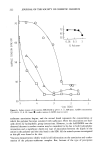
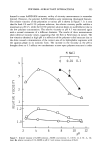
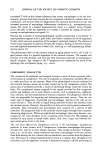
216 JOURNAL OF THE SOCIETY OF COSMETIC CHEMISTS 0.5 0.05 0.01 0.005 0.001 C ST,P T,P T,P T,P C,GP C C,P C,P H,P T,P T,P C,GP C C C VT, P VT, P C C C C C VT.,P SH C C C H c H,P C C C C C T SH C C C C C C C C C C ST,P C C CC 0.001 0.005 0.01 0.05 0.1 0.5 1 5 Keys %T C Clear 100-96 SH Slightly Hazy 95-90 H Hazy 89-85 VH Very Hazy 84-80 ST Slightly Turbit 79-75 T Turbit 74-35 VT Very Turbit 34-0 P Powdery Precipitate GP Gummy Precipitate PERCENT $DS Figure 2. Solubility diagram of Cartaretin F-23 with SDS in water. through dipole-ion interactions (4,12, 13). The third type is the strong coulombic or charge-charge interaction between oppositely charged species (14,15). In the present study, AADD is expected to interact with the anionic surfactant SDS through either hydrophobic group interaction or hydrophilic group interaction, or both, due to the nonionic/cationic nature of the polymer. Figure 2 represents the solu- bility diagram of mixtures of AADD (expressed in 100 percent activity) and SDS. In the lowest polymer region investigated, i.e., 0.001%, the systems remain clear with an increasing amount of SDS in the mixture. Nonclear mixtures appear when the polymer concentration is •0.005% and are dependent on the mixing ratio. In general, at low SDS concentrations, the mixtures stay clear. When the amount of SDS is increased, nonclear mixtures are observed. However, further addition of SDS returns the mixtures to their clear state. With all nonclear mixtures, a visible precipitate of solid material eventually appears at room temperature, except in the very dilute regions. Here, two distinct types of precipitates are observable: a redispersible, granular type (P) that ap- pears in most of the precipitated solids, and a nondispersible, gummy type (GP) that is observed at polymer concentrations •0.5% and at a mixing ratio in the region of 2:1 (w/w) polymer to SDS. Outside this range, the precipitates are more granular in nature. The pH variation of the mixtures as a function of SDS concentration, at a given polymer content, is shown in Figure 3. It is seen that a rise in the pH occurs in all cases. The onset of the pH rise is dependent on the polymer concentration: the higher the polymer

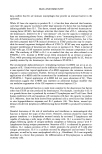
POLYMER- SURFACTANT INTERACTIONS 217 lO 9 8 pH / / ,,' =.- - • 1'5 /' •"" P" 6 i I I © • o,ol o,1 1 % Polymer I I i i i i I 0.001 0,005 0,01 0,05 0,1 0,5 1 5 PERCENT SDS Figure 3. Solution pH of mixtures of SDS/AADD. Lower curve: •), SDS alone. AADD concentration: A, 0.01%. O, 0.1%. O, 0.5%. [], 1%. Inset: O, pH of AADD alone in water. content, the more SDS is required to induce the pH change. The limiting pH value reached is seen to be close to 10. The increase in pH of the mixed solution seems to indicate that the addition of SDS to an AADD solution promotes the protonation of the polymer, with water molecules being the proton donor, thus producing hydroxide ions in the bulk solution, giving rise to the measured increase in pH. Protonation of the amine in the polymer converts the macromolecule to its cationic form. It interacts with SDS through the attraction of the anionic headgroup to the positively charged amine group in the polymer. A similar behavior of induced protonation of the cationizable group in the presence of anionic surfactant has been reported in systems containing SDS and long-chain dimethylamine oxides (17). van der Berg et al. (18) has also reported for systems containing polyeth- yleneimine (PEI) polymers an observed shift in the bulk pH on addition of SDS to the polymer solution. They interpreted their results as the formation of uncharged com- plexes between the negatively charged dodecyl sulfate ions and the positively charged monomeric groups of PEI. The onset of pH change is seen to vary with polymer concentration. This is expected since at any given pH, an acid-base equilibrium exists between the protonated and nonprotonated sites in the polymer. Addition of SDS to the polymer results in the complexation of the cationic sites while initially a region of constant pH is maintained.
Purchased for the exclusive use of nofirst nolast (unknown)
From: SCC Media Library & Resource Center (library.scconline.org)