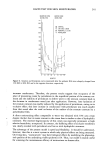
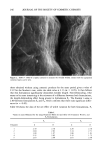
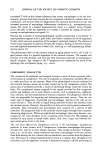
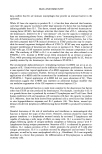
METHOD FOR STUDY OF WRINKLE-REDUCING COSMETICS 245 Figure 1. Scanning electron microscopy (X 45) of a replica utilized to measure a segment of the wrinkle lengths. positive replica, consecutive microphotographs were taken using the same magnifica- tion and compared. This leads to a standardization of the technical conditions for mea- suring. Last, ten consecutive replicas were obtained from one negative replica and the resulting microphotographs were compared. All the determinations showed that there was no difference in length and width of the wrinkle. In order to measure the wrinkle length, a section of the initial wrinkle was selected its ends were clearly defined by the characteristic lines of the skin mosaic. In Figure 1 one can see a microphotograph taken to determine the section of the wrinkle in order to measure the variation of the wrinkle length. On the other hand, in order to measure wrinkle width, the width was considered to comprise the zones of the superposed cor- neous layers of the wrinkle. Figure 2 shows an electron microphotograph taken to determine the wrinkle width, where the superposed corneous layers can be seen. Table I exhibits length determinations in each volunteer after applying the formulations for 22 days. A reduction in wrinkle length can be observed after applying any one of both formulations. This effect is better noticed by calculating the net effect by variation fraction (Table II), where minus sign means diminishing. The length variation fraction is (If - li)/li and the width one is (af - ai)/ai the subindexes i and fstand for initial and final, respectively. Comparing the results obtained when applying formulation F1 during 22 days with

246 JOURNAL OF THE SOCIETY OF COSMETIC CHEMISTS Figure 2. SEM ( x 1500) of a replica utilized to measure the wrinkle widths Zones with the superposed corneous layers can be seen. those obtained without using cosmetic products for the same period gives a value of 2.22 for the Student t-test, while the table value is 2.13 (o• = 0.05). It then follows that this formulation significantly diminishes wrinkle length. Notwithstanding, what seems to be more interesting is the existence of a difference between both formulations, the length-diminishing effect being greater in formulation F 2. The Student t-value is 2.89 between formulations F• and F2, which confirms that there exist significant differ- ences (tx = 0.05). Table III shows the data of the net effect of width variation for both formulations, Ft Table I Values (in mm) Obtained for the Long Parameter Before (li) and After (If) Treatment With F• and F 2 Formulations F• F 2 Volunteer li If li If 1 2.39 2.30 2.28 2.10 2 2.84 2.82 3.14 2.71 3 1.99 1.97 1.98 1.93 4 2.21 2.05 2.11 1.75 5 2.63 2.60 2.61 2.50
Purchased for the exclusive use of nofirst nolast (unknown)
From: SCC Media Library & Resource Center (library.scconline.org)