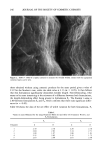
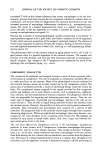
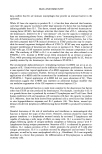
METHOD FOR STUDY OF WRINKLE-REDUCING COSMETICS 247 Table II Variation Fractions for the Length in F• and F 2 Formulations F• F 2 0.038 - 0.079 0.007 - 0.137 -0.010 -0.025 -0.072 -0.171 -0.011 -0.042 Table III Variation Fractions for the Width in F• and F 2 Formulations F• F 2 O.273 O.684 0.114 0.196 0.000 0.295 0.313 O.848 0.138 0.221 and F 2. The experimental results give a value of 2.96 for the Student t-test when the F1 formulation effect is compared with the state of the skin that had no application. Thus, the technique permits detection of a significant effect in wrinkle width when applying the base moisturizing formulation. On the other hand, if both formulations are com- pared, a width mean of 0.1676 for formulation F1 and one of 0.4488 for formulation F 2 are obtained. The Student t-test is 3.14 for the four degrees of freedom, which means that there are significant differences in the wrinkle width determinations between both formulations. Formulation F 2 has a greater effect on wrinkle width than formulation Fl. CONCLUSIONS This work leads to the conclusion that the use of the replica technique together with scanning electron microscopy permits us to characterize in a noninvasive manner the condition of a skin forearm area and to track the evolution of a wrinkle. The results with the microphotographs are reproducible according to the above-mentioned measure- ments and according to the standardization of the negative replica, the positive replica, and microphotography. The formulation with the sodium salt of pyrollidone carboxylic acid (F2) turned out to be much more effective as a wrinkle smoother than the base formulation (F). This is confirmed by both width and length wrinkle variations. ACKNOWLEDGMENTS We gratefully acknowledge the expert linguistic assistance of Prof. Claudio Telha and the helpful typewriting of Miss Ximena Ruiz.

248 JOURNAL OF THE SOCIETY OF COSMETIC CHEMISTS REFERENCES (1) P. Pugliese, New techniques of measuring skin function, Cosmet. Toilerr, 101, 41-46 (1986). (2) A. J. Quattrone and K. Laden, Physical techniques for assessing skin moisturizarion, _J. Soc. Cosmet. Chem., 27, 607-623 (1976). (3) D.C. Salrer, Instrumental methods of assessing skin moisturization, Cosmet. Toiletr., 102, 103-109 (1987). (4) M. M. Rieger and D. E. Deem, Skin moisturizers. I. Methods for measuring water regain, mechan- ical properties and transepidermal moisture loss of stratum corneum, _J. Soc. Cosmet. Chem., 25, 239-252 (1974). (5) H. Tagami, Electrical measurements of the water content of the skin surface, Cosmet. Toilerr., 97, 39-47 (1982).. (6) E. Pirrz, Non-destructive methods for evaluation of cutaneous irritancy, Cosmet. Toilerr. 98, 51-65 (1983). (7) E. Bolsits, The evaluation of moisturizing products, Cosmet. Toiletr. 101, 31-39 (1986). (8) D. R. Highley, V. O. Saboyka, J. J., O'Neill, and J. B. Ward, A stereomicroscopy method for the determination of moisturizing efficacy in humans, J. Soc. Cosmet. Chem., 27, 351-363 (1976). (9) S. Nicholls, C. S. King, and R. Marks, Short term effects of emollients and a bath oil on the stratum corneum,J. $oc. Cosmet. Chem., 29, 617-624 (1978). (10) C. A. Garber and C. J. Nightingale, Characterizing cosmetics effects and skin morphology by scan- ning electron microscopy, J. Soc. Cosmet. Chem., 27, 509-531 (1976). (11) L. L. Hantman, Methods for studying the skin surface, J. Soc. Cosmet. Chem., 34, 407-418 (1983). (12) R. Ryan, S. A. O. Hing, and R. F. Theiler, A replica technique for the evaluation of human skin by scanning electron microscopy, J. Cutan. Pathd. 10, 262-276 (1983). (13) G. L. Grove, R. M. Lavker, E. Hoelzle, and A.M. Kligman, Use of non-intrusive test to monitor age-associated changes in human skin, J. Soc. Cosmet. Chem., 32, 15-26 (1981). (14) S. Makki, P. Agache, J. Mignot, and H. Zahouani, Statistical analysis and three-dimensional repre- sentation of the human skin surface, J. Soc. Cosmet. Chem., 35, 311-325 (1984). (15) J. Koyama, I. Horll, K. Kawasaki, Y. Nakayama, Y. Morikawa, and T. Mitsui. Free amino acids of stratum corneum as a biomechanical marker to evaluate dry skin. J. Soc. Cosmet. Chem., 35, 183-195 (1984). (16) R. Marks, Techniques for the evaluation of emollients and keratolytics, J. Soc. Cosmet. Chem., 29, 433-440 (1978).
Purchased for the exclusive use of nofirst nolast (unknown)
From: SCC Media Library & Resource Center (library.scconline.org)