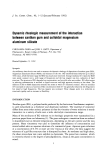
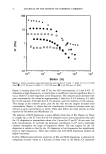
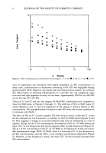
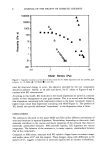
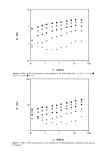
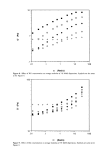
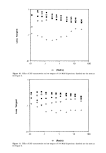
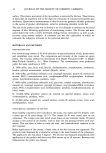
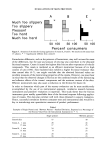
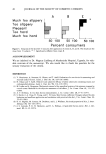
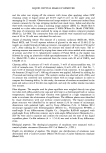
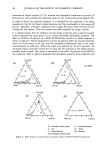
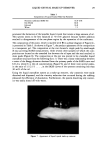
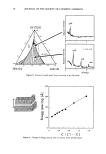
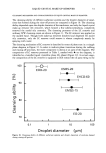
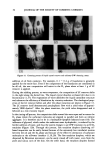
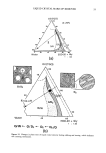
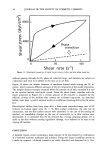
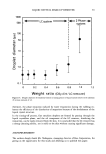
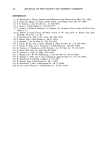
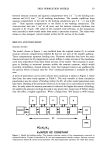
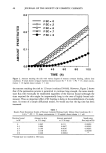
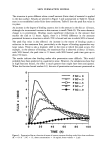
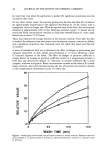
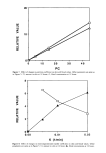
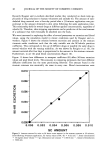
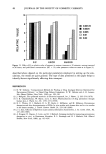
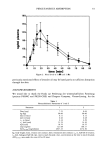
6 JOURNAL OF THE SOCIETY OF COSMETIC CHEMISTS lO ß [] [] ß [] ß ß o o o $ o [] $ o ß [] [] $ $ o ß ß [] ß .Ol .1 1 lO lOO to (Rad/s) Figure •. Foeoe½½• ooex•n•h•n •um ½on•½n•don on 1o$$ •n•½n•. ¸, 0. [%' •, 0.P%' I•, 0.•%' •, 0.4%. rates of suspensions and emulsions were highly dependent on XG concentration in many cases, sedimentation in dispersions containing 0.4% XG was negligible during several months (8,9). Based on our results and data from previous studies, we attribute XG effectiveness in reducing sedimentation to a gel-like but not completely rigid structure and high apparent viscosity at low shear, approximately 200 Pas (or 200,000 cp) in the case of 0.4% XG. Values of G' and G" and the loss tangent for MAS-XG combinations are compared to those for MAS alone in Figures 6 through ! 1. The addition of XG to MAS raises G" values (Figures 6 and 7), and the magnitude of the change is directly related to XG concentration. The straightforward conclusion is that XG raises the viscous contribution in mixtures with MAS. The effect of XG on G' is more complex. The first thing to notice is that the G' curves for the mixtures are not horizontal, in contrast to those for MAS alone (Figures 8 and 9). This suggests a change in structural behavior that may be interpreted as a loss of rigidity. Except for the 0.4% concentration, the addition of XG to 1% MAS lowers the value of G' at low frequencies but has the opposite effect at high frequencies (Figure 8). XG at a 0.4% concentration raises G' of 1% MAS at all frequencies within the attain- able measurement range. With 3% MAS, there is a lowering of G' at low frequency at all XG concentrations, and the effect is not strongly concentration-dependent (Figure 9). However, as the frequency is raised, the value of G' for the mixtures increases with XG concentration.

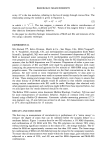
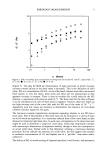
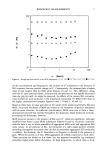
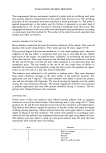
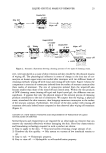
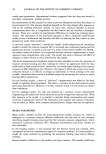
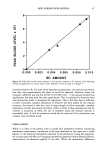
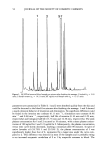
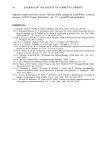
RHEOLOGIC MEASUREMENTS 7 lOO .01 .01 [] [] [] [] [] [] [] [] [] 0 0 0 0 0 0 0 0 0 ß ß ß ß ß ß ß .... ...i , ...... i ....... i ß ß ß ß ,"" .1 1 10 100 (0 (Rad/s) Figure 4. Storage and loss moduli of two MAS dispersions. C), G' 1% O, G" 1% [2], G' 3% I, G" 3%. At all concentrations and frequencies, the increase in G" attributed to the presence of XG is greater than any positive change in G'. Consequently, the mixtures have a higher value of loss tangent than for MAS alone (Figures 10 and 11). This difference, along with the G' data described above, indicates that the mixtures are less rigidly structured than the clay by itself. As might be expected, the effects of the various XG concentra- tions studied are more profound in the dispersions containing 1% MAS rather than in the higher concentration (compare Figures 6 and 7, 8 and 9, 10 and 11). Based on these data, we may speculate on the nature of the interaction between XG and MAS. Structural attributes of MAS are related to the formation of particle assemblies with an open structure. At sufficient concentration, MAS units join to form a three- dimensional network that extends throughout the dispersion. Shear breaks the network, accounting for thixotropic behavior. MAS structure persists in the presence of XG since G' values are significant, although modified from those in pure MAS dispersions (Figures 8 and 9). A picture consistent with the data is one in which assemblies of aggregated MAS units and aggregated XG units coexist. In the presence of XG, the formation of a tight single-particle network extending throughout the system that can also accommodate aggregated XG molecules is unlikely. Furthermore, the G' dependence on frequency is altered in the presence of gum. When the system is at rest, MAS aggregates are weakly connected to each other. These junctions are broken at low shear, but the separated assemblies can withstand somewhat higher shear before disruption. At high frequencies, at which there is little
Purchased for the exclusive use of nofirst nolast (unknown)
From: SCC Media Library & Resource Center (library.scconline.org)