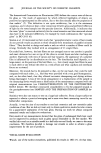
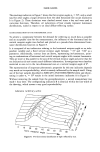
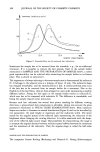
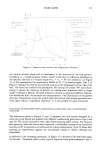
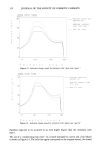
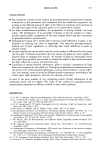
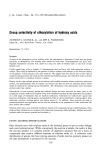
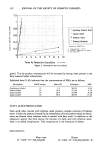
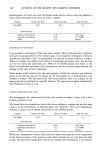
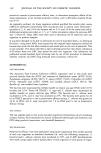
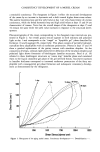
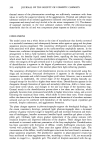
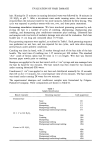
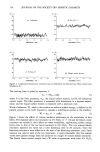
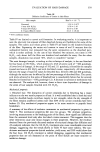
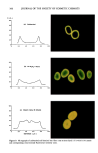
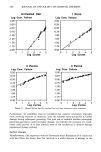
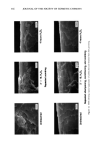
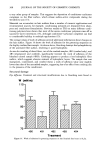
312 JOURNAL OF THE SOCIETY OF COSMETIC CHEMISTS L n c e L N c e POUPlON P$SPlON P$SP40N E-5 880 66O 440 220 ./ , / ,, / ",, // xx x ' -5.0 +2'5.0 +5'5.0 +85.0 Permanent waved and bleached hair Additional treatment: Gloss Tonic Type I after 24 hours R e c e p t o r o rs g I e Figure 12. Indicatrix change caused by treatment with "gloss tonic type I." PCUP18N PG1P18N PO1P48N E-5 72O 540 560 180 -5 0 +25 0 +5'5.0 +85.0 Permanent waved and bleached hair Additional treatment: Gloss Tonic Type II after 24 hours R e c e p t o r a n g I e Figure 13. Indicatrix change caused by treatment with "gloss tonic type II." therefore expected to be accepted to an even higher degree than the treatment with type I. The use of a "conditioning hair rinse" on a strand damaged by a perm and a hair bleach is shown in Figure 14. The solid line again corresponds to the original strand, the dotted

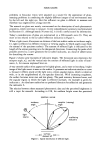
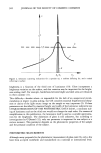
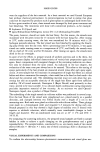
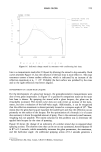
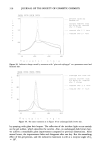
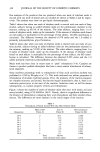
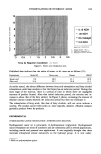
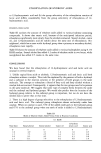
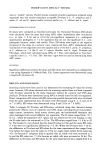
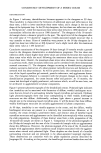
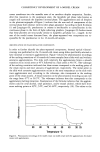
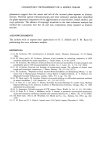
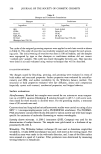
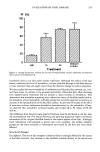
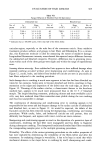
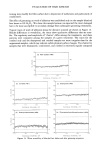
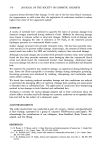
HAIR GLOSS 313 L n Q n c PGUP06N PG7P06N E-3 750 5OO 25O i i -5.0 +25.0 +55.0 +85.0 permanent waved and bleached hair additional treatment: Conditioning heir rinse, 24 hours air dried R e c e p t o r o n g I e Figure 14. Indicatrix change caused by treatment with conditioning hair rinse. line to a measurement made after 24 hours by allowing the strand to dry naturally. Both curves resemble Figure 13, but the influence of the hair rinse is more effective. The rinse treatment creates a better surface reflection, which is indicated by an increase of the reflection maximum at ½2 = 24ø. Probably the hair surface was polished by the rinse and so the light reflection was better aligned. DEVELOPMENT OF A GLOSS HAIR LACQUER For the development of a gloss hair lacquer, the goniophotometric measurements were also of very great importance. In Figure 15 a qualitative comparison made on the same hair base is shown. By spraying the strand with a gloss lacquer, the gloss can be remarkably increased. The dotted curve does not only reveal an increase of the lumi- nance, but also a reduction of the half-value angle. Additionally, it can be recognized that the reflection maximum is almost precisely located at a receptor angle of 30 ø. That means that the gloss hair lacquer equalizes the scaled layer and that the reflection occurs primarily on the surface of the lacquer. For the optimization of a formula it is of course also necessary to know the applied amount of spray. Due to the extremely small amount, weighing was not possible. The easiest solution for this problem was to determine the applied hair lacquer by the time of spraying. Figure 16 shows the change of an indicatrix of a similar strand due to repeated short spraying actions. The shortest time that can be set on our automated Aerosol-Sprayer H & R* is 0.2 seconds, which remarkably increases the gloss parameters, the maximum, and the half-value angle. An additional spraying action of 0.2 seconds generates a * Aerosol-Service AG, Dep. Comes, CH-4313 Mbhlin, Switzerland.
Purchased for the exclusive use of nofirst nolast (unknown)
From: SCC Media Library & Resource Center (library.scconline.org)