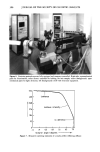
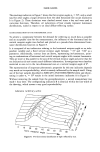
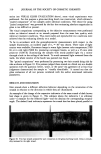
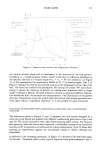
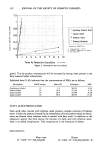
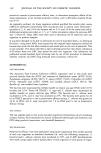
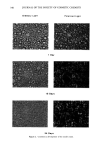
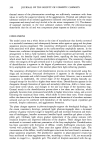
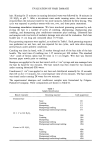
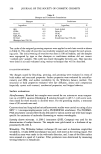
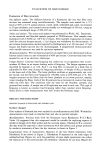
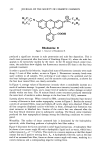
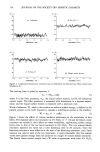
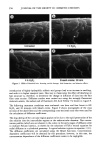
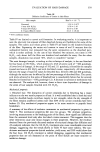
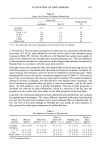
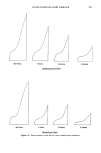
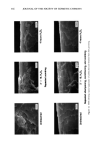
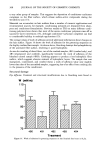
310 JOURNAL OF THE SOCIETY OF COSMETIC CHEMISTS sation (see VISUAL GLOSS EVALUATION above), some visual experiments were performed. For this purpose a gloss-matching booth was constructed, which allowed a "paired comparison" of two samples under identical conditions. The choice for using "paired comparisons" was governed by the fact that estimating absolute magnitudes in gloss is too difficult at present. The visual comparisons corresponding to the objective measurements were performed either on identical strands or on strands prepared from the same hair quality with identical treatment conditions. Thus more stable and reproducible test conditions were achieved than by evaluating directly on a model. To be in accordance with the goniophotometric measurements with respect to the sample illumination, an incident angle of ½• -• 30 ø was chosen. Three types of light sources were available, fluorescent lamps in warm light (nearest color temperature 2700 K) or in cold light (5000 K), producing convergent beams, as well as a 35-mm slide projector (3200 K) illuminating the samples with nearly parallel light via a mirror through a hole in the ceiling of the booth. To avoid unwanted light scattered from the walls, the whole interior of the booth was painted mat black. The "paired comparisons" were performed by presenting two hair strands lying side by side as shown in Figure 10. Five persons judged these strands in a blind test as a double operation with the question: better, worse, or the same? An agreement of at least four judgments characterized the sample as "visually identifiable." It turned out that the gloss evaluation of all test persons correlated with the earlier mentioned indicatrix parameters. RESULTS AND DISCUSSION Hair strands show a different reflection behavior depending on the orientation of the strands in relation to the direction in which they are illuminated. An example of the change of the respective indicatrix of the same strand of dark brown hair shape is given in Figure 11. The ordinate shows the indicatrix I in arbitrary units--a measure for the reflected light•nd the abscissa the corresponding receptor angle. The dashed lined indicatrix represents the strand that has been placed parallel to Figure 10. Two hair strands prepared for pair comparison in the gloss-matching booth. Gloss is remark- ably increased in the right strand.

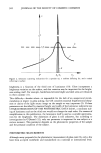
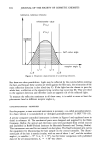
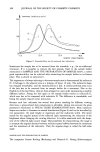
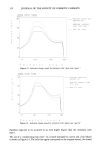
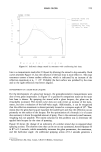
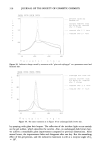
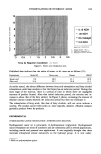
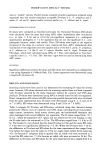
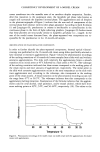
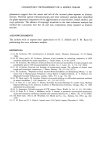
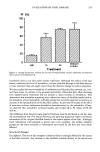
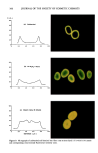
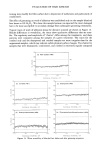
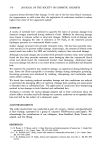
HAIR GLOSS 311 INDICATRIX in arbitrary units 8OO 550. 50 o 5 0 ,m•q o.o •.o •o 900 Indicotrices dark brown strand of o hair- measured in growing direction measured against growing direction measured across growing direction R e c e p t o r a n g I e Figure 11. Indicatrix shape variation with changing hair orientation. the optical incident plane and is illuminated in the direction of the hair growth. Compared to a completely plane surface, which would have its reflection maximum in the specular direction at a receptor angle of e 2 = e• = 30 ø (see indicatrix a in Figure 2), in this arrangement the maximum is shifted by 60-7 ø to smaller angles. Case C in Figure 5 explains this shift by the inclined position of the undamaged cuticle cells of the hair. The solid line confirms this assumption. By turning the strand 180 ø and illumi- nating it against the direction of growth, an equally sized maximum shift to larger angles is obtained. Because the solid indicatrix contains no principal different informa- tion besides the shift, we restricted our measurements to the illumination in the growth direction. Illumination across the growth direction (dotted line) mainly generates scat- tered light without a significant maximum. It is less suitable for gloss evaluation. EVALUATION OF TREATMENTS WITH CONDITIONING GLOSS TONICS AND A CONDITIONING HAIR RINSE The indicatrices given in Figures 12 and 13 represent two hair strands damaged by a perm and a hair bleach and sprayed with different conditioning gloss tonics (type I and type II). The initial indicatrices were taken before spraying (solid curves). Ten minutes after spraying, when the solvent was evaporated, a remarkable increase of the luminance maxima can be recognized as an indication for a gloss improvement. Even 24 hours after spraying an improvement against the non-sprayed strands is visible, although less remarkable. In addition to the increasing maximum, in Figure 13 a decrease of the half-value angle can be seen. Treatment with a tonic type II improves both gloss parameters and is
Purchased for the exclusive use of nofirst nolast (unknown)
From: SCC Media Library & Resource Center (library.scconline.org)