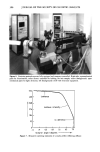
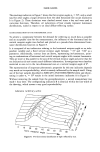
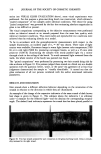
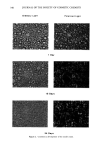
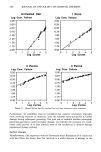
300 JOURNAL OF THE SOCIETY OF COSMETIC CHEMISTS The International Commission on Illumination (CIE) defines the current state-of-the-art for gloss as "the mode of appearance by which reflected highlights of objects are perceived as superimposed on the surface, due to the directionally selective properties of that surface" (5). This definition is not quite satisfactory, but it is the minimum consensus, and it shows at least a clear connection between gloss and preferred reflection of light by the tested sample into the specular direction. Additionally, it indicates that the term "gloss" is reserved exclusively for the visual sensation and that measured related data have to be indicated differently, for example by word combinations like "specular gloss" in ISO 2813 (6). Stamm et al. (2) mentioned in their study that "goniophotometric curves of hair strands do not provide results as precise as those obtained from monolayers of parallel oriented fibers." They decided to design and make a rack on which a number of fibers could be strung. Normally they worked with an arrangement of 21 single fibers. On styled hair, however, the hair fibers are not arranged next to one another in parallel and exact distances but one on top of the other in several layers and also touching one another. Especially with tests of sprays and hair lacquers, the appearance of a polymer film is influenced by its distribution on the hair. The distribution itself depends, to a large extent, on the position of the hair fibers, i.e., how closely single hair fibers lie next to each other or one behind the other in a tress of hair and what capillary and interfacial forces are activated. Moreover, the strands had to be prepared so that, on the one hand, they could be well compared with each other, i.e., that they were provided with a very good homogeneity, and, on the other hand, that they allowed successive shampooing and drying without being disarranged. A loss of the initial arrangement or a displacement of the sample in the measuring device would mean a falsification of the measurement compared with the original measurements (see CHARACTERIZATION OF THE PHOTOMETRIC DATA below). We therefore constructed strandholders to fix the prepared strands in the goniophotometer (see SAMPLES AND THE PREPARATION OF SAMPLES be- low). Statistics were also one reason to test on a large hair collective. From a larger surface we expected to obtain a practical averaging and a more even basic measuring curve for our before/after comparisons. Actually, it was the aim of our studies to test hair cosmetics and raw materials under conditions of use. But we did not want only to obtain qualitative results but also criteria for a quantitative assessment of the hair gloss. During our work we always compared measured results and subjective evaluations. First results of our measurements showed that the gloss of undamaged black hair could not be improved by products such as gloss sprays obtainable in the free market. We verified this result on a suitable model in a half-side test and finally we came to the same conclusion. We therefore decided to damage test strands in order to achieve a gloss improvement by the use of products. VISUAL GLOSS EVALUATION Wundt, one of the earliest researchers, published his results in 1861 (7). At that time,

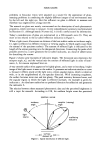
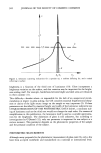
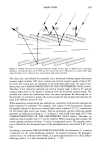
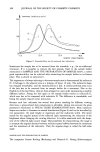
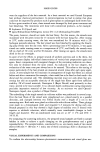
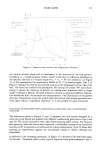
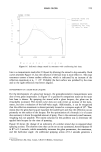
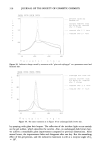
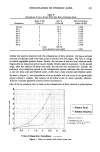
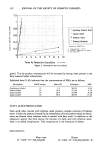
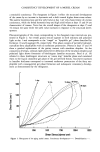
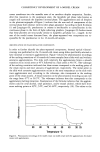
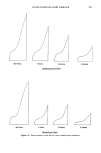
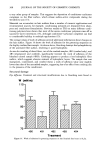
HAIR GLOSS 301 problems in binocular vision were assumed as a source for the appearance of gloss, meaning problems in combining the slightly different images of our environment seen by the left and the right eye. But this influence on gloss is difficult to measure and therefore was neglected for a long time (8). The research on gloss was mostly concentrated on the description of such photometric properties, which were easy to measure. A very comprehensive summary was formulated by Harrison (1). Although nearly 50 years old, it is still a useful source by information. Today's considerations of gloss are summarized in a CIE-research note (9). They are more or less related to the so-called reflection indicatrix in Figure 1. When a light source illuminates an element of the hair surface under an incidence angle, ½ 1, light is reflected in different receptor or viewing angles, ½2 (both angles count from the normal of the specimen surface). The amount of reflected light is indicated by the length of the arrows pointing into the designated directions. Connecting the peaks of all possible arrows by a curve generates the so-called indicatrix, as a kind of abbreviation for describing the arrows. Figure 2 shows some examples of indicatrix shapes. The horizontal axis represents the receptor angle, ½2, and the vertical axis the amount of reflected light in units of lumi- nance, L, for reasons explained later on. A very smooth surface often appears to be highly glossy, and a more or less sharp, bright image of the light source is seen on the surface. It generates an indicatrix similar to curve a, because it reflects nearly all the light into a certain angular region, which is identical with, or in the neighborhood of, the specular direction. With increasing roughness, the surface becomes more mat and less glossy. The peak intensity becomes lower, and the angular region in which the light is reflected increases. An example is given by indicatrix c. An ideal mat surface has no preferred direction for reflection and generates the indicatrix b. The relation between these measured photometric data and the perceived brightness is still a topic for research. According to CIE, for uniform bright areas the perceived specimen norma[ incidence angle light source receptor {viewing} angle scattering ,•• indicat • surface element t/F •-• Figure 1. Spatial distribution of reflected light.
Purchased for the exclusive use of nofirst nolast (unknown)
From: SCC Media Library & Resource Center (library.scconline.org)