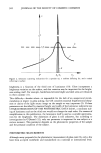
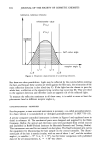
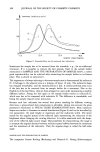
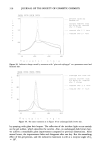
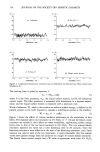
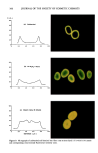
302 JOURNAL OF THE SOCIETY OF COSMETIC CHEMISTS Figure 2. Schematic scattering indicatrices for a specular (a), a uniform diffusing (b), and a mixed reflecting (c) surface. brightness is a function of the third root of luminance (10). Gloss incorporates a brightness variation on the surface, and this variation may be important for the bright- ness scaling itself. For example, borderlines between bright and dark areas are enhanced in their contrast (11). This difficulty--besides others--is responsible for the lack of an unequivoca ! recom- mendation in respect to gloss scaling, but CIE considers maximal brightness •ind sharp- ness or clarity of the light source image on the sample as very important (9). If these parameters are described by maximal height and width of the luminance indicatrix (see CHARACTERIZATION OF THE PHOTOMETRIC DATA below), a nonlinear scal- ing of luminance such as the third root would not change the rank order. For reasons of simplification in this publication, the luminance itself is used as a suitable approxima- tion for the brightness. The dimension of gloss is still unknown, but according to investigations by O'Donnel (12), only one parameter is important for one subject at a certain moment. This parameter depends on the photometric properties of the sample and the personal condition of the subject. PHOTOMETRIC MEASUREMENTS Although many proposals for the photometric measurement of gloss exist (9), only a few have been accepted worldwide and standardized on a national or international level.

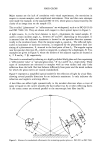
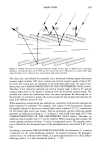
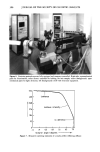
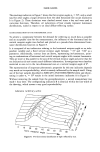
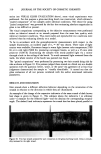
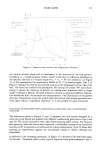
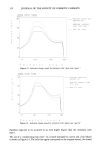
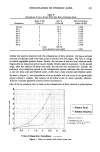
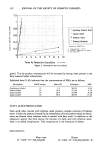
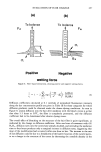
HAIR GLOSS 3O3 Major reasons are the lack of correlation with visual experiments, the restriction in respect to certain samples, and complicated instruments. Now and then new attempts were made: for example, in the standard ISO 10 216, where gloss is characterized by the clarity of an image seen on the sample (13). The so-called "glossmeters" or "reflectometers" are widespread, such as in ISO 2813 (6) and ISO 7668 (14). They are shown with respect to their optical layout in Figure 3. A light source, G, in the focal distance to lens L• illuminates the tested sample, P, under a certain incident angle, ½•, between 20 ø and 85 ø, depending on the purpose. It is assumed that the indicatrix maximum is located in the specular direction symmet- rically to the incidence beam. Here the receptor angle ½2 equals ½•. The reflected light, scaled as luminance or luminous intensity, is integrated by the photometer head con- sisting of a photoreceiver, E, situated in the focal point of lens L 2. The angular region near the specular direction 2•2, which is integrated, is adjusted by a diaphragm, B. Two examples are given in Figure 4, where the borders of the adjacent regions are located at ½• + • and ½2 -+ 13, respectively. The result is normalized by referring to a highly polished black glass and then expressing a "reflectometer value" or "specular gloss value," R' (½ •) and R' (½ •), respectively. These types of instruments are restricted to samples with an even surface and only little reflection from the bulk. But hair behaves differently from paint and the metal surfaces for which the gloss meters are mainly standardized. Figure 5 represents a simplified optical model for the reflection of light by a hair fiber, showing several possible directions for an indicatrix maximum. It only indicates the refraction and neglects scattering effects. A hair fiber can reflect light symmetrically to the incident direction when a cover of spray or liquid on the cuticle smooths the hair surface (ray A) or when reflecting facets in the cortex center are oriented parallel to the macroscopic hair fiber (ray B). G L• Figure 3. Scheme of a standardized reflectometer for estimating specular gloss acc. ISO 2813 or ISO 7668.
Purchased for the exclusive use of nofirst nolast (unknown)
From: SCC Media Library & Resource Center (library.scconline.org)