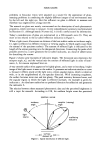
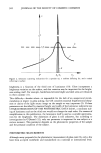
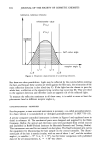
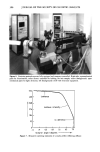
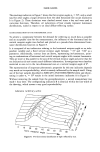
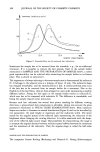
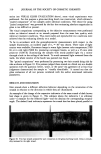
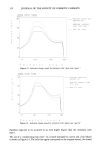
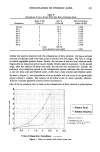
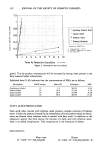
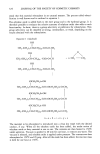
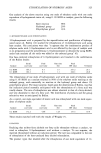
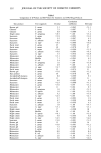
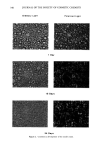
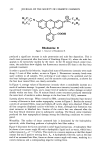
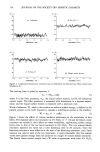
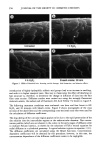
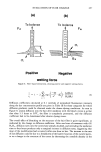
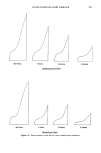
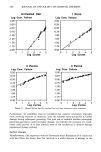
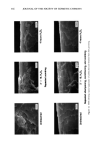
306 JOURNAL OF THE SOCIETY OF COSMETIC CHEMISTS Figure 6. Precision goniophotometer fully equipped and computer controlled. Right side: optomechanical parts for illumination center (front): turntable for holding the hair sample center (background): opto- mechanical parts for light detection left (background): shelf with electronic equipment. 552 -• ---lurn /,60 i 368 lurnin 276 - 18/, 92 t no definifio"/ -5 +9 +23 +37 51 65 79 recepfor angle / degrees • Figure 7. Measured scattering JndJcatrix of a nearly perfect reflecting diffusor.

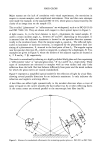
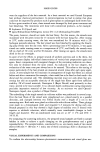
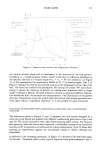
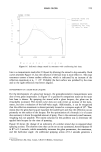
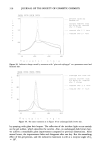
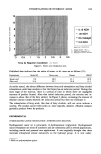
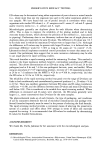
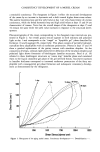
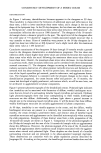
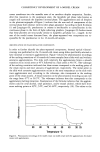
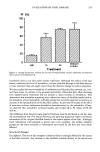
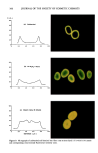
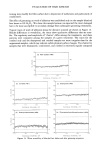
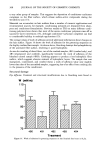
HAIR GLOSS 307 The resulting indicatrix in Figure 7 shows that for receptor angles ½2 50ø, only a small (and for other angles a large) deviation from the ideal horizontal line occurs (indicatrix b in Figure 2). These deviations were checked several times a day and were used as correction functions. Therefore, all indicatrices of hair strands represent luminance distributions, scaled in respect to an ideal diffuse-reflecting surface. CHARACTERIZATION OF THE PHOTOMETRIC DATA To achieve a compromise between the demand for collecting as much data as possible and an acceptable time for the measurements, the influence of the horizontal and the vertical receptor angles was checked and plotted as a pseudo-three-dimensional lumi- nance distribution function in Figure 8. It is composed of ten indicatrices relating to the horizontal receptor angle as an inde- pendent variable and a fixed vertical receptor angle between -15 ø and + 60 ø as a parameter. Additionally, contour lines are drawn, representing iso-luminances, point- ing to combinations of horizontal and vertical receptor angles with constant luminance. They are more or less parallel to the axis of the vertical receptor angle and prove that the ten indicatrices do not contain much different information. Investigations were therefore restricted to one cut in the two-dimensional scan at a vertical receptor angle of 0 ø. The representation of important photometric properties by this one indicatrix depends very much on its reproducibility, which is mainly influenced by the sample itself. Using one of the hair samples described in RESULTS AND DISCUSSION below and illumi- nating it under ½• = 30 ø results in the initial luminance indicatrix A in Figure 9. Without removing the sample from the goniophotometer, a second measurement was made 1 hour later. The corresponding indicatrix B is identical within the line width of the drawing, which means a very good reproducibility. luminanee (arbifrary unifs) 60 0,0 horjz. recepfor angle .._____.._•._.•0 BO Figure 8. Two-dimensional distribution of light reflected by hair.
Purchased for the exclusive use of nofirst nolast (unknown)
From: SCC Media Library & Resource Center (library.scconline.org)