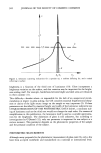
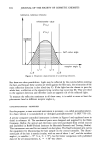
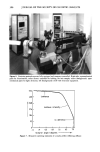
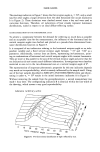
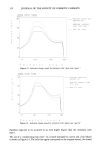
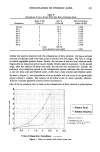
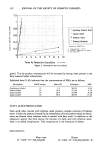
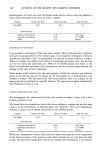
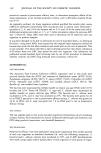
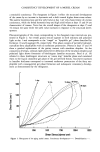
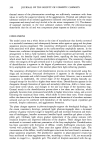
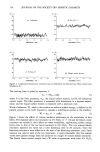
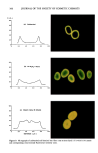
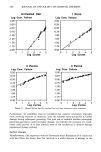
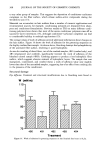
308 JOURNAL OF THE SOCIETY OF COSMETIC CHEMISTS ,øø t 160 20 luminanee {arbifrary unifs} -5.0 25.0 55.0 85.0 recepfor angle/degrees Figure 9. Reproducibility test for measured hair indicatrices. Sometimes the sample has to be removed from the turntable, e.g., for an additional treatment. If it is possible to remove the hair strands, fixed in the sample holder mentioned in SAMPLES AND THE PREPARATION OF SAMPLES below, a rather good reproducibility can be achieved after reinserring the sample holder in its former place. This is shown in indicatrix C. The importance of always referring to the same sample area is demonstrated by indicatrix D. It belongs to the adjacent area at a distance of about 10 mm. The indicatrix shape has changed remarkably, and the reproducibility is bad. A similar problem may occur if the hair has to be removed from its sample holder for a treatment. Due to the flexibility of the hair fibers, they are then arranged in a new order representing a slightly different surface. Fixing the hair again in the sample holder results in indicatrix E, which now has to be compared with indicatrix D. The difference is remarkable, and fixing the sample requires some precaution. Because each hair indicatrix has several data points standing for different viewing directions, a gloss-related data compression is advisable, taking into account the gloss parameters mentioned in VISUAL GLOSS EXAMINATION above. Most indicatrix shapes are similar to Gaussian or normal distribution (Figure 4) and can be described by two parameters: the peak height or maximum and the indicatrix width. The latter stands for the angular spread of the reflected light representing the reduction of the brightness when changing the viewing direction. It is often associated with the sharp- ness of the reflected light source image. One possibility for characterizing this range is to measure the angular distance between indicatrix parts halfway between the minimum and the maximum of the indicatrix. Then the angular range is called the half-value angle. SAMPLES AND THE PREPARATION OF SAMPLES The companies Gustav Kerling (Backnang) and Heinrich G. Herzig (Schwetzingen)

HAIR GLOSS 309 were the suppliers of the hair material. As a basic material we used Central European hair without chemical pretreatment. In preinvestigations we had to realize that gloss could not be improved by products such as gloss sprays on undamaged dark brown hair. So for a great number of tests, these strands were damaged by both perm treatment and hair bleaching. The treatments were done with commercial products, as for example: ß Stylewave X (Clynol) and ß Igora Brillantblond R/Oxigenta Lotion 6% (1:2) (Schwarzkopf GmbH) The perm, however, should not make the hair frizzy. For this reason, the strands were moistened with the perm lotion for 15 minutes with the hair lying fiat. After rinsing at 35øC under running water, the hair was neutralized for 10 minutes with a 2% hydrogen peroxide solution. The hair strand was then bleached by applying the bleach- ing pulp evenly onto the dry tress. After a processing time of 45 minutes, it was again rinsed out under running water at a temperature of 35øC, and finally the strands were left in a bath of 1% citric acid for 30 minutes. After rinsing out again, the strands were dried in the air overnight. In spite of all the efforts to prepare strands of uniform patterns and to fix them, the measurements display individual characteristics of various hair preparations again and again. Exact comparisons with marginal changes of the scattering indicatrix can there- fore only be obtained from the same strand. As indicated in the last chapter, the evaluation of the same tress part always has to be ensured. This refers to the testing of sprays particularly if the hair strands are measured several times after each spray appli- cation. A tress sample that will maintain its arrangement of single hair fibers in a strand before and after a treatment (for example, a hair wash) has to be fixed on both ends--the distal and the proximal side. The embedding material must not only allow fast pro- cessing but also an acceptable elasticity of the single hair fibers apart from sufficient stability. Of all tested materials, Xantopren L (Bayer Dental) used primarily in den- tistry, proved to be most suitable. It is a silicone-based condensation curing elastomeric precision impression material of low viscosity. As an activator we used Optosil- Xantopren liquid, also a product of Bayer Dental. The embedding of the single strands in a silicone rubber was performed in several steps. First the hair fibers of the strand were straightened out, placed exactly in a parallel direction, and clamped between two Teflon blocks over a length of 2 cm in the measuring area. Both ends were glued on either side with silicone rubber. These gluings were made in a chronological order and required 3-5 minutes for drying each one. Strands prepared in this way showed a high degree of stability even if treated with aqueous or alcoholic solutions, which normally cause considerable changes in both length and diameter. The air-conditioned room was set at 23 ø - 2øC and 45% --- 5% R.H. For measuring the scattering indicatrix, the prepared strand samples are fixed in sample holders in order to achieve a quick changing on the goniophotometer and a good reproducibility. The sample holders, constructed by us, are mainly made of two metal sheets (100 mm x 100 mm x 1 mm), one of them containing a hole to illuminate the samples. VISUAL EXPERIMENTS AND COMPARISONS To confirm the relationship between photometric measurements and visual gloss sen-
Purchased for the exclusive use of nofirst nolast (unknown)
From: SCC Media Library & Resource Center (library.scconline.org)