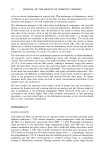
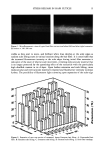
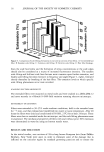
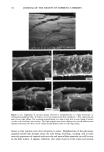
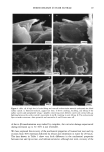
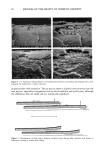
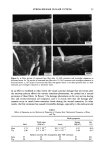
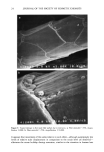
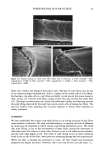
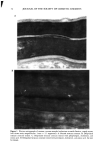
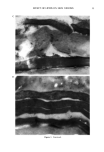
STRESS RELEASE IN HAIR CUTICLE 25 c Figure 10. Typical damage to coarse wool fiber surface due to extension. a: Fiber extended --30%, magnification x 1500. b: Fiber extended --30%, magnification x 13,000. c: Fiber extended, --30%, magnification x 8000. fibers, but without any lifting of the surface scale. The lack of scale lifting may be due to the relatively larger thickness and, with it, rigidity of the cuticle cells in wool fibers. Furthermore, the scale cells on wool fibers are highly curved around this lower-diameter fiber. In fact, for very fine wool fibers, single-cuticle cells may envelop the whole fiber (11). This high curvature gives the cuticle cells additional rigidity and thus may prevent the scale lifting observed for the much less curved cuticle cells in human hair fibers. The need for further work regarding the cuticular response to keratin fiber extension is clearly indicated. SUMMARY We have established that surface scale edge lifting occurs during extension of hair fibers under ambient conditions. We used microfluorometry to quantify this loss of adhesion by measuring the extension at which various scale-lifting phenomena occur. We think that scale lifting is due to the development of shear forces during the movement of individual scale cells relative to each other. Failure occurs in the endocuticular domain, and the scale edge begins to lift. The onset of scale lifting occurs at lower extension levels in the tip end of the fiber, where previous grooming damage has been experienced. When the fiber is released and immersed in water, the fiber length and mechanical properties are largely recovered. However, this is not true for the cuticular layer, i.e.,

26 JOURNAL OF THE SOCIETY OF COSMETIC CHEMISTS the surface scale. In this domain, irreversible damage has occurred, especially at the edge of the endocuticular layer of the surface scale. We feel that this irreversible damage to the endocuticle during fiber extension due to grooming may well be responsible for the breaking off of scale fragments during wet combing that was observed by Swift and Brown (4). It is therefore an important part of the scale ablation process in which new surfaces are generated upon loss of the surface cuticle until the whole cuticular sheath has been abraded. During the extension of fine and coarse wool fibers, no scale lifting was observed. The response of the cuticular structure to the extension of wool fibers appears to be the relative sliding of the scales, with failure in the intercellular cement between cuticle cells. Scale lifting may be prevented by the higher rigidity of the scale cells of wool, which are thicker and more highly curved than those of human hair. ACKNOWLEDGMENTS The work reported here was carried out within the framework of the TRI Core Tech- nology Project, "Analysis and Quantification of Hair Damage," sponsored by companies in the international cosmetic industry. The authors would like to thank the sponsors for their financial support. The authors would further like to thank Dr. Yash Kamath, Director of Research at TRI, for many interesting discussions. REFERENCES (1) C. R. Robbins, "Chemical and Physical Behavior of Human Hair," 3rd ed. (Springer-Verlag, New York, 1994), pp 211-226. (2) S.C. Kelly and V. N. E. Robinson, J. $oc. Cosmet. Chem., 33, 203 (1982). (3) T. Kambe, 6th Int. Hair Science Syrup. DWI, Lueneburg, Germany, 1988. (4) J. A. Swift and A. C. Brown,.]. Soc. Cosmet. Chem., 23, 695 (1972). (5) V. N. E. Robinson, J. Soc. Cosmet. Chem., 27, 155 (1976). (6) L. Wolfram and L. Albrecht, J. $oc. Cosmet. Chem., 36, 87 (1985). (7) G. Laustriat and C. Hasselmann, Photochem. Photobid., 22, 295 (1975). (8) K. Schaefer,.]. Soc. Dyers Col., 107, 206 (1991). (9) J. A. Swift, Int. J. Cosmet. Sci., 13, 143 (1991). (10) C. R. Robbins and R. J. Crawford,.]. Soc. Cosmet. Chem., 42, 59 (1991). (11) W.J. Onions, Wool, an Introduction to its Properties, Varieties, Uses and Production (Interscience Publishers, New York, 1962), p. 13.
Purchased for the exclusive use of nofirst nolast (unknown)
From: SCC Media Library & Resource Center (library.scconline.org)