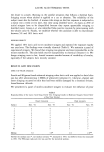
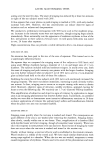
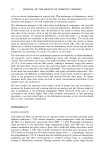
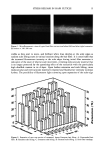
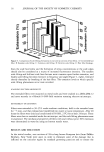
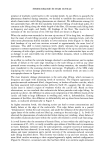
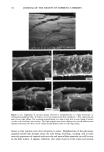
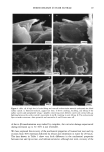
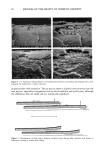
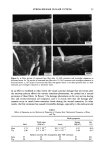
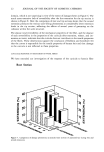
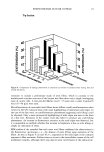
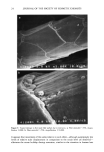
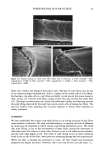
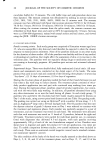
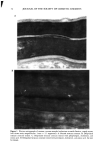
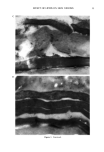
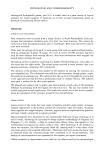
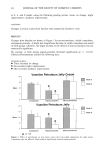
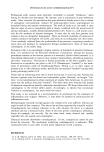
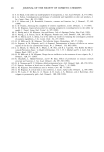
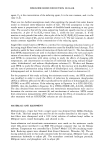
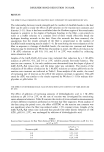
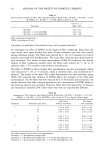
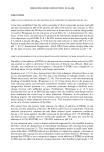
STRESS RELEASE IN HAIR CUTICLE 23 Tip Section 40 30 lO Figure 8. Comparison of damage phenomena in extended tip sections of untreated hair during first and second extensions. extension to include a preliminary study of wool fibers, which in contrast to the multilayered cuticular structure of the human hair fiber show only a single overlapping layer of cuticle cells. A fine pen-fed Merino wool (--25 ptm) and a coarse Coopworth wool (35-40 ptm) were used. Microfluorometry of unextended wool fibers shows diffuse overall autofluorescence when viewed in the UV exitation beam with some highlighting of individual scale edges. In the case of the fine wool, no autofluorescence phenomena suggesting scale lifting could be observed. Only a more pronounced highlighting of scale edges was seen in the form of a fine line. Extension of the coarser wool also failed to produce any scale-lifting phenomena. An increase in fluorescence intensity at the scale edges was observed, but it is impossible to establish whether this increase in brightness is due to scale lifting or simply an indication of stress. SEM studies of the extended fine and coarse wool fibers confirmed the observations in the fluorescence microscope, i.e., the absence of scale lifting upon extension of the fibers. As seen in Figure 9 a,b and 10 a-c, separation at the scale edges is the common response to fiber extension. Failure seems to occur in the intercellular cement of the cell membrane complex, although there may also be some involvement of the endocuticle.

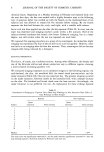
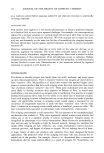
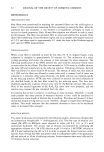
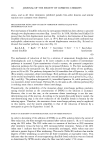
24 JOURNAL OF THE SOCIETY OF COSMETIC CHEMISTS kV 412001 5.0 k • Figure 9. Typical damage to fine wool fiber surface due to extension. a: Fiber extended --25%, magni- fication x3000. b: Fiber extended --25%, magnification x 10,000. It appears that movement of the scales relative to each other--although surprisingly low levels of relative scale displacement in comparison to the strain level are observed alleviates the stress buildup during extension, similar to the situation in human hair
Purchased for the exclusive use of nofirst nolast (unknown)
From: SCC Media Library & Resource Center (library.scconline.org)