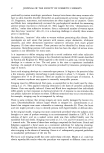
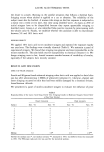
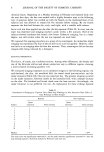
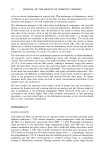
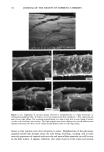
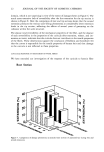
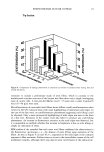
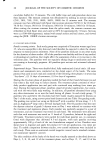
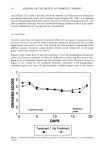
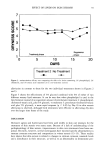
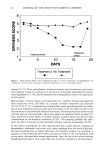
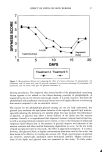
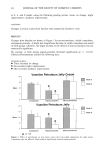
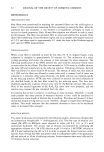
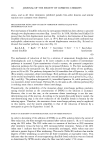
44 JOURNAL OF THE SOCIETY OF COSMETIC CHEMISTS at 0, 4, and 8 weeks, using the following grading system: worse, no change, slight improvement, moderate improvement. STATISTICS Changes in lesion counts from baseline were assessed by Student's t-test. RESULTS Changes from baseline are shown in Figure 1 for microcomedones, visible comedones, and papulo-pustules. A slight but insignificant decrease in visible comedones was noted in both groups. Likewise, the slight decrease in the density of microcomedones was not statistically significant. By contrast, in both groups papulo-pustules decreased significantly (p = 0.05). Global self-assessments yielded the following data: PETROLEUM JELLY: ß Three recorded no change. ß Six recorded slight improvement. ß One recorded moderate improvement. 20 Mean 10 T Comedones Papulo-pustules Microcomedones Week 0 Week 8 20- Vaseline Petroleum • Week 0 15- • Week 8 Mean 10- 5 T 0 Comedones Papulo-pustules Microcomedones 'Jr P= .05 Figure 1. Effect of petrolatums on acne lesion counts after twice-daily applications for eight weeks. Coinedones were not affected. Both products significantly reduced papulo-pustules.

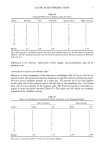
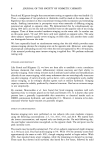
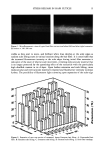
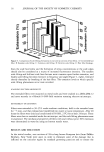
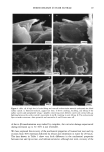
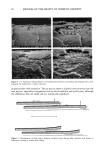
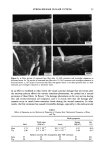
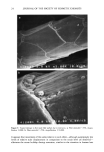
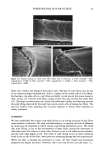
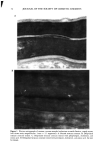
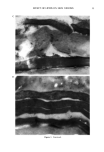
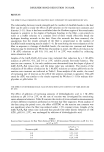
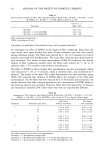
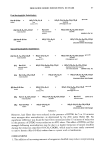
PETROLATUM AND COMEDOGENICITY 45 PETROLEUM JELLY CREAM: ß Two recorded no change. ß Six recorded mild improvement. ß Two recorded moderate improvement. The dermatologists' assessments at eight weeks roughly corresponded to the patients' estimates, except that the grades were somewhat lower. No case of worsening was observed. DISCUSSION The salient finding in this study is that Vaseline petroleum jelly was not comedogenic when applied twice daily to adolescents with active acne. The emulsion containing 30% petrolatum behaved similarly. It is well known that acne patients will develop comedones fairly rapidly when potent comedogens, such as crude coal tar, are applied (8). We have found that even moderately comedogenic substances such as esters of fatty acids (for example, undiluted isopropyl myristate) will induce microcomedones on the forehead of patients with active acne when applied twice daily for eight weeks (unpublished observations). The discussion that follows is an attempt to bring some perspective into what has been an area of frustrating contentiousness. In the 1972 "acne cosmetica" study, the test formulations were inserted inside the ear canal, based on the fact that the follicles there are larger and more numerous. What was not appreciated at the time was that in this protected site loose horny material is commonly retained in the follicular lumens, mimicking comedones. We failed to dis- tinguish between the dense compact horn that comprises a microcomedo, a pathologic impaction, and the normal accumulation of loose horny squames. A more serious error was our failure not to biopsy the opposite untreated ear. This is a necessary control in order to provide a reference for judging the amount of horny material in the treated ear. Without a control biopsy, many materials will be falsely labeled as comedogenic. Our current guidelines are as follows: The test substances are applied to the underside of the pinna in the concave area just external to the ear canal (7). An inch-long ellipse is excised for histologic evaluation, followed by semi-serial sectioning. This allows many more follicles to be visualized. It should be noted that the follicular population is heterogeneous. As in humans, individual follicles vary considerably in size and respon- siveness. The final grading is a global estimate of all the follicles within the section. This is, of course, a subjective estimate. Quantification can be obtained by preparing whole, heat-separated epidermal mounts (13). The diameters of all the follicles can be scanned, enabling calculation of the mean diameter. The daily exposures have been extended from two to three weeks. Using this new procedure, including proper controls, petrolatum was reevaluated for comedogenicity. None of five samples from different producers, including yellow and white petrolatums, were found to be comedogenic. It is reassuring for the validity of the method that "red veterinarian petrolatum," used as a sunscreen in World War II was found to be strongly comedogenic. This is an
Purchased for the exclusive use of nofirst nolast (unknown)
From: SCC Media Library & Resource Center (library.scconline.org)