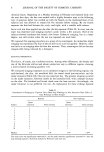
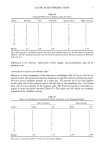
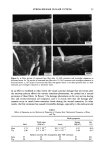
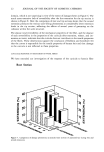
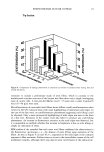
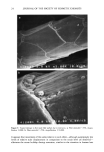
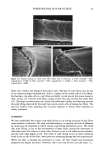
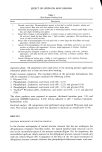
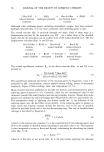
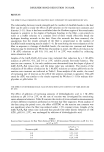
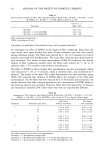
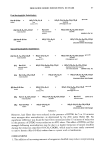
56 JOURNAL OF THE SOCIETY OF COSMETIC CHEMISTS strain, and as all three treatments exhibited pseudo first-order kinetics and similar reaction rate constants were observed. MECHANISM FOR REDUCTION OF HAIR BY AMMONIUM THIOGLYCOLATE WITH DITHIODIGLYCOLIC ACID The mechanism of disulfide reduction by mercaptans (thioIs) has been shown to proceed through two displacement reactions (Eqs. la and lb). In 1958, SchiSberl and Griifje (19) proved that the first displacement reaction (Eq. la) leads to the formation of the mixed disulfide ofkeratin and mercaptan. Later, in 1974, Bor6 and Arnaud (20) confirmed that nucleophilic substitution occurs in the second displacement reaction (Eq. lb) and in- dicated that another pathway may exist (Eq. 6): Ker-S-S-R + KerS- • R-S-S- + Ker-S-Ker --• R-S- + S + Ker-S-Ker mixed disulfide lanthionine lanthionine (6) The mechanism of reduction of hair by a solution of ammonium thioglycolate with dithiodiglycolic acid is thought to be more complex as the number of intermediate pathways is increased. Upon examination of such a system, the potential competitive reduction pathways for this system may be proposed (Scheme 1). The first nucleophilic substitution by the mercaptide ion, RS, may proceed through either of two pathways, given as (A) or (B). The pathway designated as (A) resembles that of Equation la, while (B) is simply a monomer-dimer interchange. Both pathways (A) and (B) may participate in the second nucleophilic substitution by a second mercaptan ion as given by (A•), (A2) , (B•), and (B2). The pathway designated (A•) resembles Equation lb, while pathway (A2) is a monomer-dimer interchange. Pathway (B •) is the same as (A), whereas pathway (B2) is nothing more than a monomer-dimer interchange. Theoretically, the probability of the monomer-dimer interchange pathway predomi- nating should increase as the concentration of DTDG in the solution is increased. However, this is not the case, as the monomer-dimer interchange is not the rate- determining step of the reaction. According to the pseudo first-order kinetic model, the rate-determining step is the slow reduction of the disulfide bonds in keratin by the reducing agent. Therefore, the monomer-dimer interchange pathway may be neglected in this system, and the system simplifies to that of the reduction of keratin by a mercaptan as given by Equations la and lb. EFFECT OF ADDITION OF DITHIODIGLYCOLIC ACID ON FIBER STRENGTH In order to determine if the addition of DTDG to an ATG solution limits the extent of fiber reduction, the fiber strength was assessed after various times (5, 10, or 15 minutes) using the 20% index. The 20% index ratio is a measure of the force at 20% extension after treatment versus the force at 20% extension before treatment. Values of the 20% index near 1 indicate that the fiber is essentially unchanged, while values near zero indicate a greater degree of fiber weakening. The results (Table III) indicate that similar degrees of fiber weakening occurred for all three treatments at equivalent times. This indicates that the extent of stress-supporting disulfide bond reduction was not limited as determined by SFTK results when the fiber was held under 1.5% strain.

DISULFIDE BOND REDUCTION IN HAIR 57 First Nucleophilic Substitution: Ker-S-S-Ker + HO2C-CH2-SA-H + HO2C-CH2-SB-SB-CH2-CO2H kerabn th•oi disuifide excess A TG Dithiodtglycoltc acid (A) Ker-S-S^-CHa-COaH + Ker-S-H + HOaC-CHa-SB-SB-CHa-COaH m•xed d•sulfide reduced keratin disulfide product (similar to Eq. la) (B) Ker-S-S-Ker + HOaC-CHa-SB-H + HOaC-CHa-S^-SB-CHa-COaH keratin thiol disulfide (monomer-dimer interchange) Second Nucleo@hilic Substitution: (A) Ker-S- S^-CH2-CO2H + HO2C-CH2-S^-H + HO2C-CH2-SB-SB-CH2-CO2H m•xed d•sulfide tNol d•sulfide excess A TG Dithtooyycol•c acid (A•) Ker-S-H + HO2C-CH2-SB-SB-CH2-CO2H reduced keratm d•sulfide product + HO2C-CH2-SA-SA-CH2-CO2H disulfide formed from reaction w•th m•xed d•sulfide (similar to Eq. lb) (A2) Ker-S-SA-CH2-CO2H + HO2C-CH2-SB-H + HO2C-CH2-S^-SB-CH2-CO2H m•xed disulfide th•ol disulfide (monomer-dimer interchange) (B) Ker-S-S-Ker + HO2C-CH2-SA-H + HO2C-CH2-SB-SB-CH2-CO2 H • keratln th•01 d•sulfide excess A TG D•th•odtglycolic acld (B•) Ker-S- SA-CH2-CO2H + HO2C-CH2-SB-SB-CH2-CO2H + Ker-S-H (same as A) mixed d•sulfide dlsulfide reduced keratm (B2) Ker-S-S-Ker + HO2C-CH2-Sa-H + HO2C-CH2-SA-Sa-CH2-CO2H keratin thiol dlsulfide (monomer-dimer interchange) Scheme l. However, hair fibers that were reduced in the presence of DTDG for 5 or 10 minutes were stronger after neutralization, as determined by the 20% index (Table III). No significant difference was found for hair fibers neutralized after 15 minutes of reduction in the presence of DTDG versus reduction in ATG alone. This effect of DTDG on fiber strength following neutralization may be due to a higher formation of mixed disulfide during the reduction step (Ker-S-S-CH2-COOH), which may be more easily converted to native keratin (Ker-S-S-Ker) rather than to cysteic acid or lanthionine. CONCLUSIONS 1. The addition of increasing amounts of exogenous disulfide may reduce overprocessing
Purchased for the exclusive use of nofirst nolast (unknown)
From: SCC Media Library & Resource Center (library.scconline.org)