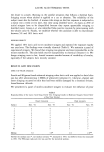
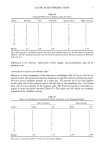
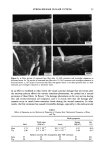
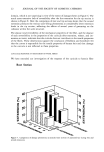
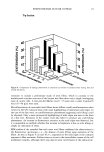
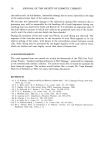
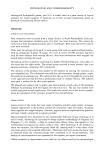
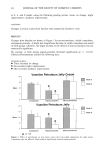
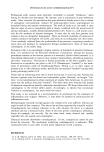
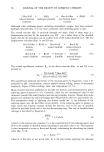
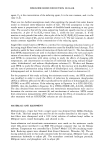
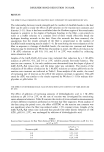
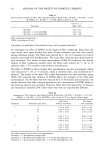
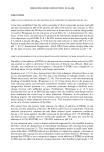
54 JOURNAL OF THE SOCIETY OF COSMETIC CHEMISTS Table II Reaction Rate Constants for Hair Fiber Segments Reduced With Either 1 M ATG, 1 M ATG q- 0. 125 M DTDG, or 1 M ATG + 0.250 M DTDG at pH 9.0 at 23øC Treatment k* 103 (s- t) (Mean, SD) 1 M ATG 1M ATG q- 0.125 MDTDG 1 M ATG q- 0.250 M DTDG 4.41, 0.31 4.48, 0.24 3.42, 1.08 ATG, ammonium thioglycolate. DTDG, dithiodiglycolic acid. THE EFFECT OF ADDITION OF DITHIODIGLYCOLIC ACID ON FIBER STRENGTH To investigate the effect of DTDG on the degree of fiber weakening, fibers from the same source were again divided into three 30-mm treatment sites that were rotated among treatment groups. The fibers were reduced for 5, 10, or 15 minutes in 10 ml of solution and rinsed with distilled water. The mean 20% index was then determined for each treatment. The results of these measurements (Table III) indicated that similar degrees of fiber weakening resulted when the fibers were reduced for 5, 10, or 15 minutes under 1.5% constant strain without neutralization. The effect of DTDG on fiber strength after neutralization was also investigated. Fibers were reduced for 5, 10, or 15 minutes, rinsed in distilled water, and neutralized for 5 minutes. The results of the mean 20% index determination for each treatment group (Table III) indicated that addition of DTDG affects the strength of the fiber after neutralization. For the fibers that were reduced for 5 or 10 minutes and neutralized, the results indicated that fiber strength increased as the concentration of DTDG added to the reducing solution was increased. However, fibers that were reduced for 15 minutes and neutralized exhibited 20% index values that were not significantly different. Table III Comparison of 20% Index for Hair Fibers Reduced With Either 1 M ATG, 1 M ATG q- 0.125 M DTDG, or 1 M ATG +0.250 M DTDG at pH 9.0 and 23øC for a Specific Time Length 20% Index 20% Index Treatment Reduction time (min) without neutralizer with neutralizer 5 0.70 + 0.08 0.68 -+ 0.05 10 0.40 - 0.04 0.61 --- 0.05 15 0.36 -+ 0.04 0.70 + 0.14 5 0.63 - 0.11 0.80 + 0.09 10 0.42 -+ 0.04 0.71 - 0.04 15 0.40 --+ 0.02 0.73 -+ 0.09 5 0.64 --+ 0.08 0.79 --+ 0.17 10 0.43 --+ 0.05 0.75 --+ 0.08 15 0.41 --+ 0.03 0.72 --+ 0.15 All values reported are the mean of six measurements: Treatment 1:1 M ammonium thioglycolate. Treatment 2:1 M ammonium thioglycolate + 0.125 M dithiodiglycolic acid. Treatment 3:1 M ammonium thioglycolate + 0.250 M dithiodiglycolic acid.

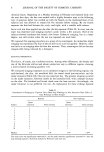
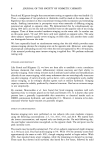
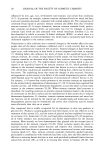
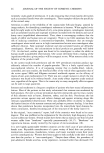
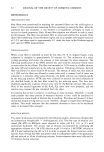
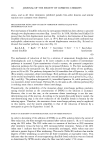
DISULFIDE BOND REDUCTION IN HAIR 55 DISCUSSION EFFECT OF PH VARIATION ON THE REACTION RATE CONSTANT OF HAIR REDUCED BY ATG It has been established that the redox potentials of thiol compounds increase with pH and that increasing the pH of the solution also affects the reaction rate constant, k. This trend has been shown by Wickett for reduction of human hair by sodium thioglycolate (1) and by Weigmann for the reduction of wool fibers by 1,4-dithiothreitol (9). Sim- ilarly, in this study, the reduction of human hair by ammonium thioglycolate was found to be dependent on pH (Table I). A 1 M ATG solution reduced hair more rapidly at pH 9.5 (which is nearest the pKs• of 10.4) than the same solution at either pH 9.0 or 8.0. Sodium thioglycolate has been observed to exhibit pseudo first-order kinetic behavior at pH • 10 (1). Ammonium thioglycolate, which differs from sodium thioglycolate only by the type of cation, also exhibited pseudo first-order kinetic behavior at pH • 10. EFFECT OF DITHIODIGLYCOLIC ACID ON REACTION RATE CONSTANT OF HAIR REDUCED BY ATG The effect of the addition of DTDG on the reaction rate constant of hair reduced by ATG was studied in order to determine if the reduction of keratin was affected. More spe- cifically, this condition was investigated to determine if DTDG was a competitive or blocking agent for the disulfide interchange mechanism. Speakman et al. (15,16) have demonstrated that stress relaxation of keratin fibers occurs in two distinguishable steps. The first step is the breakage of hydrogen bonds, van der Waals interactions, and salt linkages (17,18). The second step is the rate-determining breaking of disulfide bonds. Weigmann et al. (5,7) have shown that in the presence of both reducing agents and increased temperature disulfide bonds are transformed into energetically favored positions (i.e., stress-free positions) through a disulfide inter- change reaction with sulfhydryl groups. Furthermore, Weigmann et al. (5,7) have demonstrated by use of an SH-blocking reagent that the disulfide interchange mecha- nism dominates the second step of stress relaxation. Therefore, in the presence of a blocking reagent, the interchange mechanism cannot proceed, and structural rearrange- ment leading to stress relaxation does not occur. This would be observed as a decrease in the rate of stress relaxation of the fiber. The results from this present study indicate the effects of addition of DTDG on the kinetics of stress relaxation of hair by 1 M ATG at pH 9.0 are not significant. From the observed reaction-rate constants for hair fibers reduced under immersion conditions having 1.5% strain applied, the effect produced by the addition of 0. 125 M DTDG on the reaction rate constant was not statistically significant. The same was true for the addition of 0.250 M DTDG to a ! M ATG solution at pH 9.0. At low extension rates, stress is almost exclusively supported by the disulfide bonds in the fiber, which are displaced by an interchange mechanism with existing thiol groups into stress-free positions (5). This interchange mechanism results in rapid stress relax- ation of the fiber. If DTDG behaved as a blocking or competitive reagent, a decrease in the reaction-rate constant for stress relaxation would have been observed. Therefore, we propose that DTDG is not a competitive reagent, as the addition of DTDG to solutions of ATG does not affect the kinetics of stress relaxation when the fiber is held under !. 5 %
Purchased for the exclusive use of nofirst nolast (unknown)
From: SCC Media Library & Resource Center (library.scconline.org)