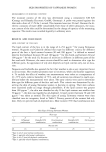
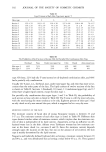
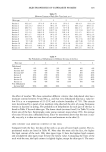
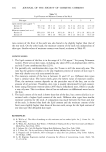
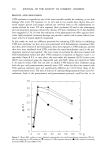
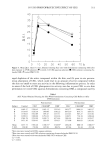
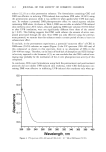
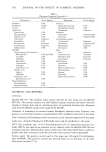
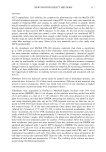
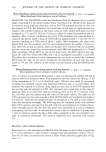
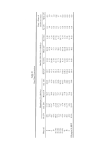
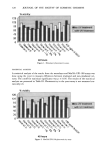
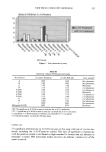
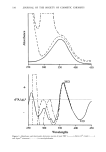
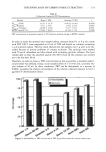
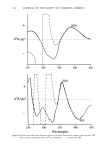
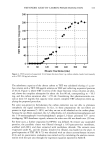
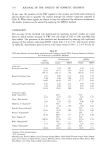
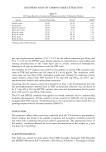
TRETINOIN ASSAY BY CARBON PHASE EXTRACTION 329 RESULTS AND DISCUSSION The commercial forms of skin-care cosmetics contain excipients of very different polari- ties that make it very difficult for the preparation of an analytical sample. Among the high number of solvents tested, tetrahydrofuran gave solutions or clear dispersed phases. Unfortunately, the absorbance spectra in THF, for the commercial samples investigated, were not useful for TRT assay, due to other components totally or partially overlapping the analyte signal (353 nm) or the absorbance increase by turbidity background. In these cases, a derivative spectrophotometric method appeared very helpful, since this technique allows one to obtain a resolution enhancement of the spectral curve and, without prior separation of insoluble excipients, to eliminate broad absorption bands re- sulting from matrix turbidity. For pharmaceutical samples, the peak-trough 363413 nm in the third-order derivative spectra (Figure 1) was found to be very highly correlated with the analyte concentration and not influenced by the other components. The relative regression equation, obtained from data of twenty THF standard solutions, is reported in Table II. Several attempts to apply this procedure to the analysis of cosmetics were unsuccessful, due to the fact that in all cases the TRT signal was completely overlapped by interfering excipients. Therefore, a treatment of the THF samples was necessary. Since there are few references for TRT extraction from whole creams (13,14), different procedures were investigated. When the THF suspension samples were loaded on columns packed with different phases, the active carbon turned out to be a very selec- tive material for TRT, being very strongly adsorbed on this phase. Preliminary experiments to choose the right carbon were made, discarding at first those with a granulometry over 50 mesh to prevent the column occlusion. Therefore, for seven carbon types, reported in Table I, the adsorbability (15) to TRT was evaluated. Ten milliliters of a THF solution of TRT 10 •g/ml were loaded on columns packed with 1 g of each dry carbon type, the eluate collected in a 10-ml volumetric flask and brought to volume with THE The amount of adsorbed TRT was calculated as the dif- ference between the original sample and the eluate concentrations. In a second step, various solvents were tested to select the most efficient one to recover TRT from the column. Pyridine was found to perform the highest recovery for all carbon types, with values ranging from 30 to 95%. On the contrary, chloroform, which pre- sented null extraction of TRT, was chosen to wash the column before the analyte elution. The obtained results, shown in the graph of Figure 2, led to selecting the carbon type Darco 20/40 mesh (Aldrich), showing adsorbability and recovery values of 97% and 90%, respectively. Afterwards, since TRT recovery was demonstrated to be dependent on the elution speed, a recovery value of 98% was achieved, optimizing the pyridine elution speed at about 6 ml/hour. The pyridine eluates obtained by applying this extraction procedure on cosmetic formu- lations show two signals, the 389-nm maximum in the second-order and the 360-410- nm peak-trough in the third-order derivative spectra (Figure 3), due only to the analyte concentration and not influenced by other components. These signal values and the drug concentrations were correlated through the regression equation reported in Table II. The determination limit for this spectrophotometric method was calculated to be 0.3 •g/ml.

330 JOURNAL OF THE SOCIETY OF COSMETIC CHEMISTS ß • ,'/ V,, ', ,./ I I I I 250 300 350 400 450 daA/dL 3 250 300 350 Wavelengths Figure 1. Absorbance and third-order derivative spectra of pure TRT ( and Apsor © ointment ( ....... ) in tetrahydrofurane. I / \, ! I I I 400 450 ), Retin-A © cream ( .... ),
Purchased for the exclusive use of nofirst nolast (unknown)
From: SCC Media Library & Resource Center (library.scconline.org)