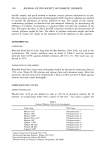
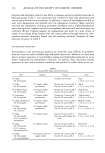
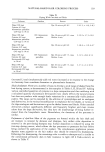
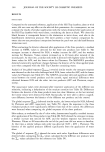
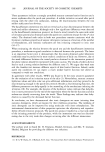
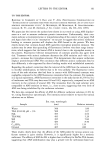
138 JOURNAL OF THE SOCIETY OF COSMETIC CHEMISTS Table III Dyeing With Thio-Substituted Catechols Thiocatechol Oxidant Process Color 4-S cysteaminylcatechol (20 mg), sodium iodate (18 mg) in 5 ml 4-S cysteaminylcatechol (20 mg), ferricyanide (59 mg) in 5 ml 4-S cysteaminylcatechol (10 mg), dopa (9 mg), ferricyanide (59 mg) in 5 ml 4-S cysteaminylcatechol (10 mg), dopa (9 mg), ferricyanide (59 mg) in 5 ml 4-(aminoethanethio)- catechol -0.3% 4-(aminoethanethio)- catechol -0.4%, m-aminophenol -O.2% 1% Sodium periodate 1% Sodium periodate 1% Sodium periodate 10 min at pH 4.5 10 min at pH 7.6 20 min at pH 7.8 Dye 20 min. at pH 7.8, rinse Oxidize 2 min Dye 10 min. at pH 7.5, rinse Oxidize 5 rnin Dye 10 min at pH 7.9, rinse Oxidize 5 min Reddish brown L 35.1, a 8.7, b 6.1 Auburn L 24.8, a 8.7.b 4.9 Red brown L 27.5, a 8.6, b 6.3 Warm red brown L 23.3, a 5.6, b 6.5 Brown L 29.1, a 3.6, b 7.0 Chestnut brown L 22.4, a 4.3, b 7.3 Catechols and thioIs. The potentially most useful application of the pheomelanin route involves hair dyeing with a combination of dopa or other catechols, and thiols such as cysteine, since this follows the natural pathway closely. Not surprisingly, because this process requires a significant number of chemical steps, it is difficult to carry it out in a controlled manner. However, analogous to the results obtained from our studies in eumelanogenesis, we have found that oxidation with a controlled amount of potassium ferricyanide under specific pH buffered conditions gives relatively intense red/brown colors on hair. In addition, significantly stronger color is produced when a second oxidative treatment is applied. This second oxidant is preferably sodium periodate, which readily converts any unoxidized intermediates into pigments. Using these com- bined processes, relatively intense, dark reddish brown colors are obtained on hair over a 20-30 minute dyeing time. The shades are markedly different (warmer and redder) from those obtained in the absence of thiol, when only eumelanogenesis can occur. Therefore, a significant variation in shade is readily obtained by changing either the thiol content or the concentration of oxidant to tion and pheomelanin formation. A higher chemistry along the pheomelanin pathway lower ratio allows for some of the dopa pathway to produce cooler gray to black processes on white hair (L 62.6, a 0.2, b 1 alter the balance between eumelanin forma- thiol:dihydroxybenzene ratio results in more to produce reddish brown shades, whereas a or other catechol to follow the eumelanin shades. Table IV gives examples of these 8.3). In all cases, adding the thiol, or increasing the amount of thiol, reduces color intensity

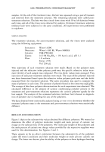
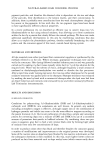
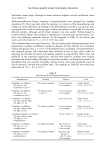
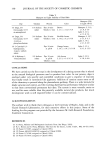
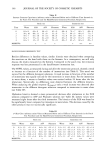
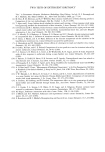
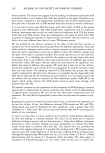
NATURAL-BASED HAIR COLORING PROCESS 139 Table IV Dyeing With Catechols and ThioIs Colorant Oxidant Process Color Dopa (100 mg) Dye 20 min at pH 8.2 L 41.5, a -0.9, b 8.3 Cysteine (61 mg) Ammonium persulfate (228 mg) in 10 ml Dopa (100 mg) 10% Ammonium Cysteine (61 mg) persulfate Ammonium persulfate (228 mg) in 10 ml Dopa (100 mg) Cysteine (121 mg) Ammonium persulfate (342 mg) in 10 ml Dopa (100 mg) 10% Ammonium Cysteine (61 mg) persulfate Ferricyanide (659 mg) in 10 ml Dopa (100 mg) 10% Ammonium Cysteine (121 mg) persulfate Ferricyanide (659 mg) in 10 ml Dye 20 min at pH 8.2, rinse Oxidize 4 min Dye 20 min at pH 8.0 Dye 20 min at pH 7.5, rinse Oxidize 4 min Dye 20 min at pH 7.5, rinse Oxidize 4 min L 29.2 a 3.7, b 10.9 L 38.4, a -0.9, b 6.7 L 14.5, a 0.6, b 1.3 L 27.3, a 2.4, b 9.4 (increased L) and simultaneously adds red tones (increased a) in response to the change in chemistry from eumelanin formation to pheomelanin formation. Shade development. There are a number of ways to develop a wide range of shades from this hair dyeing system, as demonstrated in the examples in Tables I, II, III and IV. Adding various controlled quantities of cysteine to a dopa composition and then oxidizing with a calculated quantity of potassium ferricyanide most closely reflects the natural process but does not produce wide enough shade variations for a commercially viable product palette. The range can be extended by the addition of cysteinyldopa and its analogues and derivatives, or the various benzothiazines to emphasize the red shades, or various of the dopa analogues and derivatives to give the darker browns and blacks. Other catechol derivatives produce significantly different and frequently brighter and more intense colors than the dopa derivatives, but they have the disadvantage of being further re- moved from the biosynthetic route. Nevertheless, the chemistry of the processes is similar. Performance of dyed hair. Most of the pigments are formed within the hair shaft and are resistant to removal by abrasion and shampoo. Any surface color deposition is removed in the post-dyeing shampoo step. Surface deposition is reduced by using the two-step dyeing process, which allows the dye precursors to penetrate the hair before being oxidized by application of the oxidant. The simultaneous application process deposits some pigment on the hair surface that should be removed by shampooing. Following this shampooing, the remaining color is stable to shampoo and is similar to the conventional permanent dyes in fade resistance to light (48 h Fade-o-meter), as shown in Table V.
Purchased for the exclusive use of nofirst nolast (unknown)
From: SCC Media Library & Resource Center (library.scconline.org)