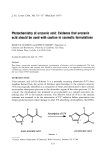
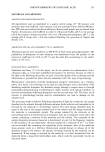
J. Soc. Cosmet. Chem., 48, 151-157 (May/June 1997) Photochemistry of urocanic acid: Evidence that urocanic acid should be used with caution in cosmetic formulations KERRY M. HANSON and JOHN D. SIMON*, Department of Chemistry and Biochemistry, University of California, San Diego, 9500 Gilman Drive, LaJolla, CA 92093-0341. Accepted for publication July 26, 1997. Synopsis Data from a previously reported spectroscopic investigation of urocanic acid are summarized. The data support the conclusion that urocanic acid should be used with caution as an ingredient in sunscreen and conditioning cosmetic formulations because reactive intermediates can be produced following absorption of the sun's lower UV-B wavelengths. INTRODUCTION Trans-urocanic acid (t-UA) (Scheme 1) is a naturally occurring ultraviolet (UV) chro- mophore formed from the action of histidase upon histidine in the stratum corneum. t-UA was originally identified as a component of sweat, and determined to have a broad, structureless absorption spectrum in the ultraviolet region of the solar spectrum (1). As a result, the chromophore was proposed to act potentially as a natural sunscreen, ab- sorbing solar UV in the stratum corneum. The effective result of t-UA in the stratum comeurn was assumed to be the attenuation of UV radiation before penetration into deeper epidermal layers where damage to other UV-absorbing chromophores, like DNA, H 0 H \ •• AbsorptioUVof H trans-urocanic acid cis-urocanic acid Scheme 1. * Current address: Department of Chemistry, Duke University, Durham, NC 27708 151

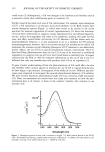
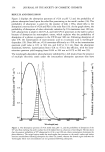
152 JOURNAL OF THE SOCIETY OF COSMETIC CHEMISTS could occur (2). Subsequently, t-UA was thought to be harmless and therefore used as a sunscreen and/or skin-conditioning agent in cosmetics (3). Further research has made such uses of UA controversial. For example, upon absorption of UV, t-UA isomerizes to cis-urocanic acid (c-UA) (Scheme 1) (4). Both isomers have similar absorption spectra (Figure 1), which were found to be similar to the action spectrum for immune suppression of contact hypersensitivity (5). Since this discovery, c-UA has been determined to suppress contact hypersensitivity and delayed hypersen- sitivity, reduce the Langerhans cell count in the epidermis, prolong skin graft survival time, and affect natural killer cell activity (6-12). Because c-UA has shown such im- munomodulatory behavior, it is now postulated to act as a mediator for UV-induced immunosuppression however, this is not proven because the mechanism by which UA modulates the immune system following absorption of UV radiation is not definitively known. Hence, the use of UA in topical formulations remains controversial. The U.S. Food and Drug Administration does not list UA as one of its restricted or prohibited ingredients to cosmetics, but use of UA in the United States is extremely rare. A request conducted by the FDA in 1991 for volunteer information on the use of UA in the U.S. reflected that only one manufacturer sells products with UA as an ingredient (3). To gain a better understanding of how the photochemistry of UA could affect the skin and therefore either caution against or promote the use of UA in topical formulations, we have begun a spectroscopic investigation of the molecule in vitro. Different spectros- copies were employed to investigate the unusual photochemical behavior t-UA exhibits. We have recently reported a photochemical study of UA as a function of pH and isomer (13). Here, we summarize our results from this study and comment on how the pho- tochemical data is of interest to those in the cosmetic industry who continue to use urocanic acid. 15xl 03 T..•, 10 5 0 240 260 280 300 320 340 Wavelength (nm) Figure 1. Absorption spectra of trans- and cis-urocanic acid (pH 7.2). Both isomers absorb in the UV-B, with c-UA (dashed line) having a smaller molar extinction coefficient (½ = 13,600 at 278 nm) relative to the naturally occurring t-UA isomer (solid line, ½ = 18,800 at 278 nm).
Purchased for the exclusive use of nofirst nolast (unknown)
From: SCC Media Library & Resource Center (library.scconline.org)