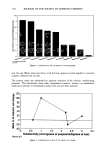
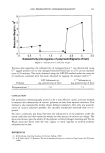
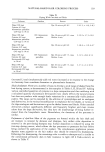
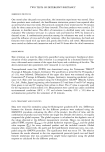
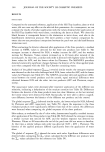
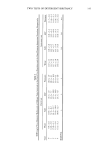
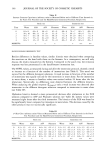
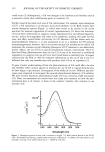
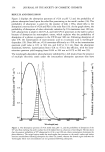
GEL PERMEATION CHROMATOGRAPHY 129 samples. At the end of the treatment time, the hair was squeezed using a pair of tweezers and removed from the treatment solution. The remaining solutions were called post- treatment solutions. The hair was then rinsed three times with 50 ml of deionized water each time, and all of the rinses were collected for analysis. Untreated treatment solutions (without hair) were subjected to the same conditions. All experiments were performed in triplicate. SAMPLE ANALYSIS The treatment solutions, the post-treatment solutions, and the rinses were analyzed using the following equipment: Intrument: Water's GPC Detectors: Water's 410 RI, Wyatt MALLS Column: TSK PW3000 Eluent: 0.15 M Na2SO 4 + 1% Acetic acid, pH 3.3 Flow: 1.0 ml/min Temp: 25øC Vol: 200 pL Two injections of each treatment solution were made. Based on the polymer mass injected and the refractive index polymer peak area, the specific refractive index incre- ment (dn/dc) of each sample was computed. The two dn/dc values were averaged. Two injections of each post-treatment solution were made. The mass of the polymer injected was then determined based upon the refractive index polymer peak area and the dn/dc measured from the treatment solution. The same procedure was used to compute the mass of polymer in each rinse. The amount of polymer found in the rinses was negligible. The average of the three polymer determinations for each experiment was obtained. The calculated difference in the amount of cationic conditioning polymer present in the treatment and post-treatment solutions represents the cationic polymer uptake by the hair sample. The analysis of the untreated solutions (without hair) showed no degrada- tion of polymer due to handling for any of the polymers. The data obtained were statistically analyzed using a t-test (1) to determine whether the measured polymer mass in the treatment and post-treatment solutions were statistically different. RESULTS AND DISCUSSION Figure 1 depicts the substantivity values obtained for different polymers. We wanted to determine the effect of polymer molecular weight and mole percent of cationic net charge on the substantivity of the polymers. The molecular weight of the polymers and the mole percent of cationic net charge values provided by the respective suppliers were used for this determination. See Figures 2 and 3. There appears to be no direct correlation between the substantivity of the polymers under the tested conditions and their molecular weight or mole percent cationic net charge. The latter two factors, plus the ability of the polymer to form hydrogen bonding

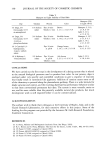
130 JOURNAL OF THE SOCIETY OF COSMETIC CHEMISTS 3.5 2.5 2 1.5 O.5 0 0.1% solids aqueous solution 30 minutes Figure 1. Substantivity: Gel permeation chromatography. and Van der Waals attraction forces with the hair, appear to work together to provide polymer substantivity on hair. The present study was performed on aqueous solutions of the cationic conditioning polymers. The interference from other components (cationic, anionic, or amphoteric surfactants) present in formulated products has not yet been assessed. 120 100 80 60 40 20 0 -20 -40 0 Neutral pH I • I , I , I , I , I 0.5 I 1.5 2 2.5 3 Substantivity (micrograms of polymer/milligrams of hair) Figure 2. Substantivity vs mole % of cationic net charge 3.5
Purchased for the exclusive use of nofirst nolast (unknown)
From: SCC Media Library & Resource Center (library.scconline.org)