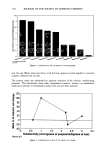
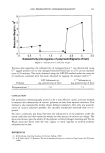
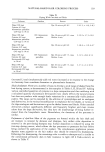
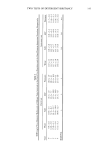
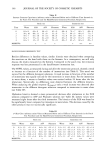
148 JOURNAL OF THE SOCIETY OF COSMETIC CHEMISTS These parameters indicate a strongly perturbed stratum corneum barrier function and a severe erythema after the patch test procedure. A milder irritation occurred after patch testing with the other two surfactants, making the discrimination between the two milder surfactants less obvious. The hand/forearm immersion test did not reveal such a clear discrimination between the harsh and milder substances. Although only a few significant differences were detected in the hand/forearm immersion protocol, we found a trend towards the same rank order of irritation potential as obtained under the patch test conditions (except for the a* color value). The obtained rank order in both test procedures remains consistent with the literature: mildness properties of anionic detergents increase as a function of the number of ethoxylations, and nonionic surfactants are less irritating compared to ionic ones (16-17). When estimating the relation between the patch test and the hand/forearm immersion procedure, a moderate-to-good correlation is detected between the protocols. The latter is an important factor since it demonstrates that the results obtained under laboratory conditions may be predictive for more realistic conditions of daily use. However, due to the weak differences between the tested products obtained in the immersion protocol, the above relation should be interpreted with some caution. The results of others did not lead to such a strong relation between the different tests (7). We argue that wash tests and the chamber test measure different aspects of skin barrier function. Indeed, under patch test conditions we can expect a much weaker barrier function (see above) as compared to wash test conditions. In agreement with other results, TEWL was found to be the most sensitive parameter for the evaluation of an irritation status of the skin (3). Nevertheless, stratum corneum hydration values and skin color can give additional information, and they proved to be discriminating enough in the patch test protocol. Besides a discriminating function, the different parameters can help equally in the unraveling of the mechanisms inducing the irritation (18). For example, the kinetics of the hydration values indicate that dehydra- tion is more pronounced at the end of the experiment when the barrier function and skin redness are already recovering from the insult. These findings may indicate that dehy- dration is caused by the decreased barrier function. In conclusion, we have demonstrated that ionic detergents are more irritating than nonionic detergents, which are known for their mildness properties. The mildness of ionic detergents can be improved by using molecules with more ethoxylations. The instrumental determination of skin properties optimizes the objectivity and reproduc- ibility of both irritation protocols. The patch test protocol resulted in a clear rank order of the irritating potential of the products, while the immersion test was less discrimi- nating due to the very weak skin changes occurring after the different immersions. ACKNOWLEDGMENTS The authors wish to thank Dr. H. Tesmann, Henkel, Germany, and Mrs. V. Lismont, Henkel, Belgium for providing the different test solutions. REFERENCES (1) D. A. W. Bucks, H. I. Maibach, R. H. Guy, "Occlusion Does Not Uniformly Enhance Penetration In

TWO TESTS OF DETERGENT IRRITANCY 149 (2) (3) (4) (5) (6) (7) (8) (9) (10) (11) (12) (13) (14) (15) (16) (17) (18) Vivo," in Percutaneous Absorption. Mechanisms-Methodology-Drug Delivery, 2nd ed., R. L. Bronaugh and H. I. Maibach, Eds. (Marcel Dekker, Inc., New York and Basel, 1989), pp. 77-94. M. Paye, B. M. Morrison, and K. P. Wilhelm, Skin irritancy classification of body cleansing products. Comparison of two test methodologies, Skin Res. Technol. 1, 30-35 (1995). T. Agner and J. Serup, Sodium lauryl sulphate for irritant patch testing--A dose-response study using bioengineering methods for determination of skin irritation, J. Invest. Dermatol., 95,543-547 (1990). S. Freemann and H. I. Maibach, Study of irritant contact dermatitis produced by repeat patch test with sodium lauryl sulfate and assessed by visual methods, transepidermal water loss, and laser Doppler velocimetry,J. Am. Acad• Dermatol., 19, 496-502 (1988). C. F. Allenby, D. A. Basketter, A. Dickens, E. G. Barnes, and H. C. Brough, An arm immersion model of compromised skin. I. Influence of irritation reactions, Contact Dermatitis, 28, 84-88 (1993). P. Clarys, I. Manou, and A. O. Barel, Influence of the solution temperature on the irritation in the hand/forearm immersion test, Contact Dermatitis (accepted for publication). A. Hannuksela and M. Hannuksela, Irritant effects of a detergent in wash and chamber tests, Contact Dermatitis, 32, 163-166 (1995). F. Goffin, M. Paye, and G. E. Pi•rard, Comparison of in vitro predictive tests for irritation induced by anionic surfactants, Contact Dermatitis, 33, 38-41 (1995). F. A. Simion, L. D. Rhein, G. L. Grove, J. M. Wojtkowski, R. H. Cagan, and D. D. Scala, Sequential order of skin responses to surfactants during a soap chamber test, Contact Dermatitis, 25, 242-249 (1995). F. Panisset, P. Treffel, B. Faivre, P. B. Lecomte, and P. Agache, Transepidermal water loss related to volar forearm sites in humans, Acta Derm. Venereol. (Stockh.), 72, 4-5 (1992). J. Pinnagoda, R. A. Tupker, T. Agner, and J. Serup, Guidelines for transepidermal water loss (TEWL) measurement, Contact Dermatitis, 22, 164-178 (1990). A. O. Barel and P. Clarys, "Measurement of Epidermal Capacitance," in In Vivo Examination of the Skin: A Handbook of Non-Invasive Methods, J. Serup and G. Jemec, Eds. (CRC Press, Boca Raton, FL, 1995), pp. 165-170. S. W. Babulak, L. D. Rhein, D. D. Scala, F. A. Simion, and G. L. Grove, Quantification of erythema in a soap chamber test using the Minolta Chroma (Reflectance) Meter: Comparison of instrumental results with visual assessments, J. Soc. Cosmet. Chem., 37, 475-479 (1986). A. Emilson, M. Lindberg, and B. Forslind, The temperature effect on in vitro penetration of sodium lauryl sulfate and nickel chloride through human skin, Acta Derm. Venereol. (Stockh.), 73, 203-207 (1993). C.L. Froebe, F.A. Simion, L.D. Rhein, R. H. Cagan, and A. Kligman, Stratum corneum lipid removal by surfactants: Relation to in vivo irritation. Dermatologica, 181, 277-283 (1990). M. Rieger, Surfactant interactions with skin. Cosmet. Toiletr., 110, 31-50 (1995). I. Effendy and H. I. Maibach, Surfactants and experimental irritant contact dermatitis, Contact Der- matitis, 33, 217-225 (1995). E. Berardesca and H. I. Maibach, Bioengineering and the patch test, Contact Dermatitis, 18, 3-9 (1988).
Purchased for the exclusive use of nofirst nolast (unknown)
From: SCC Media Library & Resource Center (library.scconline.org)