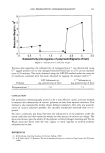
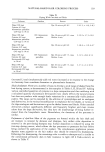
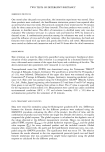
GEL PERMEATION CHROMATOGRAPHY 131 0 3.5 0.5 1 1.5 2 2.5 3 Substantivity (micrograms of polymer/milligrams of hair) Figure 3. Substantivity vs molecular weight. Previous data regarding the substantivity of polyquaternium 7 was determined using C TM tagged polymer (2) on very damaged bleached blond hair at 22øC and an exposure time of 30 minutes. The result obtained using the GPC/RI method under the same set of conditions correlated with the result obtained by tagging the polymer with C•4: GPC Substantivity C TM Substantivity Polymer (pg polymer/mg of hair) (pg polymer/mg of hair) Polyquaternium 7 7.0 7.1 CONCLUSION Gel permeation chromatography proved to be a very effective, quick, and easy method to measure the substantivity of cationic polymers on hair from aqueous solutions. This method is also reproducible within closely defined parameters. Not only was quantifi- cation of cationic polymers possible, but specially synthesized materials were not re- quired. No direct correlation was found between the substantivity of the polymers under the tested conditions and their molecular weight or mole percent of cationic net charge. The latter two factors, plus the ability of the polymer to form hydrogen bonding and Van de Waals attraction forces with the hair, appear to work together to provide polymer substantivity on hair. REFERENCES (1) M. Hamburg, Statistical Analysis for Decision Making, 1983. (2) A. R. Sykes and P. A. Hammes, The use ofmerquat polymers in cosmetics, Drug Cosmet. Ind. (February 1980).

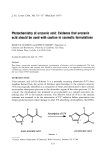
j. Soc. Cosmet. Chem., 48, 133-140 (May/June 1997) A novel natural-based hair coloring process K. C. BROWN, E. MARLOWE, G. PROTA and G. WENKE, Research and Development Laboratories, Clairol Inc., 2 Blachley Road, Stamford, CT 06922 (K.C.B., E.M., G.W.), and Department of Organic and Biological Chemistry, University of Naples, Naples, Italy (G. P.) Accepted for publication July 31, 1997. Presented in part at the 5th World Congress of the International Society of Cosmetic Dermatology, Montecatini, Italy, October 26-29, 1995. Synopsis In an attempt to develop hair dye products that give more natural-looking colors, some of the basic steps from the natural biosynthetic pathway to melanin have been imitated chemically. Our hair coloring process starts with 3,4-dihydroxyphenylalanine (dopa). By careful selection of oxidant and oxidation conditions, dopa is converted on hair to 5,6-dihydroxyindole in high yield. This indole has been known for many years to be the immediate precursor to the black eumelanins, and it can be readily polymerized in situ to dye the hair an intense black color. Additionally, the natural process produces the red and yellow pheomelanins by incorporating sulfur-containing nucleophiles such as cysteine into the melanogenic process. We have also found that significant color changes can be produced by adding a variety of nucleophiles to the system, including cysteine and other thiols. By these means, a wide range of shades can be produced on hair under conditions acceptable to the user of the hair dye. Performance of the dyed hair appears to be comparable to that of current permanent dyes and is clearly superior in both application technique and performance to the alternative natural dye products available today. INTRODUCTION Until this century, alteration of the coloration of hair and skin for cosmetic purposes could only be achieved by the use of various types of naturally available materials. Frequently the color change required long processing times and stringent conditions, especially when lightening was desired, and the results were variable and usually not predictable. The discovery of synthetic dyes simplified the processing steps necessary for dyeing hair and gave much more reliable and versatile results, so that today, natural dye products account for an infinitesmally small fraction of hair dye sales. Even so, there is a growing trend towards the use of natural materials, despite the fact that most of the available natural dye products still rely on centuries-old technology along with its problems and inconveniences. The products are supplied as powders that require soaking in hot water to extract the active dye components. Since the dye content is generally low, 133
Purchased for the exclusive use of nofirst nolast (unknown)
From: SCC Media Library & Resource Center (library.scconline.org)