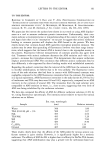
LETTERS TO THE EDITOR 161 TO THE EDITOR: RESPONSE TO COMMENTS BY S. BALL AND Y. APPA (NEUTROGENA CORPORATION) ON "INTERACTIONS OF CLEANSING BARS WITH STRATUM CORNEUM PROTEINS: AN IN VIT•?O FLUO- RESCENCE SPECTROSCOPIC STUDY" (S. MUKHERJEE, M. MARGOSIAK, K. ANANTHAPADMA- NABHAN, K. Yu, AND M. ARONSON, J. Soc. COSRIET. CHERL, 46, 301-320, 1995). We appreciate the interest the authors have shown in our work on using ANS displace- ment as a tool to measure surfactant-protein interactions. Unfortunately, their com- ments indicate a misinterpretation or misunderstanding of the content of our paper. Ball and Appa claim that it is an "assumption" on our part to suggest that anionic surfactant binding to corneum proteins will displace the ANS bound to the protein. We have clearly shown that corneum-bound ANS quenches tryptophan (protein) emission. The authors may be aware that quenching of fluorescence involves very short range interac- tions, which suggests that the bound ANS is located close to the tryptophan moiety in the protein. Fluorescence lifetime measurements of corncure proteins also agree with this. Treatment with anionic surfactant decreases the ANS emission and--this is im- portant-increases the tryptophan emission. This demonstrates that anionic surfactants displace protein-bound ANS. The conclusion that different anionic surfactants bind to skin differently is also supported by direct binding results with radiolabeled materials. Regarding the authors' contention that the removal of the ANS from the corneum is due to miceliar solubilization, we believe that to be very unlikely. The fluorescence inten- sities of the soak solutions that had been in contact with ANS-treated corneum were negligible compared to the ANS fluorescence intensities from the corneum. For example, in a typical experiment, ANS fluorescence intensities in the soak slurries (0.25% by wt.) of isethionate and TEA soap bars were 0.8 and 0.83, respectively, compared to an ANS intensity in the corneum of around 400. The intensities from the soak solution were comparable to ANS emission in water, i.e., close to zero, suggesting that very little of ANS was being solubilized by the surfactant solutions. We have also compared the affinity of ANS for different surfactant solutions (1.0% by wt.) using fluorescence spectroscopy. The intensity ratios (relative to water) for various solutions are as follows: Em. max. wavelength Sample (nm) Relative intensity Water 500 1.00 TEA (0.04 M pH = 9.6 500 1.07 NaL 495 4.64 TEA/NaL 495 5.26 SLS 495 5.84 SLI 485 8.5O C12(EO) 6 475 124 Octanol 465 438 These results clearly show that the affinity of the ANS probe for various anionic sur- factant systems is quite similar. However, it is significantly higher for a nonionic surfactant. The affinity of ANS for SLI is higher than its affinity for Na/Na-TEA laurate, suggesting that ANS solubilization may play a greater role for isethionate-based sur-

162 JOURNAL OF THE SOCIETY OF COSMETIC CHEMISTS factant systems. The results also suggest that the binding of isethionate surfactants with corneum proteins is even weaker than what was reported in our paper. However, as we have shown, compared to the displacement mechanism, the miceliar solubilization ef- fects play only a minimal role in ANS removal from the corneum by anionic surfactants. It is true that we have used TEA-Na laurate with 0.04 mole/1 of TEA in the system instead of pure TEA-laurate. The ANS displacement experiments and the surfactant binding experiments were carried out under identical conditions with TEA-Na laurate rather than pure TEA laurate. Thus, the comparisons in the paper are valid. Since TEA is present in significant amounts in these systems, we believe that the results are not likely to be very different from that of a pure TEA-laurate system. We are puzzled by the authors' comment on the effect of pH and their attempt to reanalyze our water treatment data using data from two different experiments. Note that while results for substrates such as skin or stratum corneum are self-consistent within a particular series, experiments carried out at different times with different samples may not agree with respect to absolute numbers. The trends that one can see will, however, be consistent. It is, therefore, not valid for the authors to pick and choose data from experiments done at two different times with corneum from two different skin sources for absolute values. We expect that the authors are well aware of the significant vari- ability that exists in different skin samples. We wish that it were not so, but unfortu- nately such variability is a fact of life. In all our comparisons we used the corneum or skin from the same donor. The enhanced removal by TEA-laurate was greater than what could be explained by pH effect alone. However, it is possible that the higher pH of the TEA bar by itself may also be detrimental to skin condition. It is interesting to note that the authors did not choose to mention the Zein dissolution results (Table III in our paper), which clearly indicate that TEA-laurate interacts much more strongly with proteins than does SLI. The authors' comment on our explanation of the mechanism of ANS binding to corneum protein and its displacement by anionic surfactant also reveals a lack of understanding of ligand-protein interaction. We did not say that electrostatic interactions were not important. We said that the hydrophobic interactions can overcome electrostatic repul- sions. Regarding the question of statistical analysis of the data, we did show the standard error for each set of data. In fact, the differences between TEA-laurate and SLI, and TEA- laurate-based soap and the SLI-based bar were significant, with a greater than 95% confidence (p 0.05) limit. We did not selectively disclose data and we are prepared to defend all our conclusions. It seems to us that there is a basic confusion in the authors' minds between deposition on skin and binding to corneum proteins. The focus of our work was to measure surfactant binding to protein and not deposition per se. Using three different techniques (fluorescence, direct corneum binding, and Zein dissolution), we showed that TEA- laurate binds more to proteins than does SLI. The authors have not provided any evidence that suggests otherwise. It is possible that washing with a TEA-laurate cleans- ing bar causes less overall deposition on the skin than washing with an isethionate bar, although the original study [Wortzman et al. inJ. Soc. Cosmet. Chem., 37, 89-97, (1986)] demonstrating that by means of a fluorescein probe was faulty. The latter aspect is discussed in a forthcoming paper in J. Soc. Cosmet. Chem. In any case, it is quite mis-
Purchased for the exclusive use of nofirst nolast (unknown)
From: SCC Media Library & Resource Center (library.scconline.org)