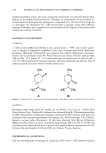
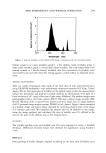
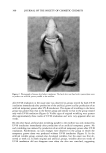
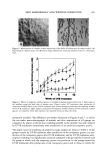
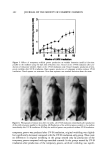
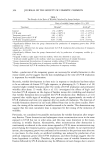
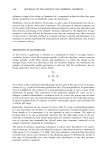
278 JOURNAL OF THE SOCIETY OF COSMETIC CHEMISTS linalool and linalyl acetate, the main constituents of lavender oil, penetrate human skin, leading to detectable blood levels (10). Therefore, in continuation of our research ac- tivities about the biological fate of fragrance compounds (11), the aim of this study was to investigate the absorption of (-)-(R)-carvone from a massage, using three different massage techniques, and to quantify the concentration of this fragrant in the plasma after ending the cosmetic treatment. MATERIALS AND METHODS CHEMICALS (-)-(R)-carvone (p-Mentha-6,8-dien-2-one optical purity 99%) and racemic piperi- tone (1-methyl-4-isopropyl-l-cylohexen-3-one) were obtained from Roth (Karlsruhe, Germany). Methanol (Lichrosolv ©) was obtained from Merck (Darmstadt, Germany). Peanut oil was purchased from W. Pauli (Vienna) and sodium chloride infusion flask 100 ml (Na + 15.4 mmol, C1- 15.4 mmol and aqua ad injectionem ad 100 ml, pH = 5.0-7.0, 308 mosm/1) from Laevosan (Austria). All other chemicals and solvents were of analytical grade and used without further purification. CH3 CH3 I o , H2C•CH3 3H 3 A i:1 Figure 1. Structures of (-)-carvone and racemic piperitone. The chiral center is marked with an asterisk. MATERIALS Breathing masks (large adult face masks, cat. no. 01065, size 6, lot no. 1362H6 from King Systems Corp., Noblesville, Indiana) were obtained from B + P Beatmungsprodukte GmbH, Neunkirchen, Seelscheid, Germany). Isolute-C18 (EC) columns (100 mg) were purchased from International Sotbent Technology Ltd., Mid Glamorgan, UK. Lithium- heparine vacuum tubes (Vacutainer, 10 ml) were obtained from Becton Dickinson, Meyland Cedex, France, and the irradiation lamp Osram HX 16 (220 V, 60 W) was purchased from Osram fitted with a special filter (golden amber, transmission of 43% between the wavelengths of 620 and 660 nm Osram, Vienna, Austria). EXPERIMENTAL CONDITIONS One and one-half gram of massage oil containing 20% (w:w) (-)-(R)-carvone in peanut

ABSORPTION OF CARVONE 279 oil was spread on a defined skin area of the lower abdomen (376 cm 2) of a female subject (body weight 56 kg, height 165 cm, age 25 years, non-smoker). Starting a week prior to the massage, all food and cosmetics containing carvone were avoided. The subject put on a breathing mask before the massage to avoid a possible uptake of the fragrance compound by inhalation. To study the penetration of carvone, the following three different massage techniques were used. Each experiment was repeated three times. Normal massage. For ten minutes the oil was gently massaged into the skin, and the remaining oil was completely removed. Blood samples (5.0 ml) were drawn from the left cubital vein 0, 5, 10, 15, 20, 25, 30, 40, 55, 70, 85, and 100 minutes after finishing the massage and collected in heparinized tubes. Blood samples were centrifuged at 4øC (4500 rpm/5 min) and the plasma separated and stored at 4øC until chromatographic and spectroscopic investigations. Between the blood drawings a physiological sodium chloride solution was injected into the veinflow to prevent clogging of the needle. As previous experiments showed that terpenes might accumulate in body fat, only one massage per week was applied to the female subject. Massage with an occlusion wrap. The massage oil was gently massaged into the skin for one minute. Then a plastic film (0.5 x 1 m) was tightly wrapped around the body to cover the massaged skin area. Finally, after putting a hot poultice on the lower abdomen, the area was covered with a thick woollen blanket. After 20 minutes this occlusive wrap was removed and the remaining oil was washed off. Time intervals for blood drawing were the same as described above. Irradiation massage. After spreading the massage oil for one minute over the above- defined skin area, the stomach was irradiated with an orange light for 20 minutes. Then the oily residue was removed and blood drawing was continued as described. Cosmeti- cians frequently apply this method in the treatment of wrinkles and for relaxation (12). Orange light is recommended to raise the skin temperature in order to increase the absorption of different compounds (e.g., terpenes), although no evidence for this specific application exists in the literature. EXTRACTIONS After adding piperitone as the internal standard (200 ng/ml) 2 ml of plasma was extracted by using solid-phase extraction cartridges, equilibrated with 3 ml of methanol and 3 ml of water. The cartridges were washed with 2 ml of water and (-)-carvone, and the internal standard was eluted with 0.5 ml of methanol (recovery: 94.3 _+ 2.17%). Extracted plasma samples were immediately analyzed by gas chromatography (GC) and by gas chromatography coupled with mass spectroscopy (GC/MS). All steps of the sample preparations were done on ice or in a cold room to prevent loss of the volatile compounds. GC-ANALYSIS OF CARVONE An HRGC Mega 2 Series instrument with a flame ionization detector (FID) was used (Fisons Instruments S.p.A., Rodano, Italy). Separation of carvone from piperitone was performed on a 10 m x 0.25 mm Permabond SE-30-DF-0.25 fused silica column (Machery & Nagel, Germany), operated with an oven temperature of 65øC. The carrier
Purchased for the exclusive use of nofirst nolast (unknown)
From: SCC Media Library & Resource Center (library.scconline.org)