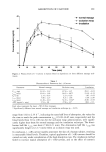
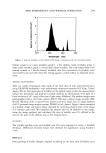
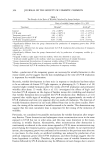
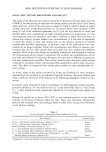
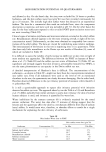
280 JOURNAL OF THE SOCIETY OF COSMETIC CHEMISTS gas was nitrogen (75 kPa) and that for the FID was hydrogen (60 kPa air: 80 kPa make-up gas: 70 kPa). Samples were introduced onto the column by split injection (split ratio = 1:10) whereby the injector temperature was set at 260øC and the detector temperature at 220øC, respectively. The injection volume was 1.5 tal. The limit of quantitation was 5 + 1.23 ng/ml (n = 5) of plasma by spiking drug-free human plasma with carvone to give a concentration of 5 ng/ml. GC/MS ANALYSIS For GC/MS analyses, a QP-1000EX-GC/MS-system (Shimadzu, Kyoto, Japan) was used. The GC-column was a 50 m x 0.25 mm i.d. capillary with a 0.25-mm film thickness (Machery & Nagel, Germany), operated at a temperature program of 60øC for two minutes, and then increased at 3øC/min to 250øC. The helium carrier gas flow rate was 1 ml/min. Samples were introduced onto the column by splitless injection (the split was opened 30 s after the injection injection port temperature 250øC. The column effluent was introduced directly into the ion source, which was held at 180øC. Electron impact spectras were introduced at 50-600 amu/2 s, with ionization energy of 70 eV and with a vacuum pressure of 8.10 -6 torr. Chemical ionization spectra were recorded with ammonia as the reactant gas (prepressure 1 bar, vacuum pressure 5.10 5 torr, ionization energy 200 eV, ion source 180øC). KINETIC ANALYSIS OF CARVONE The data sets were fitted via nonlinear iterative least square regression analysis. Curve modeling was performed using a two-compartment open pharmacokinetic model with the program MW-Pharm, Version 3.0 (Mediware, Groningen, The Netherlands), in which AUC represents the area under concentration-time curve tl/2tx, tl/2[3, the distri- bution and elimination half-lives, respectively ka, the absorption rate constant t .... the time to peak and c .... the peak concentration. Results were expressed as the mean _+ standard deviation (SD). The significance of differences (p 0.05) was evaluated by the Student's t-test. RESULTS AND DISCUSSION (-)-Carvone was quantified in plasma and urine samples by GC-FID well separated from the internal standard piperitone (t R = 7.65 min and 8.21 min, respectively). To confirm the results of the GC-FID measurements, analyses were carried out by GC/MS with retention time and mass spectra comparison exhibiting identical main fragments for carvone (m/z at 82 amu, 93 amu, 108 amu, and 150 amu) and for piperitone (82 amu, 110 amu, 137 amu, and 152 amu), respectively. Carvone quickly penetrated the skin of the female subject and could be detected in blood ten minutes after starting the massage, with peak plasma concentrations of 24-32 ng/ml. The resulting mean plasma levels of (-)-(R)-carvone are shown in Figure 2 the corresponding pharmacokinetic parameters from the fitted curves are summarized in Table I. Dependent on the massage technique, some pharmacokinetic parameters sig- nificantly changed. While the values for the absorption rate constant k a were in a close

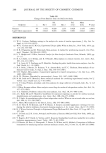
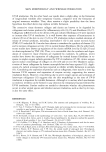
ABSORPTION OF CARVONE 281 40- 30- 10- O: -a- normal masage • ß occlusion wrap ' _ , o Time (min) Figure 2. Plasma levels of (-)-carvone in human blood in dependence on three different massage tech- niques. Table I Pharmacokinetic Parameters for (-)-Carvone Parameter Normal massage Occlusion wrap Irradiation C•,a• (ng) 23.92 + 2.32 32.56 + 3.35 28.31 + 4.01 tma x (min) 25.81 + 3.05 36.65 + 4.87* 23.49 + 4.35 ka (l/h) 2.34 + 0.53 2.23 + 0.29 1.82 + 0.22 t•/2,• (min) 7.80 + 2.27 9.21 _+ 1.96 6.69 + 2.87 t•/2• (min) 33.49 + 6.10 74.45 + 15.62' 26.81 + 4.93 AUC (ng/ml x min) 1713 + 28 2746 + 33* 1843 + 113 Each value represents the mean _+ SD of three massages. * Significantly different from normal massage and irradiation technique (p 0.05). range from 1.82 to 2.34 h -1, indicating the same half lives of absorption, the values for the time to reach the peak concentration tma x (23.49--36.65 min, respectively) and the blood levels from 30 to 100 min for the occlusion wrap administration, were signifi- cantly higher than those for normal massage and the irradiation technique. The distri- bution half-life tl/2• was short (7.80-9.21 min). The elimination half life tl/2[ 3 was significantly longer (2.2-2.7 times) when an occlusion wrap was used. In conclusion, (-)-(R)-carvone rapidly penetrates the skin of a human subject, resulting in measurable blood levels. Therefore, topical application of (-)-(R)-carvone should be carried out only under consideration of the high absorption rate. The irradiation method failed to increase topical absorption of (-)-(R)-carvone, and so the effect of cosmetic
Purchased for the exclusive use of nofirst nolast (unknown)
From: SCC Media Library & Resource Center (library.scconline.org)