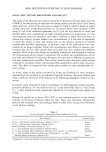
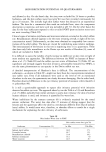
SKIN IRRITATION POTENTIAL OF QUATERNARIES 315 skin, while removal of the offending substance may reduce potential irritancy to neg- ligible. Even prolonged contact of a surfactant with the skin might not elicit irritancy effects adverse reactions might depend on permeation to lower strata of the skin. For example, an oil-soluble surfactant may exhibit adverse effects that depend on the stratum corneum lipid levels. A surfactant that can blend into or mix with barrier lipids might have long-term effects on the barrier competency of the skin. Penetration into or through skin is a function of the surfactant's molecular weight and shape. Unless the stratum corneum is damaged prior to or during the surfactant's application, high-molecular-weight compounds should remain on the surface. Blends of surfactants exhibit features that might differ radically from the effects of the individual components. Formulators must proceed cautiously in the blending of surfac- tants since the results might be unpredictable and might depend on the formation of mixed miceliar species. In light of older as well as more recent data, the irritancy of diverse types of surfactants on intact human skin should not be judged on the basis of their ionization. Other characteristics and usage are likely to exert a far greater impact: Lower skin irritancy Higher skin irritancy High molecular weight Water solubility Rinse-off product Little or no skin permeation Low molecular weight Lipid solubility Leave-on product High skin permeation Rational analysis, based on some of the above concepts, suggests that the water-insoluble stearalkonium chloride, e.g., left on the skin is less likely to cause irritation than the lipid-soluble (and penetration-enhancing) laureth-4. The mechanisms of skin irritancy manifestations such as scaling and tautness remain obscure. The literature includes many suggestions for explaining skin irritancy after (repeated) mild exposure to dilute surfactant solutions. Particularly noteworthy are the reviews by Rhein (17), Imokawa (18), Abraham (19), and Rawlings et aL (20). Despite much effort, no definitive evidence has been published that can explain the phenomena of skin irritancy by surfactant exposure. Any attempt to explain the phenomena caused by different surfactants by a single mechanism is likely to fail. Instead, it is more likely that irritant responses in skin can be caused by several mechanisms, either alone or in concert, and might depend on the nature of the surfactant. CONCLUSIONS 1. Skin irritancy by surfactants is related to the fate of the topically applied substance. Permeation into the epidermis is a primary requisite. Permeation through the epi- dermis is likely to elicit toxic responses, especially in the case of quaternaries. Photodecomposition of surfactants remaining on the skin might cause responses that cannot be assessed by patch testing (21). The chemical structures of quaternaries and their general stability make them useful in cosmetic products. 2. The tendency of quaternaries to bond to negatively charged sites blocks their ten-

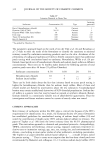
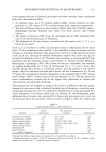
316 JOURNAL OF THE SOCIETY OF COSMETIC CHEMISTS dency to permeate unless high concentrations are employed. 3. Formulators should not reject the use of quaternaries in hair or skin care products because of earlier and probably unjustified generalizations about irritancy. 4. It must be recognized that the proof of non-irritancy and safety of every surfactant- containing product must be assessed before marketing. APPENDIX • "MR. LATVEN: We have investigated between 45 and 50 surface-active agents fol- lowing instillation in the eye and found essentially the same result. However, we have got to add one thing, namely, that the nonionics can be just as irritating as the cationics in specific instances, as you have already pointed out. The incidence, however, is less. We find around 25 per cent of all nonionics are irritating in consideration of corneal opacity and around 62 per cent of anionics fall into the opaci- fication class, where it is 100 per cent with the cationics. As you have also pointed out, the important question is whether or not the final formulas produce corneal opacity. That raises a very important question, namely: When one investigates a final formulation and obtains results such as that, only one out of nine or ten animals shows opacification. How can one interpret it? I must admit complete ignorance. DR. DRAIZE: Occasionally one serious reaction only is obtained in a group of test subjects. Such a single reaction is deemed significant, since in the general population an occasional sensitive individual may be encountered, and from a standpoint of overall safety such an individual may not be overlooked. MR. LATVEN: I wonder if I could ask another question on your interpretation, namely, the insidious character of a number of these surface-active agents is the fact that they don't produce pain on instillation .... " REFERENCES (1) J. H. Draize, in Appraisal of the Saj•ty of Chemicals in Foods, Drags, and Cosmetics (Assoc. Food Drug Officials, U.S., Topeka, Kansas, 1959). (2) H. P. Drobeck, "Current Topics on the Toxicity of Cationic Surfactants," in Cationic S•factants, J. Cross and E.J. Singer, Eds. (Marcel Dekker, New York, 1994). (3) R.A. Cutler and H.P. Drobeck, "Toxicology of Cationic Surfactants," in Cationic S•rfactants, E. Jungermann, Ed. (Marcel Dekker, New York, 1970). (4) J. H. Draize and E. A. Kelley, Toxicity to eye mucosa of certain cosmetic preparations containing surface-active agents, Proc. Sci. Sect. Toilet Goods Assoc., 17, 1-4 (1952). (5) L. W. Hazelton, Relation of surface active properties to irritation of the rabbit eye, Proc. Sci. Sec. Toilet Goods Assoc., 17, 5-9 (1952). (6) P. C. M. Van der Valk, J.P. Nater, and E. Bleumink, Skin irritancy of surfactants as assessed by water vapor loss measurement,J. Invest. Dermatol., 82, 291-293 (1984). (7) E. Berardesca, D. Fideli, P. Gabba, G. Rabbiosi, and H.I. Maibach, Ranking of surfactant skin * Discussion after the Draize and Kelley presentation (4). From page 4 of the Proceedings of the Sdentific Section of the Toilet Goods Association, 17, May 1952.
Purchased for the exclusive use of nofirst nolast (unknown)
From: SCC Media Library & Resource Center (library.scconline.org)