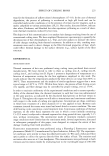
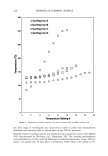
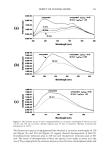
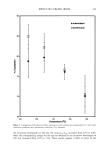
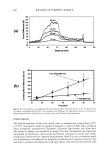
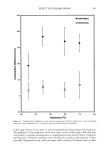
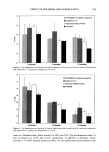
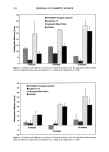
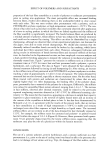
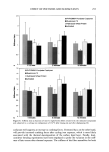
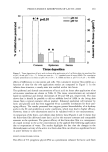
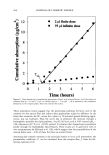
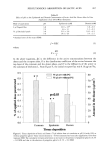
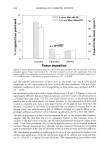
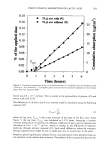
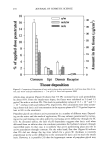
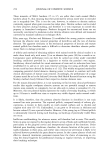
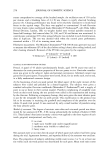
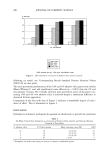
264 JOURNAL OF COSMETIC SCIENCE 0.9 0.3- 0.0 i i pH 3.8 • pH 7.0 Corneum Epidermis Dermis Tissue deposition diff. not sig. p=0.12 - 120 - 100 - 80 • - 60 ,• - 40 • - 20 0 Figure 3. Tissue deposition of lactic acid six hours after application of a 75-pl o/w infinite-dose emulsion at pH 3.8 (n = 6) and pH 7.0 (n = 7). Error bars represent SEM. The cumulative receptor penetration at six hours at pH 3.8 is 0.01% +_ 0.01 SEM and that at pH 7.0 is 0.01% + 0.0 SEM. oil-in-water emulsions was investigated. The low concentration of propylene glycol used in this study is typical of PG levels in cosmetic products containing tx-hydroxy acids. The tissue concentrations for infinite-dose and topical film are shown in Figures 6 and 7, respectively. The time dependency of the transdermal penetration of lactic acid in the infinite-dose situation, assessed by the cumulative absorption in the receptor phase, is shown in Figure 8. Propylene glycol is more efficacious in the infinite-dose situation. It significantly en- hances the active level in the tissue fractions (Figure 6) as well as in the receptor fluid (Figure 8). This is expected, as the penetration enhancement effect is related to the amount of loading of the enhancer. However, significant enhancement of lactic acid delivery to viable epidermis was observed even for consumer-relevant topical-film ap- plication (Figure 7). It remains to be seen whether such enhancement could be correlated with the greater anti-aging efficacy of the formulation. EFFECT OF PRODUCT STRUCTURE The in vitro percutaneous absorption of lactic acid from the o/w, w/o, and w/o/w emul- sions was determined using topical application of 2-pl product film. The amounts in

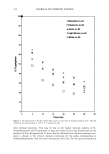
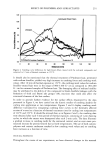
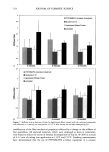
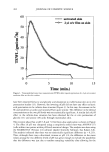
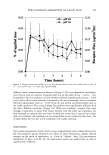
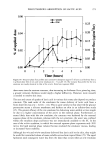
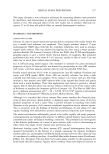
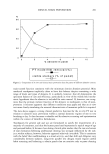
PERCUTANEOUS ABSORPTION OF LACTIC ACID 265 0.05 0.04 0.03 0.02 O.Ol 0.00 -- pH 3.8 -- pH 7.0 0 1 2 3 4 5 6 0.25 - 0.20 - 0.15 - 0.10 - 0.05 0.00 Time (hours) Figure 4. Receptor phase flux profiles of lactic acid delivered from a 2-1al o/w emulsion film at pH 3.8 (n = 6) and pH 7.0 (n = 7). Error bars represent SEM. different tissue compartments are shown in Figure 9. The total deposition and absorp- tion of lactic acid as a percent of applied dose was in the order of o/w w/o/w w/o. Compared to the w/o emulsion, the o/w emulsion delivered significantly more (p 0.05) lactic acid to all the tissue fractions. Compared to the w/o/w emulsion, the o/w emulsion delivered significantly more (p 0.02) to the SC and dermis and directionally more to the viable epidermis. The receptor-phase flux profiles were significantly different with the three different emulsions (Figure 10). With o/w emulsion, receptor flux went through a maximum in about three hours, whereas with the other two emulsions, the flux increased to a plateau after one hour. It should be noted that in most of our studies with o/w emulsion, the maximum in the receptor flux occurs within the first hour. The receptor fluxes for w/o and w/o/w emulsions were nearly identical. DISCUSSION Percutaneous absorption of lactic acid to tissue compartments can be enhanced by acidic pH and propylene glycol. However, the effects of these formulation changes depend strongly on the mode of application, i.e., finite or "infinite" dose. The percutaneous absorptions of lactic acid for the two application modes are qualitatively as well as quantitatively different.
Purchased for the exclusive use of nofirst nolast (unknown)
From: SCC Media Library & Resource Center (library.scconline.org)