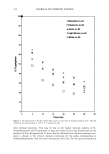
j. Cosmet. sci., 49, 275-283 (July/August 1998) Dental stain prevention by abrasive toothpastes: A new in vitro test and its correlation with clinical observations P. L. DAWSON, J. E. WALSH, T. MORRISON, and J. GRIGOR, Unilever Dental Research, Quarry Road East, Bebington, Wirral L63 3JW, United Kingdom. Accepted for publication July 15, 1998. Synopsis A new in vitro test based on the removal of a model film from polished hydroxyapatite discs has been developed to predict more precisely the stain prevention properties of toothpastes in vivo. It is argued that dental stain prevention, as opposed to removal, is the predominant function provided by abrasive pastes suitable for unrestricted home use. It is necessary, therefore, to focus on abrasive systems capable of efficient removal of the relatively soft and invisible up-to-24-hour-old salivary pellicle formed between brushings, rather than on hamer visible mature stain. A cleaning model of this film has therefore been developed. The abrasive effect on the model film of a typical silica xerogel has been examined, and the data compared with clinical observation of stain build-up. A good correlation was apparent. Stain prevention increased dramati- cally from zero to 4% w/w silica, after which higher levels had little or no beneficial effect, despite a continuing increase in potential dentine damage. INTRODUCTION It is well known (1) that the chemical nature of many of the foods and beverages that we consume can create a hostile environment in the mouth unless some form of regular cleaning, beyond that of natural salivary irrigation, is practiced. Acids and sugars, via bacterial plaque growth, promote physiological damage to teeth and gums in addition to tainting the breath, and residual colored compounds will cause unsightly discolor- ation of the tooth surfaces (2). These effects can be mitigated to a large extent via daily brushing with a dentifrice (3). The rapid removal of plaque and food residues during brushing is believed to be predominantly a mechanical bristle function, and thus related mainly to brush design and operator skill (4). The control of dental stain, however, requires, in addition, the presence of an abrasive agent (5). Since Roman times a wide variety of finely ground minerals have been essential ingredients of tooth-cleaning preparations (6). Today, finely divided amorphous silicas (SiO2), precipitated chalks (CaCO3), and calcium phosphates (e.g., dicalcium phosphate dihydrate) are normally used in toothpastes (7). 275

276 JOURNAL OF COSMETIC SCIENCE These minerals, of Moh's hardness 2.5 to 3.5, are softer than tooth enamel (Moh's hardness about 5), thus ensuring that their potential for serious tooth wear in extended use is acceptably low. This is not the case, however, in relation to dentine surfaces commonly exposed when gum recession has taken place. Dentine surfaces can be eroded by these abrasives during brushing, and therefore it is very important to control this property in formulated toothpastes. Products designed for unrestricted home use are necessarily constrained to moderate-to-low dentine abrasion rates defined and measured currently by standard radiotracer techniques (8,9). Fifty years ago, Kitchen and Robinson (5) established the strong positive correlation between the abrasive stain removal properties of dentifrices and the rate of dentine abrasion. The apparent similarity in the mechanical properties of dentine and mature stained pellicle has therefore made it difficult to dissociate dentifrice abrasive perfor- mance from its damage potential. A widely used method of obtaining subjects with stained teeth for clinical studies is to make them brush only with water (5) or an abrasive-free paste (10) for a month or so. Comparative paste performance tests can then be carried out either under controlled brushing conditions provided by a hygienist or within the panelist's own regime. Satisfactory clinical methods for visual assessment of stain and its reduction have been established (11), and an in vitro stain removal screening test using artificially stained bovine teeth has been devised by Stookey et al. (12). This widely recognized method for comparing potential dental abrasive cleaning power is claimed to correlate well with clinical observations of mature stain removal. Accordingly, the performance of a range of pastes tested for us by the Indiana University Oral Health Research Institute using the Stookey method closely followed their respective dentine abrasion rates. For the reasons discussed above, it is not surprising to find in most clinical performance studies that regular toothpaste abrasive systems are not powerful enough to remove mature stain instantly or completely, but are able only to reduce it somewhat (11,13). Moreover, this test protocol hardly represents the reality of everyday brushing, in which up to 24 hours is insufficient time to acquire any visible deposit under normal condi- tions. It is likely, therefore, that the primary abrasive function in dentifrices is not stain removal but stain prevention. The acquired pellicle, composed mainly of salivary gly- coproteins, is known to form readily on tooth enamel surfaces and to thicken and toughen with time (13-15). Undisturbed, it can grow to 10 microns in thickness and become colored (5) over a period of weeks. However, if the young (up to 24-hour) pellicle is substantially removed during each brushing, no build-up of potentially visible films can occur. Inefficient toothbrushing, for whatever reason, will therefore lead to stain. This usually forms in areas not exposed to the regular abrasive action of foods and toothbrush bristles, particularly in the gingival crevice and interproximal regions of the dentition. Under habitual poor brushing conditions, therefore, the abrasive function of the paste is vir- tually redundant in these areas, and neither stain removal nor prevention is likely to be achieved however powerful the paste abrasive system. In the current absence of safe and effective chemical treatments, persistent stainers have the choice of remaining so, vis- iting the dental hygienist for professional cleaning at regular intervals, or improving their brushing technique.
Purchased for the exclusive use of nofirst nolast (unknown)
From: SCC Media Library & Resource Center (library.scconline.org)