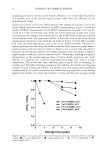
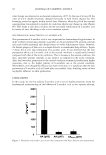
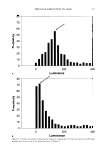
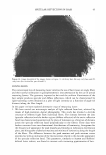
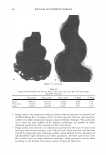
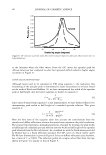
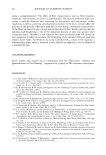
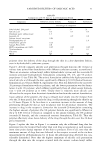
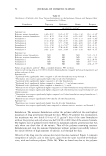
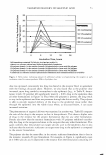
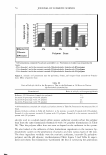
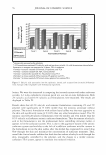
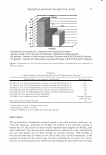
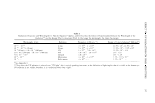
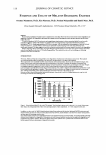
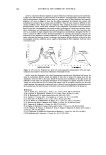
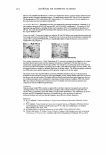
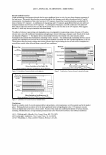
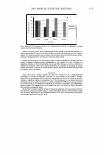
2003 ANNUAL SCIENTIFIC MEETING Results: Deoxyarlmtin was less cytotoxic than hydroquinone by 4 fold on both light and dark human melanocytes (Table 1). Further more deoxyarbutin was as effective as hydroquinone in inhibiting In situ tyrosinase activity of dark human melanocytes at equimolar concentrations (Figure 2). Table I. Concentration (µM) of each test compound that lead to 95% viability of dark and light human melan ocvtes. Compound Dark human melanocytes Light human melanocytes hvdroauinone 0.391 1.5625 deoxvarbutin 1.5625 6.25 4- tertrv butvl phenol 50 50 koiic acid 50 50 arbutin 50 50 Figure 2.Effect of 5 days of treatment with deoxyarbutin and hydroquinone f 1.2 ,_,,__,,_�- -- ··•···dAUeatedcell (Ty..-oalnaae catalytic actlvlty(DPM/1'!1 prtn per control)) on In situ tyrosinase activity of dark human melanocytes. " I 0.6 +--�-�--=-- - i ! 0.4 +- - - - - - - - - 1 0.2 +- - - - - - - - - -- --a--- HQ treated cell (Ty.-oelnaae catalytic actlvlty(DPM/1-19 prtn rcontrol ! 10 Cone (mlcromol■r) 15 Animal study showed that both deoxyarbutin and hydroquinone are able to reverse graft hyperpigmentation (Figure 3). However the mean value for Change in L from the baseline was higher for deoxyarbutin treated group at the 2 weeks treatment point compared to hydroquinone. Brown discoloration of the hair in hydroquinone treated mice was observed. Such brown discoloration was not observed in the deoxyarbutin treated mice. 30.00 25.00 20.00 I 15.00 � 10.00 5.00 0.00 2wks-d0 Change In L value from the ba-llne 4wks-d0 Swks-d0 8wks-d0 ---+- Cont ···•·· HQ --4--dA TSP Figure 3.Time course of change in L value from treatment with Deoxyarbutin, Hydroquinone and 4-TBP Conclusion: The ability of deoxyarbutin to inhibit pigmentation with reduced cytotoxicity relative to hydroquinone establishes deoxyarbutin as an excellent skin depigmentation agent. References: 1. Boissy RE and Nordlund JJ: Biology of Melanocytes, In: Arndt KA, LeBoit PE, Robinson JK, Wintroub BU ( eds): Cutaneous Medicine and Surgery: An Integrated Program in Dermatology. Philadelphia, WB Saunders Co, pp. 1203-1209 (1995) 2. Manning DD, Reed ND, Schaffer CF: Maintenance of skin xenografts of widely divergent phylogenetic origin of congenitally athyrnic (nude) mice. J Exp Med 133: 488-494 (1973) 3. U.S patent no. 6,068,834 (5/30/00) 119

120 JOURNAL OF COSMETIC SCIENCE FRONTIERS OF SCIENCE AWARD LECTURE SPONSORED BY COSMETICS AND TOILETRIES® The Enigma of Beauty Jodi Cobb National Geographic Magazine, Washington, DC What exactly is beauty and why are we so obsessed by it? Evolutionary scientists claim that recognition of beauty is an ancient, innate and universal biological means to ensure the survival of the species. They say beauty is an advertisement for your value as a mate, for the quality of your genes. Not everyone agrees. But we all believe we know it when we see it. Standards of attractiveness are surprisingly universal. All cultures value symmetry, clear skin and thick shiny hair-markers of youth, health and fertility. But that's where the fun begins. From the exorbitant hair and makeup of the Huli wigmen of Papua New to the bizarre tradition of footbinding in China, humans have gone to obsessive, humorous and absurd lengths to achieve beauty, or prolong it or fake it. Or exploit it. Jodi Cobb, a staff photographer at National Geographic for over 20 years who has worked in more than 5 5 countries, will take you on a trip around the world and through the looking glass in search of answers to the enigma of beauty.
Purchased for the exclusive use of nofirst nolast (unknown)
From: SCC Media Library & Resource Center (library.scconline.org)