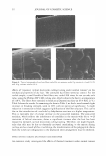
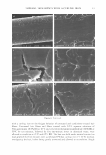
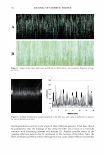
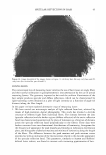
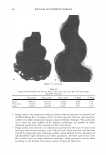
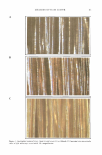
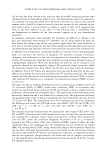
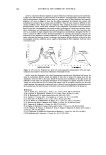
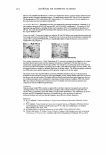
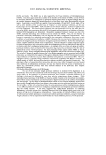
16 JOURNAL OF COSMETIC SCIENCE cuticle cell. There may be some debris on the scale faces and jagged scale edges, which is normal and indicative of chipping damage from standard grooming practices. Twenty hair fibers were prepared for each individual experimental category tested. At least ten of these were examined in the SEM. Damage phenomena or special features observed in more than 7 5 % of the hair specimens of a specific category are described as "typical" or "representative" in this discussion. EFFECTS OF REPEATED, CYCLICAL CURLING/COOLING OF DRY HAIR It should be noted that these fibers had been treated individually in a parallel arrange ment. Individually treated fibers will be much more affected by the hot metal surface than a hair fiber assembly, which tends to absorb and distribute the heat and moderate temperature within the hair strand. Hair fibers exposed to 50, 100, 150, and 200 sequential ten-second-long thermal treatments with the curling iron showed an increase in various types of surface damage as a function of progressive thermal exposure. Even though the level of damage increases with the increasing number of cycles of heating/cooling, the same types of damage phenomena are inherent in all exposed fibers. The thermally-induced damage phenom ena are shown in Figure 2. There is increased matting and compacting of the surface cuticle cell. While radial cuticular cracking is still observed, fine axial cracking of the exposed surface cuticle cell has become a frequent damage phenomenon (Figure 2a-d). Increased levels of fusion of the scale edges are displayed (Figure 2e, f). After 200 thermal curling treatments, fusion of the scale edges has become especially severe, as can be seen in Figure 2f. In extreme cases of fusion, pores or holes are frequently seen in the fused scale edges. These pores may possibly be areas where moisture and heat escaped via the CMC and endocuticle during the dry thermal treatment (Figure 2£). PROLONGED, HIGH-LOAD CURLING OF DRY HAIR Our SEM observations revealed that prolonged (ten-minute) curling of the "dry" hair fibers under O g, 10 g, 20 g, and 30 g of tension resulted in the following types of damage: (a) cuticular compression and moderate disintegration of the cuticula at the fiber/metal interface, (b) fusion at the scale edges, and (c) moderate-to-severe levels of radial cracking of the cuticula. We also showed that the damage became more severe with increasing load during curling. Topographical examination of the side of the curl of hair fibers that had been in direct contact with the heated metal of the curling iron for ten minutes while freely suspended without tension (0-g load) produced several interesting results that are indicative of moderate levels of cuticular modification: (a) While the inside of some curls showed rather well-maintained surface cuticles and good cell differentiation, other curls dis played matting and compacting of the surface cuticle cell. (b) Most fibers showed various levels of radial cracking of the cuticula during gentle uncurling of the hair fiber in the dry state (Figure 3). The above observations seem to suggest that the contact time of ten minutes for

THERMAL TREATMENTS WITH A CURLING IRON 17 Figure 2. (a-f) Thermally induced damage phenomena commonly observed in dry hair fibers exposed to 50, 100, 150, and 200 sequential ten-second-long thermal treatments with the curling iron. individual hair fibers with the heated metal surface of the curling iron is a severe condition. The severe radial cracking of the cuticula during gentle uncurling of the cooled hair fiber in the dry state especially indicates that the long contact time of the fiber with the hot curling iron leads to cuticular damage. Uncurling in the wet or moist state when the fiber is swollen may reduce cuticular cracking.
Purchased for the exclusive use of nofirst nolast (unknown)
From: SCC Media Library & Resource Center (library.scconline.org)