14 JOURNAL OF COSMETIC SCIENCE 4. Prolonged curling of wet hair under increased tension with no regard to the specifications. Obviously, repeated curling was adopted to understand the cumulative effect of this grooming procedure on hair damage. The other purpose of this study was to understand the combined effect of hygrothermal and mechanical stress on the structure of the hair fiber. EXPERIMENT AL MATERIALS Hair. Root sections of untreated (not chemically treated) dark brown European hair (14" long) was obtained from DeMeo Brothers, New York. Curling iron. We used Philips Styling Comb Model HP-4480 (Courtesy of Philips) under various conditions. The temperature gradient was measured along the length of the curling iron with a thermocouple. Avoiding the top and the bottom, the middle region of the curling iron used in this study ranged in temperature from 110° to l 20°C. METHODS Individual dry or wet hair fibers were used in this study. Each fiber had direct contact with the hot metal surface, and the temperature of the curling iron was not affected by the single fiber, as in the case of a hair tress. It is assumed that the single hair fiber will be much more severely affected by the hot metal surface of the curling iron than a hair tress, which tends to absorb and dissipate the heat at the fiber/metal interface, thereby reducing the temperature of the hot metal surface. Four separate experiments were carried out, each to establish the nature of damage to the hair fiber at the exact location where the hair fiber surface and hot metal are in contact with each other. In each of the experiments, individual fibers were mounted in parallel to assure direct contact of specific lengths and areas of fibers with the hot metal. Four curling protocols adopted in this work are detailed below. (I) Repeated cyclic curling/cooling of dry hair fibers. Individual fibers were mounted in parallel and subjected up to 50, 100, 150, and 200 times to ten-second intervals of thermal treatment with a curling iron interrupted each time by cooling (20 fibers for each category). This experiment simulates curling of hair fibers approximately every two, three, and seven days during a given year. The fibers were held at the root ends and the middle/tip sections were curled, simulating the way the hair would be curled during normal styling practices. At least ten fibers were examined in the SEM for each curling frequency. After the thermal treatment, the side of the curled hair fiber, which had been in direct contact with the heated metal, was examined. (2) High-load and long-time curling of dry hair fibers. In the first experiment, individual fibers were taped together at the root and tip sections and then strung over the heated curling iron for ten minutes under various levels of tension. While the control fibers were allowed to hang freely without an applied load, other fibers were individually suspended under an increasing load of 10 g, 20 g, and 30 g (20 fibers for each category). At least ten hair fibers were examined for each category. The increasing loads were

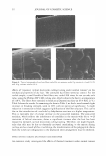
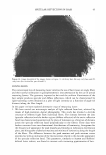
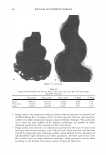
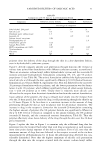
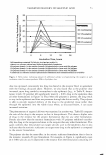
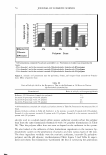
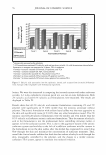
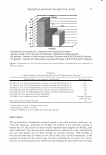
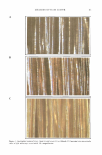
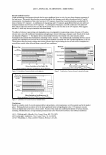
THERMAL TREATMENTS WITH A CURLING IRON 15 chosen to simulate various tensions that may be applied to hair fibers during styling with a curling iron. After curling for ten minutes and cooling, the hair fiber was gently uncurled and the hair/metal contact zone was examined. ( 3) Repeated, cyclical short-term curling/cooling of wet hair. For this experiment, individual hair fibers were immersed in water for 15 minutes, blotted between paper towels, and then subjected to 20, 50, and 100 cycles of curling with the curling iron. Each cycle consisted of ten seconds of thermal treatment with the hot curling iron and 30 seconds of immersion in water, followed by blotting. The fibers were held at the root ends, and the middle/tip sections were curled, simulating the way the hair (attached to the head) would be curled during normal styling practices. After the respective number of cycles of wetting and thermal exposure, the fibers were allowed to cool. Each hair fiber was gently uncurled, and the fiber/metal (f/m) contact zone was examined for the nature of cuticular damage. ( 4) Prolonged, high-load curling of wet hair. Individual hair fibers were shaped into large loops by raping together the root and tip ends. The looped fibers were immersed in lukewarm water for 15 minutes, blotted between paper rowels, and strung over the heated curling iron for ten minutes under loads of O g, 10 g, 20 g, and 30 g. After cooling, each hair fiber was gently uncurled and the cuticula in the heated zone were examined for damage. FIBER SURF ACE Ex.AMINA TION The f/m contact zone was examined by mounting the inside of the curl "face-up" on double-sided tape and coating with 100 A of platinum. We used a Hitachi S-4500 digital cold field emission scanning electron microscope (FESEM) for this study. RES UL TS AND DISCUSSION For ease of comparison, the typical topography of untreated hair fibers without thermal treatment is shown in Figure 1. The untreated controls show good differentiation of the Figure I. (a, b) Typical topography of untreated hair.
Purchased for the exclusive use of nofirst nolast (unknown)
From: SCC Media Library & Resource Center (library.scconline.org)