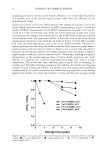
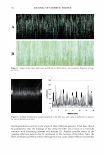
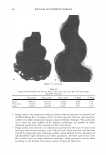
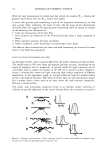
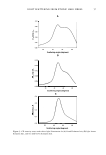
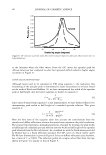
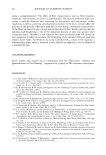
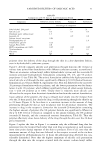
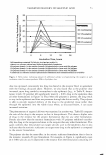
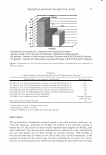
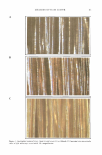
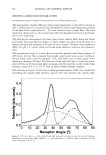
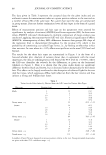
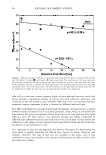
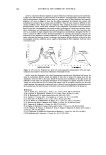
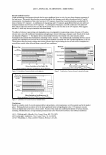
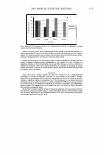
C SPECULAR REFLECTION IN HAIR Peak 1 -----------convex Peak 2 �-◄---------+---concave Peak 3 --------------+--convex Peak4 --------+---�----+--concave Distam:e(mmt Figure 13. Continued. Table V 43 Luster Parameters Calculated From Images of Curly and Very Curly Hair Shown in Figures 13B and 13C Luster parameter Peak 1 Peak 2 Peak 3 Peak 4 Peak 5 Curly hair Integrated specular intensity 33010 6653 17768 13283 22234 Integrated diffuse intensity 22579 5926 11544 11544 17508 Stamm's luster 0.32 0.11 0.35 0.13 0.21 Very curly hair Integrated specular intensity 15435 14141 13581 10314 Integrated diffuse intensity 10270 9742 8749 7345 Stamm's luster 0.33 0.31 0.36 0.29 As shown in Table IV, the number of reflections decreases with increasing concentrations of sebum, which was also clearly evident after visual inspection of Figure 12. It should also be added that the reflection shapes could be also characterized in terms of perimeter, roundness, compactness, etc. While we conducted such an analysis in relation to African hair, we did not find any obvious correlations between such parameters and the hair treatments.

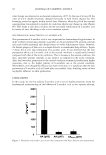
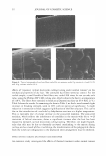
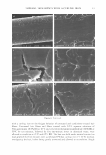
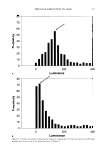
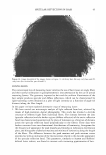
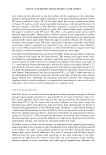
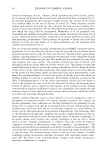
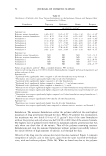
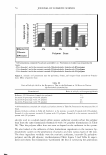
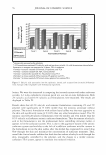
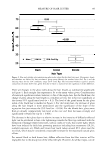
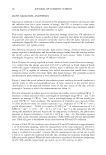
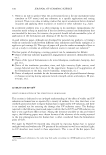
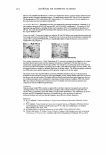
44 JOURNAL OF COSMETIC SCIENCE ANALYSIS OF REFLECTION PATTERNS FROM FRIZZY, VERY CURLY, AND CURLY HAIR We also attempted to conduct luster analysis for samples of frizzy, very curly, and curly hair as shown in Figures 13A-13C. Hair was prepared as conventional two-gram tresses, which were hung in the light box and illuminated with a uniform white light at an angle of approximately 45 degrees. In contrast to our previous analysis of straight hair, which was typically spread on a cylinder to impart curvature, and thus produce specular and diffuse reflections, in these experiments we took advantage of the natural (or artificial) curliness of the hair sample to observe and quantify the reflection patterns. As seen in Figure 13A, the reflections in frizzy hair occur at random and correspond to single fibers. At higher magnifications one can see that they consist of sequences of microreflections similar to those presented in Figures 1 and 2. As with African hair, such hair cannot be subjected to conventional goniophotometric analysis as described in our previous paper. On the other hand, the luster of such hair can be studied using the image threshold technique similar to that employed for African hair. In the case of curly and very curly hair (Figures 13B and 13C) there are distinct specular reflection bands, which can be analyzed by measuring light intensity as a function of distance. Four vertical lines, 50 pixels in width, which covered the area of the inset in Figures l 3A-l 3C, were employed to generate a light-scattering curve. Such plots consist of several peaks, which as indi cated in the figures can be assigned to specular reflections from both convex and concave portions of the hair bundle. Based on these plots, several luster parameters may be calculated, which include integrated specular intensity (S), integrated diffuse intensity (D), and Stamm's luster (Lsramm) (Table V). A line drawn at the base of each peak indicates the integration limits, with the integrated diffuse reflection corresponding to the area between the line and the distance axis, while the integrated specular reflection corresponds to an area under the scattering curve. This is analogous to the method we employed previously to calculate the luster of a non-curly hair tress (1). Stamm's luster parameter was calculated using the formula Lsramm = S/(S - D). The results indicate that luster parameters are slightly higher for convex reflections than for concave reflections. Further, we find that very curly hair appears to be more lustrous than curly hair or frizzy hair. This may be attributed to the well-defined nature of the curls in the very curly hair and their high curvature as compared to the relatively low curvature of curly hair. On the other hand, integrated specular intensities were higher for convex reflections in curly hair. We also employed image threshold analysis in order to isolate the specular reflection centers on a black background for frizzy, very curly, and curly hair. Figures 14A-14C contain the images of isolated specular reflection centers for frizzy, very curly, and curly hair, respectively, and Table VI collects the results of calculations. The data include the total number of pixels and the breakdown for black and white pixels for the three types of hair under investigation. Frizzy hair has the largest number of total pixels since it occupies the greatest area for a given image size, followed by very curly and curly hair. Similarly, the image of frizzy hair contains the largest amount of black pixels, followed by successively lower quantities in the very curly and curly hair samples. On the other hand, curly hair contains the highest percentage of white pixels, with decreasing amounts found in very curly and frizzy hair. Both absolute and relative contents of white pixels (or specular reflections) may also contribute to the overall perception of luster, since it was shown in the previous paragraph that a reduction of luster is associated with a decrease in the number of reflections centers.
Purchased for the exclusive use of nofirst nolast (unknown)
From: SCC Media Library & Resource Center (library.scconline.org)