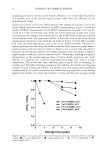
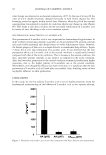
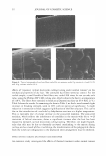
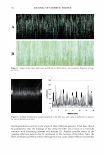
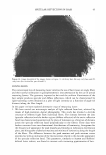
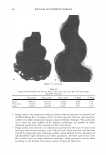
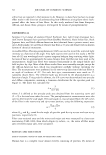
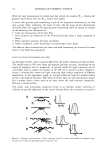
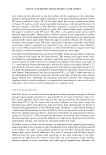
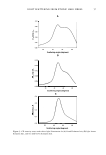
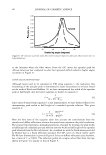
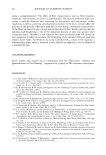
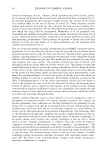
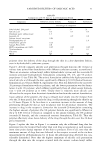
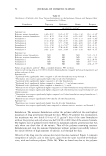
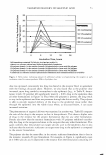
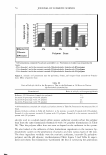
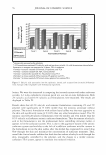
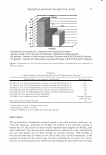
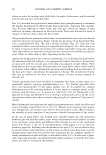
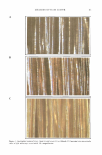
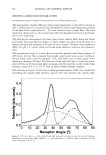
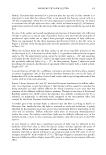
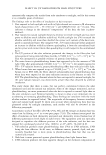
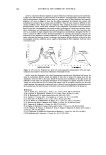
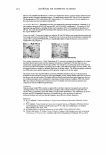
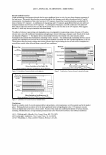
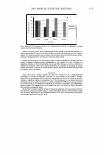
56 JOURNAL OF COSMETIC SCIENCE three modes of light scattering described above can occur inside the hair fiber, depending on the size of the absorbing and scattering entities. For small particles the scattering occurs in all directions, whereas for sizes greater than the wavelength of light, the intensity of the light scattered in the forward direction increases and the scattering profile becomes unsymmetrical, with the intensity maximum generally shifting to angles higher than the angle of incidence. Evidently, the angular distribution of the scattered light depends greatly on the internal structure of the fiber and its absorptive and scattering behavior. If the fiber interior is dominantly absorptive, then there is less scattering and therefore lower diffuse reflectance. Thus, the light scattering by the internal structure contributes to both peak broadening and the diffuse reflectance ob served as a second peak in the GP curve. The GP intensity scans shown in Figure 3A-C indicate indeed that the change in luster arises from the decrease in diffuse reflectance due to the efficient light absorption by melanin granules. We note that pigment granules are reported to be larger and more numerous in African-American hair than in European hair (18). These differences are probably less meaningful than the effect of final color on fiber absorptive properties. In Figure 4 we show a picture taken of the tresses of Piedmont hair, dark brown European hair, and a carbon fiber tape under illumination with white light. The picture demonstrates how absorptivity changes the diffuse reflectance and perceived luster. The surface of the carbon fiber tape is an example of a smooth high specular reflection surface with a high absorbing interior, leading to a bright narrow luster band compared to hair tresses. EFFECT OF ELLIPTICITY ON LUSTER In order to eliminate the color effect and demonstrate that the ellipticity index has an effect on luster, we compared the results of the hair fibers in ethnic groups with black color. The typical GP curves for hair fibers of Asian and African-American origins are shown in Figure SA-D. As mentioned earlier, luster was found to increase, with the ellipticity index similar to that of European hair. The fact that the ellipticity of the fiber is indeed affecting peak broadening, and thus also the luster, is demonstrated by the following experiment. We took nylon fiber with a near ideal surface (no roughness) and with no color. We determined the nylon fiber diameter to be 80 µm and the ellipticity index to be 1, i.e., cylindrical fiber. The goniophotometric intensity scan was recorded with the nylon fiber. Thereafter, the ellipticity index of the same fiber was increased in two steps, to 1.35 and 7, by applying mechanical pressure on the fiber. The results in Figure 6 show the decrease in W 112 with the increased ellipticity index. Simplified schematics in Figure 7 show how the change in ellipticity affects light reflection char acteristics. In the case of cylindrical nylon fiber, parallel light rays are reflected and refracted at the surface. The light path length from the near side to the far side of the fiber determines the light scattering volume and also the angular spacing between the specularly reflected light from the front surface and the emerging light from the fiber interior. The result is that the emerging light will be at angles slightly different from the main specular peak, leading to peak broadening. In the case of flattened nylon fiber, the decrease in the minor axis results in a shorter light path length and thus in a smaller scattering volume. Therefore, the angular region of reflected light is close to the specular direction, leading to a narrow peak. Also, a larger major axis creates a larger surface area

LIGHT SCATTERING FROM ETHNIC HAIR FIBERS 57 A 0.10 0.08 cu 0.06 � 'iii C: 0.04 .E 0.02 0.00 20 40 60 80 Scattering angle (degrees) B 0.020 0.016 0.012 � 'iii 0.008 0.004 0.000 20 40 60 80 Scattering angle (degrees) C 0.4 0.3 cu � 0.2 'iii C: 0.1 0.0 20 40 60 80 Scattering angle (degrees) Figure 3. GP intensity scans under white light illumination for (A) blond Piedmont hair, (B) light brown European hair, and (C) dark brown European hair.
Purchased for the exclusive use of nofirst nolast (unknown)
From: SCC Media Library & Resource Center (library.scconline.org)