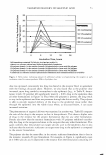
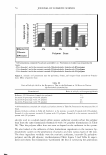
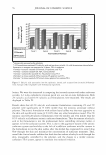
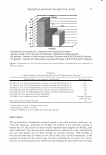
J. Cosmet. Sci., 55, 81-93 CTanuary/February 2004) Analyzing the laser-light reflection from human hair fibers. II. Deriving a measure of hair luster F.-J. WORTMANN, E. SCHULZE zuR WIESCHE, and B. BOURCEAU, DWI, German Wool Research Institute, Veltmanplatz 8, 52062 Aachen (F.-j. W.), Schwarzkopf GmbH, Hohenzollernring 127-129, 22763 Hamburg (E.S.z. W.), and Fiantec GmbH, Technologiezentrum, Europaplatz, 52068 Aachen (B.B.), Germany. Accepted for publication October 8, 2003. Synopsis Hair shine or luster is perceived as an important, though analytically somewhat elusive, attribute of beauty, primarily associated with clean and healthy hair. Principles for the assessment of hair luster are developed that are consistent with the practical situation. These principles are related to the components of light, specularly and diffusely reflected from single hair fibers, as measured by laser-based, multiangle goniopho tometry, presented in Part I. Considering various definitions of gloss, their tradition, practical implemen tation, and their inherent limitations for testing hair, the gloss index as a physically consistent measure of hair luster is derived from the ratio of the integral intensities of the light components. Changes of the parameter values along hair length, namely their decrease, are analyzed for hairs of different color and ethnic origin. The correlation with shine evaluations of hair tresses by panels, based on literature data, is analyzed and ascertained. INTRODUCTION When applying hair cosmetic products the consumer expects perceivable, beneficial effects. Since among our senses vision undoubtedly plays a most important role, claims for increased hair shine (luster, gloss) are frequent for hair cosmetic consumer products, as well as for the raw materials they contain. This is due to the fact that hair shine is perceived as an important, though analytically somewhat elusive, attribute of beauty, primarily associated with clean and healthy hair. Hair shine is generated when a beam of light strikes the hair surface. Parts of the light are specular! y reflected and then perceived at a particular angle and direction, generating surface highlights and brightness contrast, while other parts are scattered and diffusely reflected. A further fraction of light is refracted into the hair, where it is absorbed, scattered, or reflected. All of the effects depend on the geometry of the hair surface, the Address all correspondence to F.-J. Wortmann. 81

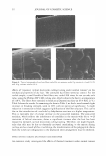
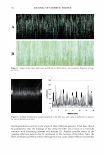
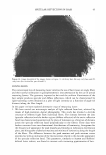
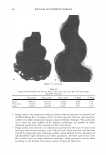
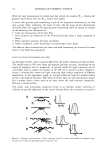
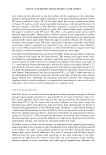
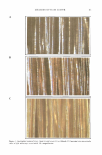
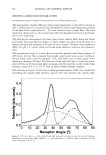
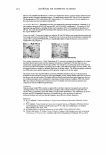
82 JOURNAL OF COSMETIC SCIENCE refractive index, the incident angle of the light, the angle of observation, and the external and internal structure of the hair fiber. Part I (1) described the application of multichannel laser goniophotometry to determine the angular distribution of reflected light from single hairs. Analyzing these distribu tions for hairs differing in ethnic origin and color gave details on changes of light reflection, including information on the cuticle angle. These were discussed in terms of changes of the hair surface along the hair length. The principles for the generation of hair shine, as outlined above, are in our view directly related to the practical situation. Figure 1 shows the appearance of an Asian black (Fig. lA), a medium-brown (Fig. lB), and a blonde Caucasian (Fig. lC) clean hair tress spotlighted under a stereomicroscope at a magnification of approx. 20 x. Such tresses can be taken to represent a freely moving hair style without major fiber interactions. Largely white light reflexes are observed on single hairs that contrast with nonreflecting adjacent areas, which are either dark or light, depending on hair color. Against the background of the technical terminology (2,3), as discussed in detail below, the phenomena observed in Figure 1 are appropriately termed "hair luster," because they are associated with the contrast gloss (2) of dark areas adjacent to light reflexes. These highlights are due to specularly reflected light from single fibers, where a high number of intensive, white reflexes, dynamically appearing and vanishing with the movement of the hair, give "shine" and enhance the appearance of beauty. The overall level of shine that may be achieved on the basis of a given degree of luster strongly depends on hairstyle (4). Various approaches have been described to determine hair luster on hair tresses as a measurable quantity, applying goniophotometry (e.g., 5,6). Further approaches have been color measurements (7) and image analysis (e.g., 8). In parallel, the common laboratory practice for screening products is to use expert or consumer panels to sub jectively rank hair luster, e.g., by means of a "shine box" (6,9-12). Noteworthy is the approach by Tango and Shimmoto (13) to develop a method and a device for the in vivo determination of hair shine that is related to the principles of commercial "gloss meters" (10,14). More fundamental investigations also applied goniophotometry to single hair fibers and arrays of parallel, single fibers (5,11,13,15-17). Though gross changes in hair appear ance through hair care products may well be detected on hair tresses, effects related to the assembly as such complicate if not prevent a detailed interpretation of the results. In the case of single fibers, this method gives detailed insight into the interaction between light and the fiber surface, and a variety of parameters can be defined in terms of the intensities of specularly and diffusely reflected light. In view of the conclusions drawn from Figure 1, the use of goniophotometry would appear to be an especially promising approach. Problems with this method in the past (5,11), due to inherent large variations between individual hairs, as well as long recording times, have been overcome through multi-angle detection and fast data acquisition for the complete angular in tensity distribution of reflected light, as described in Part I (1). On this basis a physi cally, practically plausible, and mathematically stable parameter to describe hair gloss, luster, and shine is introduced and assessed.
Purchased for the exclusive use of nofirst nolast (unknown)
From: SCC Media Library & Resource Center (library.scconline.org)