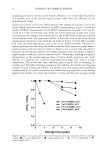
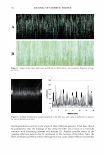
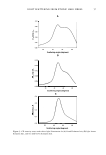
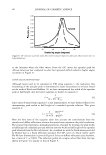
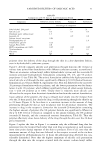
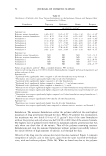
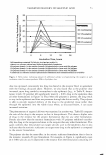
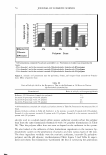
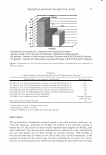
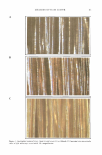
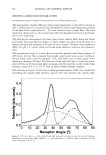
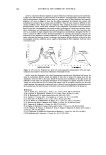
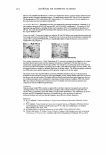
MEASURE OF HAIR LUSTER 85 blonde, Caucasian hair measured at a pos1t10n near the tip end. In this context it is important to note that the surface of hair is not smooth but features cuticle cells in a tile-like arrangement, where the cell scale edges point towards the fiber tip. To ensure a consistent bias of light reflection due to the cuticle inclination angle (1), all measure ments were carried out with the direction of the incident light toward the tip end of the hair. In view of the surface and overall morphological structure of human hair, the reflection of light is subject to a special type of geometry that in turn and with the principles of geometrical optics leads one to expect three principal components of light reflection. These are represented by the three Gaussian distributions fitted to the GP curve in Figure 2. Details of the fitting procedure and the parameters derived thereof are given in Part 1 (1). When the incident beam hits the fiber surface in the root-to-tip (RT) direction at the incident angle E 1 (1), a first fraction of the light, S, is specularly reflected at the receptor angle 'Ys· For the experimental setup, using the incident angle E 1 = 40° and assuming a tilt angle for the cuticle of 2. 5 ° leads to an expectation value for the receptor angle of the specularly reflected light of 'Ys = 35°. At this position, Figure 2 shows the peak describing the intensity distribution of specularly reflected light with a width at half height of 9°-10°. A second fraction of light, D5, is diffusely scattered at and near the fiber surface, namely at surface roughnesses (18), at the various interfaces between the cuticle cell layers of human hair (19), at the interface of cuticle and cortex, and at optical imperfections of the cortex, such as voids and inclusions. Figure 2 shows between 40° and 45° the broad Gaussian distribution for diffuse reflec tion. It is important to note from Figure 2 that the hair surface cannot be considered as being primarily an ideal, diffuse reflector for which scattering occurs such that the intensity of the diffusely reflected light is uniform. Though on the basis of Reich and Robbins' analysis (11) of GP curves, the existence of a uniform contribution for 0 5 is assumed, its magnitude is obviously small compared to the non-uniform effect and covered by the broad Gaussian distribution for diffuse reflection. A further part of the incident beam is refracted into the fiber according to Snell's or Descartes' law. Inside the hair the light is scattered at voids and inclusions, is partly absorbed by hair pigment and color, and is thus wavelength filtered, depending on the color and its intensity. Diffuse reflection takes place at structural inhomogeneities within the cortex. For lightly colored hair, light may be diffusely reflected at or in the medulla (4,20), a more or less continuous and hollow, tube-like structure in the fiber interior. In very blonde or white hair a significant amount of light may be reflected at the backside of the fiber, that is, from the hair/air surface interface opposite the point of incidence. When this third component of light re-emerges from the fiber, it is experi mentally observed, as shown in Figure 2, as a separate peak in the GP curve (5,15,17) at angles around 64 ° with a width of 25° (1). This type of light is considered as a specific fraction of diffusely reflected light, termed D i , since it is related to the internal reflection effect.

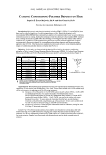
86 JOURNAL OF COSMETIC SCIENCE DEFINING HAIR GLOSS Surfaces and objects often show gloss, which is attributed to specular reflectance at the respective surface. Due to the diversity of surface structures, different kinds of gloss can be observed. Hunter, as early as 1937 (2), intensively investigated the phenomenon of gloss and arrived at a classification with six different types of gloss that were defined in terms of measurable parameters. Stamm et al. (5) reviewed the semantics of gloss, luster, shine, etc. for human hair. Measuring by goniophotometry light reflected from single hairs or hair strings, Bustard and Smith (15) and Stamm et al. (5), respectively, chose one of these classes, namely "contrast gloss," to represent the "luster" of hair. Their approach relates to the work by Nickerson on the gloss of cotton yarn and fabric (3 ), where she found this type of gloss well applicable to test textile luster in correspondence with the visual assessment. Hunter (2) defines contrast gloss as "contrast between specularly reflecting areas and other areas." It is measured by comparing the intensity of the light that is specularly reflected with the intensity of that which is diffusely scattered, so that: gt = s!d (1) gt is Hunter contrast gloss. s and dare the intensities of specular and diffuse reflection, respectively, measured at two positions, namely (a) at the expected receptor angle for specularly reflected light and (6) normal to the material surface. Following the notation introduced by Stamm et al. (5 ), lower case letters are employed to designate these so-called spot values. Since Equation 1 goes to infinity as d approaches zero, Nickerson suggested as an alternative: (2) where gt is the "Nickerson contrast gloss," considered to represent luster. For cotton, Nickerson (3) found a good correlation between contrast gloss values and visual esti mates of luster. Nickerson contrast gloss becomes zero when d equals s} unity when d equals zero, and negative when d s. In view of the complex structures of the GP curves for different types of hair (1), all three cases are likely to occur in practice. The approach applying spot values is valid, notably for fl.at surfaces, where the angle of incidence and the receptor angle for specularly reflected light are equal and where the intensity of the scattered light shows no angular dependence. However, both of these conditions are obviously not fulfilled for human hair, implying that spot measurements, as implemented in commercial testing devices (10,13,14) are expected to be at best of very limited use for determining hair gloss. In this view, it is not unexpected, that Stamm et al. (5), Bustard and Smith (15), and Guiolet et al. (17) found that the gloss parameters defined in equations 1 and 2, based on spot values, have high precision but poor sensitivity. Various approaches have been devised to determine integral values for specularly and diffusely reflected light (5, 11, 15), applying the principles inherent to equation 1 and especially equation 2 in order to derive parameters to describe hair luster. The definition of these parameters was either based on theoretical considerations (5, 15) or on empirical observations (11). Inherent to the approaches is the principle that diffuse reflection from hair occurs uniformly.
Purchased for the exclusive use of nofirst nolast (unknown)
From: SCC Media Library & Resource Center (library.scconline.org)