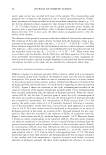
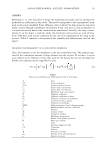
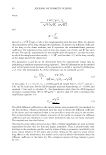
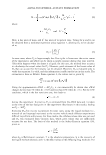
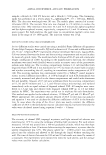
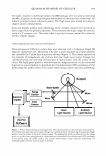
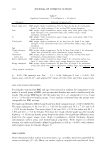
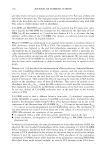
94 where and JOURNAL OF COSMETIC SCIENCE h2 � 2 =_ 4Drn and erfc u = 21. J:' exp( -w2)dw is the complementary error function. Here, D rn denotes the permeability of the drug through the membrane, D d denotes the diffusion coefficient of the drug in the donor medium, and K represents the membrane/donor partition coefficient. The parameter a has units of mass per square root of time, and �2 has units of time. The specific requirements for the simplification of equation 1 are that the times at which the samples are taken satisfy t 2-3 � 2 , and less than -1/3 of the drug initially in the donor has left the donor (16). The parameters a and � can be determined from the experimental release data by performing a nonlinear regression using equation 1. Detailed information on the method used to find good initial estimates of the parameters a and � is reported by Bellantone et al. (16). The permeability P m of the membrane can be estimated as (16): KD m a� P --h-= m 2�( 4AC0 �- a-v;:) (2) In this study, A = 1.76 cm2, C0 = 50,000 µg/ml, � ranged from 3-5 hr 112 , and Dd 0.01 cm2/hr in all cases. For the ATA/isopropyl myristate formulations, a - 10,000, and equation 2 was used to calculate Pm. For formulations other than the ATA/isopropyl myristate, a ranged from 100 to 500 µg/hr 112 , and less than 2% error is introduced by simplifying equation 2 as a,v;: pm= 8�AC 0 (3) The ATA diffusion coefficients in the various donors were estimated by two methods. In the first method, cellulose permeation data was used to obtain the diffusion coefficient in the donor, and was employed when it was possible to assay the drug in the receiver. The second method used the relative viscosities of the media to estimate the diffusion coefficient and was employed in cases where permeation data was not easily evaluated. The methods are described below. Obtaining D d using cellulose permeation data. Here, cellulose membranes are used in release experiments because they are thin and highly permeable. Thus, a pseudo-steady state develops in the membrane quickly, and the release of drug is primarily controlled by the donor region behavior. If the donor and receiver media are the same (to avoid solvent drag effects in the membrane), this model can be used to obtain information about the diffusion coefficient in the donor D d· The cumulative amount of drug released is given by (17):

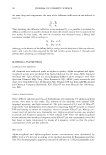
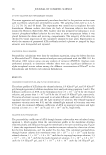
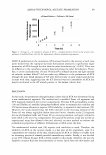
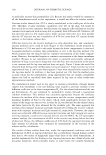
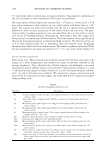
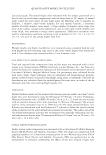
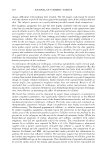
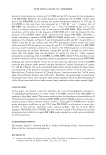
ALPHA-TOCOPHEROL ACETATE PERMEATION 95 (4) where Here, K has units of mass, and A 2 has units of reciprocal time. Values for Kand A can be obtained from a nonlinear regression using equation 3, allowing D d to be calculat ed as Dd = (�) 2 AC 0 (5) In some cases, when D dis large enough, the M-vs-t plot is linear over the entire course of the experiment, and dM!dt can be taken as nearly constant during that time interval. (This often happens when the donor is a liquid.) In this case, the method loses accuracy in calculating the actual values for D d· However, good estimates of the lowest value of D d that can account for the linearity can be obtained. However, D dis evaluated only to verify that equation 3 is valid, and this information is sufficient for use in this study. The estimation is done as follows: From equation 4, the release rate is given by Using the approximation dM!dt = APmCo, it can numerically be shown that dM!dt changes by less than 5 % when At 0.05 and less than 10% when At 0.1. For the 10% condition, which is the less restrictive one, this leads to (6) during the experiment. In practice, P rn is estimated from the dM!dt data and tis taken as the time of the last data point in the experiment (four hours in this study), leading to D d 40P 2• Estimating D d from viscosity measurements. In some cases, using the liquid medium (i.e., mineral oil and isopropyl myristate) as the receiver vehicle made diffusion experiments difficult to perform and/or assay. For these media, the cellulose release data was not used and D d was estimated from viscosity data, which gives values that are sufficiently accurate for use here. The basis of this method is the Stokes-Einstein equation (18), given as where k8 is Boltzmann's constant, T is the absolute temperature, Tl is the viscosity of the liquid medium (donor), and r is the effect radius of the diffusing drug molecule. For
Purchased for the exclusive use of nofirst nolast (unknown)
From: SCC Media Library & Resource Center (library.scconline.org)