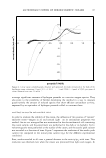
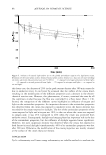
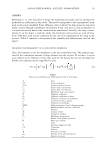
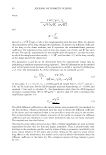
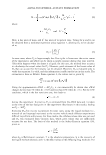
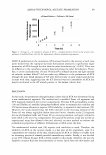
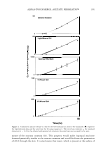
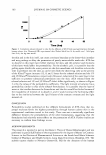
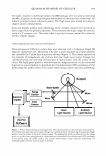
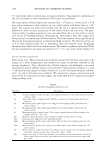
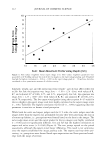
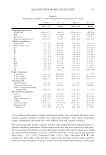
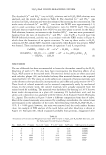
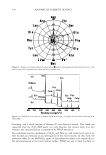
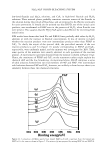
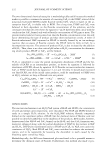
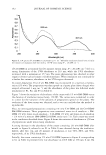
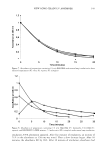
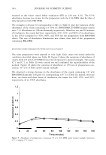
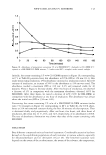
98 JOURNAL OF COSMETIC SCIENCE IN VITRO CADA VER SKIN PERMEABILITY STUDIES The same apparatus and experimental procedure described in the previous section were used to perform cadaver skin permeability studies. The sampling times were 2, 4, 6, 8, 12, 24, 30, 36, and 48 hours. The experiment was carried out in triplicate for each formulation. Human cadaver skin from the back of Caucasian subjects was kindly donated by Novartis (Somerville, NJ). Cadaver skin was prepared by hydrating it in an isotonic phosphate-buffered solution for one hour at room temperature before it was placed between the donor and receiving compartments. The integrity of the skin was checked by visual inspection of the cumulative amount-vs-time plots. Experiments in which the amount of permeated ATA suddenly reached a plateau or jumped by large amounts were disregarded and repeated. STATISTICAL DATA ANALYSIS Permeability calculations were done by nonlinear regression, using the Solver function in Microsoft Excel™. Other statistical analyses were performed with the SPSS 10.1 for Windows 2000 version using one-way analysis of variance (ANOVA). Analyses were performed primarily to determine whether there were any significant differences in alpha-tocopherol acetate release among the different concentrations of Klucel® in the formulations and between each solution formulation. RESULTS DIFFUSION COEFFICIENTS OF ATA IN THE DONOR MEDIA The release profiles of ATA from the ethanol solution, 1 % Klucel® gel, and 3% Klucel® gel through regenerated cellulose membrane were analyzed using equations 5 and 6. The diffusion coefficients of ATA in the formulation were 2.5 x 10- 2 cm2/h for the ethanol solution, and greater than 1 x 10- 2 cm2/h for the 1 % and 3% Klucel® gels, respectively. The ratios of solvent viscosity were used to calculate diffusion coefficients of ATA for the isopropyl myristate solution and the light mineral oil solution. The ethanol/isopropyl myristate viscosity ratio was 0.91 and the ethanol/light mineral oil viscosity ratio was 0.70, and the estimated diffusion coefficients of ATA in isopropyl myristate and light mineral oil were 2.3 x 10- 2 cm2/h and 1.8 x 10- 2 cm2/h, respectively. CADA VER SKIN PERMEABILITY The permeability coefficient of ATA though human cadaver skin was calculated using equation 1, which applies when the concentration profile in the membrane develops relatively slowly and diffusion through the membrane is the rate-controlling step. Figure 1 shows the experimental data for the cumulative amount released as a function of time for the five formulations, and the model fits the data. The calculated permeabilities through human cadaver skin membrane were 1.0 x 10⁻⁴ ± 1.5 x 10- 5 cm/h for the ethanol solution, 1.1 x 10- 2 ± 1.6 x 10- 3 cm/h for the isopropyl myristate solution, 1.4 x 10⁻⁴ ± 3.8 x 10- 6 cm/h for the light mineral oil solution, 2.1 x 10- 4 ± 2.6 x 10- 5 cm/h for 1 % Klucel® gel, and 4.7 x 10⁻⁴ ± 4.6 x 10- 5 cm/h for 3% Klucel® gel.

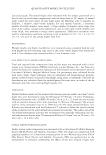
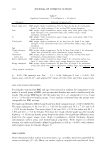
ALPHA-TOCOPHEROL ACETATE PERMEATION - C 8000 � f 6000 c 1 1 4000 .. . :i 'i E � 2000 :I u 0 ♦ Ethanol Solution o 1%Klucel • 3% Klucel f 2 3 4 5 Time (hr) 99 Figure 1. Average (n = 3) cumulative amount of ATA ± standard deviation found in the receiver com partment of modified Franz cells for the regenerated cellulose membrane experiments. ANOV A performed on the cumulative AT A amount found in the receiver at each time point showed that the isopropyl myristate formulation produced a significantly larger permeation of ATA through the skin than the other formulations (p 0.001). There was no difference in the cumulative amount detected among the other formulations. There fore, it can be concluded that 1 % and 3% Klucel® or ethanol solution and light mineral oil solution without Klucel® did not make any difference in the permeation of ATA through the skin. Small amounts of AT were detected only in some studies and did not increase with time, suggesting that the AT detected was not a metabolite of AT A but may be attributed to the AT already present in the human cadaver skin. DISCUSSION In this study, the permeation through human cadaver skin of ATA was determined using a new mathematical approach. The method used a modified Franz cell apparatus and 95% degassed ethanol in the receiver compartment. Previous ATA permeability studies (14) used Dulbecco's modified phosphate-buffered saline to maintain skin viability and 3% bovine serum albumin to improve ATA solubility, as reported in the literature (19). However, the study reported that the ATA collected in the receiving medium of the Franz cell was always negligible (below detection limits). Another study (21) reported the use of phosphate buffer and Tween 80 as a receiving medium, and again it failed to show ATA in the receiving compartment. The goal of the present study was to find an experimental setup that allowed a fast and relatively accurate method to evaluate the permeability properties of different formulations of AT A across the skin. The mathematical method used (16) requires sink conditions to work. Therefore, the solubility of ATA in the receiver media is a key part of the experiment, even if it compromises the viability of the skin. Solubilization of ATA in Dulbecco's buffer with an increasing percent of ethanol provided unsatisfactory results. Finally, it was decided to use 95% ethanol because ATA is freely soluble in this media. However, the use of a lipophilic receptor fluid has the potentiality to extract lipids from the skin barrier and
Purchased for the exclusive use of nofirst nolast (unknown)
From: SCC Media Library & Resource Center (library.scconline.org)