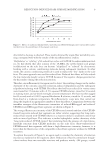
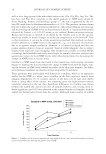
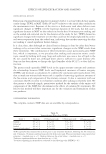
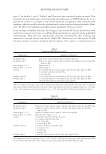
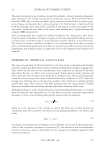
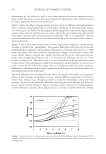
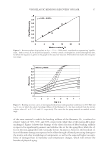
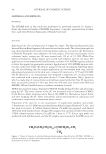
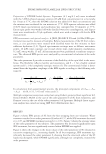
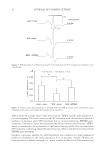
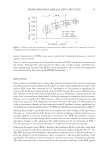
VISCOELASTIC BENDING RECOVERY OF HAIR 33 B(t) is the time-dependent bending stiffness at any time after the initial deformation at t=0. The fi ber is released at t=ω, and B(t-ω) is accordingly the bending stiffness of the same fi ber if it had been bent at the time of release. B(t) relates to the straight fi ber and tends to re-straighten it, while B(t-w) derives from the bent state of the same fi ber and thus opposes re-deformation. Since both variables act on the same cross- sectional area and shape, R becomes a normalized parameter, for which diameter-related effects are canceled. Furthermore, it was established (1) that hair shows changes of relaxation behavior with aging time, tA, which are consistent with Struik’s (14) effective time principle and with an aging rate of μ=1 (see equation 10 below). That is, hair bending recovery curves shift on the log-time scale without changing their shape by one decade to higher times with every decade of increase in tA. In analogy to the case of extensional relaxation (8,15), time-dependent bending stiffness is described by: ' f B(t) B B (t) (4) with 0 'B f B B (5) B0 is the initial value of the bending rigidity at t=0. B∞ is the limiting, elastic stiffness reached by the fi ber after complete physical relaxation. Ψ is the relaxation function. In the context of the two-phase model, B∞ is the contribution of the elastic, partly α-helical fi laments, while ΔB is the limiting elastic contribution of the matrix, for which the vis- coelastic behavior is described by Ψ(t). A feasible choice for Ψ(t) is the stretched exponential of the Kohlrausch-Williams-Watts (KWW) function (1,16), given by: m ( ) exp[ (t/ ) ] W t (6) where τ is the characteristic relaxation time and m the shape factor, which give the posi- tion and the width of the function on the log-time scale, respectively. It was found (1) that the shape factor of the KWW function was independent of humidity and aging time, with a mean of m=0.28, which is close to the universal value of 1/3 (14). The relaxation of the matrix contribution to the overall fi ber bending stiffness is very fast in water (8,15), where hair is well above its humidity-dependent glass transition (6). This removes all effects of aging and yields effectively ΔB=0 after the wetting of the bent fi bers during the initial step of the experiment. A substantial rubber elastic contribution to ΔB, as is expected from the considerations of Hearle et al. (17), could experimentally not be verifi ed, namely by Feughelman and Druhala (18), and is thus neglected. Since this removes the time dependence of the numerator in equation 3, the combination of equations 3 and 4 simplifi es to: ( ) B ] '% f f /[B t t (7)

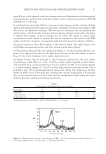
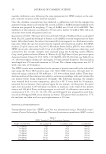
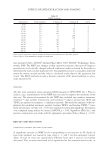
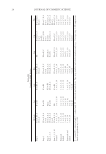
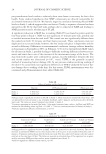
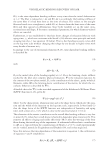
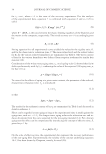
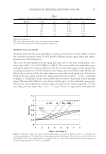
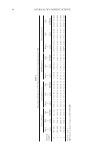
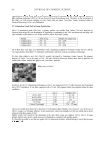
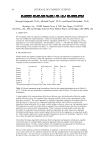
JOURNAL OF COSMETIC SCIENCE 34 for tA=const, where t=0 is the start of the recovery experiment. For the analysis of the experimental data, equation 7 is combined with equation 6 and m=0.28 to yield: 0.28 (t) 1/{1 K exp[ (t/ ) ]} W R (8) where K = ΔB/B∞ is the ratio between the elastic bending rigidities of the fi laments and the matrix in the composite, respectively. The initial recovery at t=0 is accordingly given by: 0 . R (9) Fitting equation 8 to all experimental curves yielded the values for the rigidity ratio, K, and for the characteristic relaxation time, τ. The mean values for K and the related values for R0 for the various relative humidities are summarized in Table I. The water content of hair for the various humidities was deduced from sorption isotherms for similar hair material (19). Consideration of the τ-data versus aging time, tA, on a log/log-scale (1) showed that log(τ) shifts synchronously with log(tA), confi rming the value of the expected (14) aging rate, μ, for hair (11) as: A log / logt 1 P W d d (10) To correct for the effects of aging at a given water content, the parameter of the reduced, characteristic relaxation time, τ r , is introduced: W W /t r A (11) so that r log log log W W A t (12) The results for the arithmetic means of log τ r are summarized in Table I and discussed in detail in reference 1. Fibers can be regarded as non-aging as long as the experimental time is small against the aging time, such as t 0.1t A . For longer times, aging reduces the relaxation rate and in- duces deviations from the curve expected for the non-aging material (14). For a known aging rate this effect can be compensated by introducing the concept of effective time, λ, given for μ=1 by: O ) A t A ln(1 t/t (13) On the scale of effective time, the experimental data represent the recovery performance of the non-aging fi ber. Experimentally, the validity of the concept underlying equations 10–13 has been shown by Chapman, namely, for wool (20).
Purchased for the exclusive use of nofirst nolast (unknown)
From: SCC Media Library & Resource Center (library.scconline.org)